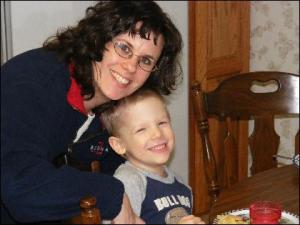

Halloween fell on a Friday night, capping a month of Friday night frights. It was a month featuring a falling stock market amidst worldwide economic turmoil when banks wouldn’t lend and the government decided to borrow billions to get them lending again. It was a month that saw GM and Chrysler shrink even closer to bankruptcy, desperately hoping to get a government loan so that GM would buy Chrysler and shrink its workforce even more. It was a month of preparation for an historic election dividing the country.
Halloween in Detroit was unseasonably warm and a pleasant diversion to the real frights in the world. It was a parade of little creatures in masks walking in the light of pre-daylight-savings and ending the night in darkness.
No fear in the world can prepare a parent for the fate of a little boy facing the dreaded disease of cancer. A few hours before Halloween began, Noah’s mother got the phone call she dreaded.
Noah’s cancer had spread. The doctors had found “many new lesions throughout the right arm and leg and one in his skull.”
Diana wrote in her Carepages blog that “the chemo and drug did absolutely nothing—didn’t even slow it down. We have removed him from this trial.” The MIGB radiation therapy that looked promising had a backlog of waiting kids, meaning Noah was to wait for treatment for many weeks.
Until then, the strategy is an aggressive chemo treatment of Topotecan and Cytoxin, followed by Neupogen shots to help the white blood cells. The MIBG radiation therapy scheduled hopefully by the end of the year shoots radioactive isotopes into Noah’s body. For at least five days, he will have to be in complete isolation followed by more intense chemo.
A little boy facing such harsh treatment and such long odds seems inhuman and cruel. There is no superhero who can slay such devastation. But a terrifying phone call could not stop Noah’s mother from dressing him up in his Spiderman outfit and going trick and treating with him on Friday. And nothing could stop a mother from taking Noah to the zoo on a warm November Monday.
We can only hope that the subconscious wish for a boy to be superhuman can help his immunity, making him impervious to the blasts of radioactive isotopes and chemotherapy.
We need a superhero who can save a child. We need another miracle.
I laughed along with millions of Americans as I watched Tina Fey’s satire of Sarah Palin in the Saturday Night Live Palin-Biden debate skit on October 4th. But minutes later, I became uneasy as the satire turned to Jews: Barney Frank, billionaire investor George Soros, and Herb and Marion Sandler, the real life couple who built Golden West Financial into a subprime lending powerhouse before selling it to Wachovia Bank. After the character playing Herb Sandler claimed how well they were doing after making $24 billion, the caption below read, “People who should be shot.”
In the vitriolic environment of the election season and the stock and credit market crisis, it didn’t take long for the satirical finger-pointing to begin. Hamas leaders have made the claim that the “Jewish lobby” is responsible for the global financial crisis. Online hate is sprouting with messages on mainstream finance chat boards about Lehman Brothers and Goldman Sachs such as “(Jews have) infiltrated Government and Wall Street and have ruined our country” and “They (Jews) love money nothing else, no faith or religion can be so heartless to their victims.”
If Adolph Hitler were alive today, he might have reveled in the power and incredible speed of the Internet. Just think of his cunning and ability to distill hate-plagued propaganda and then imagine his words instantly spread through every home and computer via the World Wide Web.
Today, we don’t have Hitler but there are thousands of people spewing poisonous messages into the most popular of websites. If you haven’t seen You Tube videos, “A Zionist Nightmare” and “Auntie Semite USA”, you can thank the Anti-Defamation League (www.adl.org) and the Jewish Internet Defense Force (www.thejidf.org). The Jewish Internet Defense Force describes itself as a group of Jewish activists who fight anti-Semitism and terrorism trends throughout the Internet. When the JIDF asked Facebook to remove its “Israel is not a country” page, the response from Facebook was that the anti-Israel group was “legitimate political discourse.” Facebook members were exposed to what the JIDF called “one of the most vile, most anti-Semitic, most pro-Jihad and most disgusting, and most importantly, most active hate groups on the Internet.”
The JIDF was able to technically take control of the website and removed it from Facebook. But they haven’t yet been able to remove “Auschwitz Night Fever” from the Internet, one of the most loathsome videos I have ever seen (found on YouTube and Ning). The video merges the Bee Gees singing, John Travolta dancing, and atrocities from Schindler’s List, glorifying the random murder of Jews.
Prepare for the hate parade. Prepare for the anger that is arising post George W. Bush, spilling out as the power of the United States withers with its economy. The rise and fall of the housing, credit, and stock markets, have poisoned the world economy. Putin and other world “leaders” are castigating the United States for its financial negligence as Americans spew anger at Wall Street bankers who walk away with millions while their firms collapse. There is also plenty of blame for the last two heads of the Federal Reserve, Greenspan and Bernanke, both Jewish. It’s not surprising that the furor over the Fed, government, and Wall Street is starting to target Jews
Thankfully, we have watch-dog organizations like the Anti-Defamation League which is committed to fight anti-Semitism hatred. In its “Agenda for the New Administration,” ADL focuses on the threat of Islamic extremism as well as the “use of the Internet as a vehicle to spread hate.” It is monitoring the new trend of hate Web sites formatted for Web-enabled cell phones and translating Hamas Web sites from Arabic into English, revealing “how Hamas glorifies violence and how it attempts to indoctrinate children.” The ADL is also challenging Professor Kevin MacDonald from California State University, widely admired by anti-Semites, who has said, “A political crisis over Jewish influence is exactly what the United States needs.”
On Wednesday, November 5th, ADL National Director Abraham Foxman, is coming to the West Bloomfield JCC’s 2008 Jewish Book Fair to discuss his latest book, The Deadliest Lies: The Israel Lobby and the Myth of Jewish Control and counter the bigotry of Professor MacDonald and others who believe that “Israel has the world’s one remaining military superpower completely at its bidding.” We need to join ADL and Foxman as they battle the onslaught of Jewish hatred.
It is frightening enough to contemplate the stock market and credit collapse twisting from a recession into possibly a depression. But it’s even harder to imagine the return of worldwide extremist hatred toward Jews. We must be prepared for anything and one way is to visit the ADL Action Center at www.adl.org/actioncenter. Online, you can sign petitions and letters to world leaders with a few clicks of your mouse. You can register views on critical topics and make a donation in support of a specific ADL issue.
We need to act now. Whether we hear Abraham Foxman at the JCC, donate to the JIDF, ADL, or take part in the Action Center, we can do something. The worst thing is to sit in silence and do nothing while the world markets falter and anti-Semitism ensues. Rather than clinging to despair and waiting for others to act, we can be vigilant and focus on what each of us can do to repair the world.
Why do I watch The Office religiously? The NBC sitcom about the inner workings of the paper distributor, Dunder Mifflin, is the only show I must set on record if I can’t catch it on its original Thursday night. Maybe it’s the inside joke: am I watching an episode of my own company? Dunder Mifflin is an old-fashioned paper wholesaler and The Office takes place almost completely in its Scranton branch. Those in our company’s branches in Harrisburg, Pittsburgh, and Philadelphia may feel more recognition than I do when they watch the mishigoss in a company that distributes paper products in a world with Staples, Office Max, and Office Depot down the street.
On its corporate website, Dunder Mifflin Inc. is “listed as a mid-cap regional paper-and-office-supply distributor with an emphasis on serving small business clients. With a corporate office in New York City, Dunder-Mifflin has branches in Buffalo, Stamford, Albany, Utica, Scranton, Akron, Camden, Nashua, and Yonkers.” My company, IDN-Hardware Sales, Inc., distributes locks and security products to regional small companies such as locksmiths, hardware stores, and door companies in Buffalo, Syracuse, Harrisburg, Pittsburgh, Philadelphia, Cleveland, Hartford, Warren, and Livonia. But I would agree with Dunder’s leading salesperson, Dwight Schrute, who proudly announces, we offer better “service” than our large company competitors. Dun
I like to watch the nefarious world of the modern day work environment and how regional manager, Michael Scott, navigates it. I enjoy the daily adventures of Angela, Creed, Dwight, Jim, Oscar, Pam, and the other fine team members and how they communicate with each other and screw up their company and each other. I like to watch the absurd pointlessness of their jobs.
I could easily write a sitcom based on the adventures of our outstanding company and its crackerjack employees. How many do we have now? Somewhere between 80 and 85, depending on how you quantify some of the part-timers. Anyway, I could but won’t write anything great or derogatory about myself of any of them. However, I could certainly mention some of the proud members of the Hardware Sales Hall of Fame, some of our past employees (excluding the names of course.)
I could mention the guy who looked strangely like Charles Manson (but with longer hair) who was fired from his warehouse job. I could say that I closed the door (just like Michael Scott would have) and watched when he came to the front door, scared of what weapon he might have brought with him. Thankfully, he came and went, another crisis brilliantly averted by my staff and me.
I could say something about that impressive-sounding interviewee who I thought might be our next great salesperson and eventually a few years later was listed in the local newspapers, shot dead after a drug deal went bad. How about my head warehouse receiving clerk who left town with his girlfriend after the police found he had stolen from the local car wash chain that bought padlocks from us?
I angrily remember the time I received the 50-page lawsuit on my desk brought from a woman who quit but said she was “wrongfully discharged.” I remember distinctly when I had to fire a guy from the warehouse for ineptitude and the tears he wept in my office. I can’t forget my relief when he came to the counter a few months later and said how happy we was in his new job at Amana.
In over 28 years in one company that grows from eight to eighty people, you’re bound to get good and bad employees. Unfortunately, I remember the bad a lot more than the good. And the stories that go along with them. I didn’t know whether to laugh or cry over the very overweight inside sales person who fell in love with a customer service person at a manufacturer in the southeast and took a trip to visit her. When he came back, he wept to our sales manager that everything went great until he walked to her refrigerator one night and heard a loud crunch and when turning on the light, realized he had stepped on her beloved cat and killed it. Burdened with grief and guilt, he buried the cat in the backyard and when she asked him if he saw the cat the next morning, he said no but finally had to tell her the brutal truth.
She threw him out and he drove all the way back to Michigan, flooded with remorse. Not surprisingly, his sales dropped dramatically the month after and he eventually quit the company.
We have had so many employees leave that I can barely remember their names and when they worked, but I remember those who died.
In my office is a collage and a photo of another inside salesperson who was weakened with AIDS and eventually had to quit and died within the same year. He stands next to my uncle who worked for 15 years on our Livonia counter, servicing customers. My uncle could make me laugh whenever he wanted, with a crude joke and a put-down. Even though he wasn’t a manager, he was the original Michael Scott, working to make others laugh or groan. My uncle would have enjoyed Michael Scott and Ari Gold in the HBO show, Entourage. These are people who say what they want to make life at work less boring and miserable. They don’t care who gets upset as long as they have fun.
The new Inc. August 2007 issue states, “Fun! It’s the New Core Value.” How I wish it were so. I may face the wrath of employees who wonder why I can say anything funny or bad about anyone, even past employees. “Just shut up and sit” is the current work mantra.
I am doing just that now, shutting up and sitting, wondering if I should dig into University of Michigan’s price profiles, or write something funny that I remember.
I am still a procrastinator at heart and would rather read the latest newsletter of The Office than work. But seriously, even fun can be educational, like these “Workplace Safety Tips, by Dwight Schrute”:
Workers are getting injured, sick, and are dying in EVERY office, EVERY day. You cannot avoid it. Unless you do the following.
- Do not fall. Falls (e.g. down stairs, out doors, windows, etc.) are dangerous and lead to fractures, sprains, contusions and death.
- Do not burn yourself. Overheating your tea is a good way to burn yourself. Do you want that? In order to assure that your skin is not harmed, tea should not be heated to more than 98.6 degrees.
- Stay in your seat. By staying in your seat, you are less likely to encounter any of these hazards. Wait until you have 3 tasks to do, and then get up.
As usual, Dwight is right. I am waiting for 2 more tasks to do before I get up out of
my chair. It’s the only safe and sensible thing to do.
I laughed along with millions of Americans as I watched Tina Fey’s satire of Sarah Palin in the Saturday Night Live Palin-Biden debate skit on October 4th. But minutes later, I became uneasy as the satire turned to Jews: Barney Frank, billionaire investor George Soros, and Herb and Marion Sandler, the real life couple who built Golden West Financial into a subprime lending powerhouse before selling it to Wachovia Bank. After the character playing Herb Sandler claimed how well they were doing after making $24 billion, the caption below read, “People who should be shot.”
In the vitriolic environment of the election season and the stock and credit market crisis, it didn’t take long for the satirical finger-pointing to begin. Hamas leaders have made the claim that the “Jewish lobby” is responsible for the global financial crisis. Online hate is sprouting with messages on mainstream finance chat boards about Lehman Brothers and Goldman Sachs such as “(Jews have) infiltrated Government and Wall Street and have ruined our country” and “They (Jews) love money nothing else, no faith or religion can be so heartless to their victims.”
If Adolph Hitler were alive today, he might have reveled in the power and incredible speed of the Internet. Just think of his cunning and ability to distill hate-plagued propaganda and then imagine his words instantly spread through every home and computer via the World Wide Web.
Today, we don’t have Hitler but there are thousands of people spewing poisonous messages into the most popular of websites. If you haven’t seen You Tube videos, “A Zionist Nightmare” and “Auntie Semite USA”, you can thank the Anti-Defamation League (www.adl.org) and the Jewish Internet Defense Force (www.thejidf.org). The Jewish Internet Defense Force describes itself as a group of Jewish activists who fight anti-Semitism and terrorism trends throughout the Internet. When the JIDF asked Facebook to remove its “Israel is not a country” page, the response from Facebook was that the anti-Israel group was “legitimate political discourse.” Facebook members were exposed to what the JIDF called “one of the most vile, most anti-Semitic, most pro-Jihad and most disgusting, and most importantly, most active hate groups on the Internet.”
The JIDF was able to technically take control of the website and removed it from Facebook. But they haven’t yet been able to remove “Auschwitz Night Fever” from the Internet, one of the most loathsome videos I have ever seen (found on YouTube and Ning). The video merges the Bee Gees singing, John Travolta dancing, and atrocities from Schindler’s List, glorifying the random murder of Jews.
Prepare for the hate parade. Prepare for the anger that is arising post George W. Bush, spilling out as the power of the United States withers with its economy. The rise and fall of the housing, credit, and stock markets, have poisoned the world economy. Putin and other world “leaders” are castigating the United States for its financial negligence as Americans spew anger at Wall Street bankers who walk away with millions while their firms collapse. There is also plenty of blame for the last two heads of the Federal Reserve, Greenspan and Bernanke, both Jewish. It’s not surprising that the furor over the Fed, government, and Wall Street is starting to target Jews
Thankfully, we have watch-dog organizations like the Anti-Defamation League which is committed to fight anti-Semitism hatred. In its “Agenda for the New Administration,” ADL focuses on the threat of Islamic extremism as well as the “use of the Internet as a vehicle to spread hate.” It is monitoring the new trend of hate Web sites formatted for Web-enabled cell phones and translating Hamas Web sites from Arabic into English, revealing “how Hamas glorifies violence and how it attempts to indoctrinate children.” The ADL is also challenging Professor Kevin MacDonald from California State University, widely admired by anti-Semites, who has said, “A political crisis over Jewish influence is exactly what the United States needs.”
On Wednesday, November 5th, ADL National Director Abraham Foxman, is coming to the West Bloomfield JCC’s 2008 Jewish Book Fair to discuss his latest book, The Deadliest Lies: The Israel Lobby and the Myth of Jewish Control and counter the bigotry of Professor MacDonald and others who believe that “Israel has the world’s one remaining military superpower completely at its bidding.” We need to join ADL and Foxman as they battle the onslaught of Jewish hatred.
It is frightening enough to contemplate the stock market and credit collapse twisting from a recession into possibly a depression. But it’s even harder to imagine the return of worldwide extremist hatred toward Jews. We must be prepared for anything and one way is to visit the ADL Action Center at www.adl.org/actioncenter. Online, you can sign petitions and letters to world leaders with a few clicks of your mouse. You can register views on critical topics and make a donation in support of a specific ADL issue.
We need to act now. Whether we hear Abraham Foxman at the JCC, donate to the JIDF, ADL, or take part in the Action Center, we can do something. The worst thing is to sit in silence and do nothing while the world markets falter and anti-Semitism ensues. Rather than clinging to despair and waiting for others to act, we can be vigilant and focus on what each of us can do to repair the world.
Why do I watch The Office religiously? The NBC sitcom about the inner workings of the paper distributor, Dunder Mifflin, is the only show I must set on record if I can’t catch it on its original Thursday night. Maybe it’s the inside joke: am I watching an episode of my own company? Dunder Mifflin is an old-fashioned paper wholesaler and The Office takes place almost completely in its Scranton branch. Those in our company’s branches in Harrisburg, Pittsburgh, and Philadelphia may feel more recognition than I do when they watch the mishigoss in a company that distributes paper products in a world with Staples, Office Max, and Office Depot down the street.
On its corporate website, Dunder Mifflin Inc. is “listed as a mid-cap regional paper-and-office-supply distributor with an emphasis on serving small business clients. With a corporate office in New York City, Dunder-Mifflin has branches in Buffalo, Stamford, Albany, Utica, Scranton, Akron, Camden, Nashua, and Yonkers.” My company, IDN-Hardware Sales, Inc., distributes locks and security products to regional small companies such as locksmiths, hardware stores, and door companies in Buffalo, Syracuse, Harrisburg, Pittsburgh, Philadelphia, Cleveland, Hartford, Warren, and Livonia. But I would agree with Dunder’s leading salesperson, Dwight Schrute, who proudly announces, we offer better “service” than our large company competitors. Dun
I like to watch the nefarious world of the modern day work environment and how regional manager, Michael Scott, navigates it. I enjoy the daily adventures of Angela, Creed, Dwight, Jim, Oscar, Pam, and the other fine team members and how they communicate with each other and screw up their company and each other. I like to watch the absurd pointlessness of their jobs.
I could easily write a sitcom based on the adventures of our outstanding company and its crackerjack employees. How many do we have now? Somewhere between 80 and 85, depending on how you quantify some of the part-timers. Anyway, I could but won’t write anything great or derogatory about myself of any of them. However, I could certainly mention some of the proud members of the Hardware Sales Hall of Fame, some of our past employees (excluding the names of course.)
I could mention the guy who looked strangely like Charles Manson (but with longer hair) who was fired from his warehouse job. I could say that I closed the door (just like Michael Scott would have) and watched when he came to the front door, scared of what weapon he might have brought with him. Thankfully, he came and went, another crisis brilliantly averted by my staff and me.
I could say something about that impressive-sounding interviewee who I thought might be our next great salesperson and eventually a few years later was listed in the local newspapers, shot dead after a drug deal went bad. How about my head warehouse receiving clerk who left town with his girlfriend after the police found he had stolen from the local car wash chain that bought padlocks from us?
I angrily remember the time I received the 50-page lawsuit on my desk brought from a woman who quit but said she was “wrongfully discharged.” I remember distinctly when I had to fire a guy from the warehouse for ineptitude and the tears he wept in my office. I can’t forget my relief when he came to the counter a few months later and said how happy we was in his new job at Amana.
In over 28 years in one company that grows from eight to eighty people, you’re bound to get good and bad employees. Unfortunately, I remember the bad a lot more than the good. And the stories that go along with them. I didn’t know whether to laugh or cry over the very overweight inside sales person who fell in love with a customer service person at a manufacturer in the southeast and took a trip to visit her. When he came back, he wept to our sales manager that everything went great until he walked to her refrigerator one night and heard a loud crunch and when turning on the light, realized he had stepped on her beloved cat and killed it. Burdened with grief and guilt, he buried the cat in the backyard and when she asked him if he saw the cat the next morning, he said no but finally had to tell her the brutal truth.
She threw him out and he drove all the way back to Michigan, flooded with remorse. Not surprisingly, his sales dropped dramatically the month after and he eventually quit the company.
We have had so many employees leave that I can barely remember their names and when they worked, but I remember those who died.
In my office is a collage and a photo of another inside salesperson who was weakened with AIDS and eventually had to quit and died within the same year. He stands next to my uncle who worked for 15 years on our Livonia counter, servicing customers. My uncle could make me laugh whenever he wanted, with a crude joke and a put-down. Even though he wasn’t a manager, he was the original Michael Scott, working to make others laugh or groan. My uncle would have enjoyed Michael Scott and Ari Gold in the HBO show, Entourage. These are people who say what they want to make life at work less boring and miserable. They don’t care who gets upset as long as they have fun.
The new Inc. August 2007 issue states, “Fun! It’s the New Core Value.” How I wish it were so. I may face the wrath of employees who wonder why I can say anything funny or bad about anyone, even past employees. “Just shut up and sit” is the current work mantra.
I am doing just that now, shutting up and sitting, wondering if I should dig into University of Michigan’s price profiles, or write something funny that I remember.
I am still a procrastinator at heart and would rather read the latest newsletter of The Office than work. But seriously, even fun can be educational, like these “Workplace Safety Tips, by Dwight Schrute”:
Workers are getting injured, sick, and are dying in EVERY office, EVERY day. You cannot avoid it. Unless you do the following.
- Do not fall. Falls (e.g. down stairs, out doors, windows, etc.) are dangerous and lead to fractures, sprains, contusions and death.
- Do not burn yourself. Overheating your tea is a good way to burn yourself. Do you want that? In order to assure that your skin is not harmed, tea should not be heated to more than 98.6 degrees.
- Stay in your seat. By staying in your seat, you are less likely to encounter any of these hazards. Wait until you have 3 tasks to do, and then get up.
As usual, Dwight is right. I am waiting for 2 more tasks to do before I get up out of
my chair. It’s the only safe and sensible thing to do.
“I gain strength, courage and confidence by every experience in which I must stop and look fear in the face…I say to myself, I’ve lived through this and can take the next thing that comes along.” Eleanor Roosevelt
The baby boomer generation never had to face a real gut-wrenching financial crisis. But look at these headlines: “It’s a Worldwide Crash” (Jim Cramer, thestreet.com, Oct 6, 2008.) “A Financial Ice Age Dawns” (Business Week, page 020, Oct. 13, 2008.) This is after the president, Fed chairman, Treasury secretary, Congress, and two presidential nominees spent two weeks hashing out a $700 billion bailout of the financial markets. They yelled and blamed others about the “worst crisis since the Great Depression.” After a horrific week in the stock market, the Senate, House, and then the president signed a huge, bloated bill with $150 billion of added pork “sweeteners.”
Just add more government debt to the already massive, growing debt burdens our children will face throughout their lifetimes and see what happens: more panic. If we think our children don’t notice our fears, we’re deluding ourselves. My 13-year-old daughter wrote for her school assignment that she prayed the “Bush bailout” would save our economy. It’s heartbreaking enough to live in Michigan and view signs like the one on Orchard Lake from a painter “desperately needing work.” It is beginning to remind me of the movies of the Great Depression but rather than “Brother, Can you Spare a Dime?” it’s “Brother, Can you Spare Three Trillion?” for Fannie, Freddie, AIG, Lehman bankruptcy leftovers and for the government to spare bad bank investments that were packaged with over-priced, under-financed mortgages mixed with other toxic financial manure.
Nothing will save us but ourselves. The lack of calm confidence from our “leaders” is mirrored in ourselves. 75% don’t trust the president and even more people distrust Congress and the financial markets.
We watch credit markets deteriorate while blame is scattered everywhere. Was it the greed-obsessed landscape of no-money-down lending, mortgage-backed security loans or credit default swaps? Was it the naked shorting of financial stocks or the absurd credit risks that investment banks and mortgage companies took? Was it the massive volume of borrowing and buying from the United States and its citizens on mortgages, Chinese goods, stocks, and other products on highly-leveraged credit cards and IOUs? All of these things eventually brought down Fannie Mae, Freddie Mac, Lehman Brothers, Bear Stearns, Washington Mutual, Countrywide Financial, and ruptured AIG and Wachovia, to name a handful.
Each day brings a stunning new surprise. How much will this all eventually cost us taxpayers? Who is the next financial institution to be saved by the Federal Government? Maybe Ford and GM will get their requested loans from a government that is wallowing in a staggering amount of debt.
The new documentary movie, “I.O.U.S.A.” being shown around the country, paints a grim picture that an economic disaster will befall our nation if the federal government’s $53,000,000,000,000 is left to continue to grow. Warren Buffett, viewing the premiere of “I.O.U.S.A”, commented, “I do not regard our national debt as unduly alarming. We’ve overcome things far worse than what is going on right now.”
I’m glad the world’s richest man isn’t worried. He has always been able to make money for himself in good times and bad. But while he and a few others show calm confidence, Ben Bernanke, Hank Paulsen, and George W. Bush move desperately from one panic-driven moment to another.
There are real reasons to fear. But what good does it do to experiment with one financial device after another and then plead for more money to buy out bad loans that banks made to one another? Now, no one trusts anyone else. Banks won’t lend to each other. People are dumping their stocks and bonds and are afraid that their money market funds will become worthless.
After the horror of 9-11, our president didn’t ask Americans to pitch in and help the country. He said, “Do your business around the country. Fly and enjoy America’s great destination spots.” The message was for us to keep shopping and buying. We have had that message drummed into us for decades: Buy with credit and keep our economy strong. And now, after years of continued buying, U.S. shoppers finally have cut spending (NY Times, “Full of Doubts, U.S. Shoppers Cut Spending,” Oct 6, 2008.)
So here we are, drowning in debt, our house values and retirement funds plummeting, paralyzed by fear. The worry about terrorists seems so benign when the localized panic about losing our jobs and savings is so powerful. And that’s the irony: terrorists struck Western democracy and capitalism and we fought back with borrowed billions in Afghanistan and Iraq while we kept borrowing and buying more and more. We became our own worst enemies with new, exotic weapons of financial mass destruction.
Who’s winning now? We may fear another Al Qaeda attack or whether Ahmadinejad’s Iran will get nuclear weapons and worry that Israel is as leaderless as the United States. We can fear our next president and whether he will be too weak or too strong in foreign affairs or if either has a clue about what will fix our financial mess.
None of this fear will help our economy or us. Somehow, we need to keep living and stay positive, no matter how gloomy things look. We must focus on improving our own lives. We should pray for our “leaders and advisors” and then listen closely to the words of Adele Brockman: “Use your imagination not to scare yourself to death but to inspire yourself to life.”
Amen.
Arnie Goldman is the president of a small business in Southeastern Michigan and is trying not to be “scared to death” for his company, its employees, and his country.
Facing Our Fears
“I gain strength, courage and confidence by every experience in which I must stop and look fear in the face…I say to myself, I’ve lived through this and can take the next thing that comes along.” Eleanor Roosevelt
The baby boomer generation never had to face a real gut-wrenching financial crisis. But look at these headlines: “It’s a Worldwide Crash” (Jim Cramer, thestreet.com, Oct 6, 2008.) “A Financial Ice Age Dawns” (Business Week, page 020, Oct. 13, 2008.) This is after the president, Fed chairman, Treasury secretary, Congress, and two presidential nominees spent two weeks hashing out a $700 billion bailout of the financial markets. They yelled and blamed others about the “worst crisis since the Great Depression.” After a horrific week in the stock market, the Senate, House, and then the president signed a huge, bloated bill with $150 billion of added pork “sweeteners.”
Just add more government debt to the already massive, growing debt burdens our children will face throughout their lifetimes and see what happens: more panic. If we think our children don’t notice our fears, we’re deluding ourselves. My 13-year-old daughter wrote for her school assignment that she prayed the “Bush bailout” would save our economy. It’s heartbreaking enough to live in Michigan and view signs like the one on Orchard Lake from a painter “desperately needing work.” It is beginning to remind me of the movies of the Great Depression but rather than “Brother, Can you Spare a Dime?” it’s “Brother, Can you Spare Three Trillion?” for Fannie, Freddie, AIG, Lehman bankruptcy leftovers and for the government to spare bad bank investments that were packaged with over-priced, under-financed mortgages mixed with other toxic financial manure.
Nothing will save us but ourselves. The lack of calm confidence from our “leaders” is mirrored in ourselves. 75% don’t trust the president and even more people distrust Congress and the financial markets.
We watch credit markets deteriorate while blame is scattered everywhere. Was it the greed-obsessed landscape of no-money-down lending, mortgage-backed security loans or credit default swaps? Was it the naked shorting of financial stocks or the absurd credit risks that investment banks and mortgage companies took? Was it the massive volume of borrowing and buying from the United States and its citizens on mortgages, Chinese goods, stocks, and other products on highly-leveraged credit cards and IOUs? All of these things eventually brought down Fannie Mae, Freddie Mac, Lehman Brothers, Bear Stearns, Washington Mutual, Countrywide Financial, and ruptured AIG and Wachovia, to name a handful.
Each day brings a stunning new surprise. How much will this all eventually cost us taxpayers? Who is the next financial institution to be saved by the Federal Government? Maybe Ford and GM will get their requested loans from a government that is wallowing in a staggering amount of debt.
The new documentary movie, “I.O.U.S.A.” being shown around the country, paints a grim picture that an economic disaster will befall our nation if the federal government’s $53,000,000,000,000 is left to continue to grow. Warren Buffett, viewing the premiere of “I.O.U.S.A”, commented, “I do not regard our national debt as unduly alarming. We’ve overcome things far worse than what is going on right now.”
I’m glad the world’s richest man isn’t worried. He has always been able to make money for himself in good times and bad. But while he and a few others show calm confidence, Ben Bernanke, Hank Paulsen, and George W. Bush move desperately from one panic-driven moment to another.
There are real reasons to fear. But what good does it do to experiment with one financial device after another and then plead for more money to buy out bad loans that banks made to one another? Now, no one trusts anyone else. Banks won’t lend to each other. People are dumping their stocks and bonds and are afraid that their money market funds will become worthless.
After the horror of 9-11, our president didn’t ask Americans to pitch in and help the country. He said, “Do your business around the country. Fly and enjoy America’s great destination spots.” The message was for us to keep shopping and buying. We have had that message drummed into us for decades: Buy with credit and keep our economy strong. And now, after years of continued buying, U.S. shoppers finally have cut spending (NY Times, “Full of Doubts, U.S. Shoppers Cut Spending,” Oct 6, 2008.)
So here we are, drowning in debt, our house values and retirement funds plummeting, paralyzed by fear. The worry about terrorists seems so benign when the localized panic about losing our jobs and savings is so powerful. And that’s the irony: terrorists struck Western democracy and capitalism and we fought back with borrowed billions in Afghanistan and Iraq while we kept borrowing and buying more and more. We became our own worst enemies with new, exotic weapons of financial mass destruction.
Who’s winning now? We may fear another Al Qaeda attack or whether Ahmadinejad’s Iran will get nuclear weapons and worry that Israel is as leaderless as the United States. We can fear our next president and whether he will be too weak or too strong in foreign affairs or if either has a clue about what will fix our financial mess.
None of this fear will help our economy or us. Somehow, we need to keep living and stay positive, no matter how gloomy things look. We must focus on improving our own lives. We should pray for our “leaders and advisors” and then listen closely to the words of Adele Brockman: “Use your imagination not to scare yourself to death but to inspire yourself to life.”
Amen.
Arnie Goldman is the president of a small business in Southeastern Michigan and is trying not to be “scared to death” for his company, its employees, and his country.
When my wife reminded me about the walk at Drake Park on Sunday, I said, “Yeah, sure,” my head still in the fog of the financial tsunami featuring the bankruptcy of Lehman Brothers, the government bailout of AIG, money-market fund losses, and Treasury Secretary Paulson’s plan for the government to buy $700 billion of toxic mortgage-backed securities. I couldn’t think about the meaning of a charity walk while the economy was teetering in the midst of the worst crisis since the Great Depression.
Shabbat came after the stock market recovered and a calm sanity seemed to reappear. On Sunday morning, we picked up our friend, Beverly Yost, who had asked if we could join her in the Janis Warren Walk to raise money to battle ovarian cancer. I had sent a donation but was not looking forward to getting up early on a chilly, cloudy morning to walk. I had silently accepted, however, knowing this was just a little mitzvah and certainly not worth making a fuss about.
I knew that this was the first walk of its kind but understood little of ovarian cancer except that one of our dearest friends is a survivor and that her sister has been suffering for months from the same awful disease. When we arrived at Drake Park on Sunday, September 21st, the sky was gloomy but the volunteers were spirited as they passed out shirts, ribbons, bagels, donuts, coffee, fruit, and had ordered pizza for after the walk.
I enjoyed the food and the commitments of the walkers and volunteers but was still nonchalant until the Warren family spoke about the horrors of ovarian cancer, known as “the Silent Killer.” As Janis’ son-in-law Danny, daughter Stephanie, and husband Larry Warren began to speak, the wind died down and the sun came out. The weather became nice but the facts of ovarian cancer are anything but. Over 22,000 women were diagnosed with the disease last year and over 15,500 will die this year. The chances of women getting ovarian cancer are about 1 in 67 but greater for white women over 55 and even higher for Ashkenazi Jews. Most importantly, there is NO SCREENING TEST for ovarian cancer: no Pap Smear, no blood test, nothing.
If you don’t know whether you have ovarian cancer, what are the signs? Some signals are abdominal or pelvic discomfort, persistent gastrointestinal distress such as gas and indigestion, frequent urination, unexplained weight gain or weight loss, pelvic or abdominal swelling and bloating, and persistent fatigue. These systems are so common in women that it becomes difficult to tell if you’re just stuck in unnecessary fear or if you really have cancer: that is the terrible dilemma.
Janis Warren was an 11-year survivor of breast cancer but she walked daily, watched her health rigorously, and had routine checkups. When she started getting “vague” abdominal discomfort and occasional stomach cramps, she thought it was just signs of getting older and didn’t complain. By the time ovarian cancer was detected, it had already spread. Chemotherapy, radiation, two surgeries, and a colostomy kept her going for awhile, but after 18 months of the war on cancer, she died. Her last words to her family were, “You will be just fine when I am gone.”
The heart-breaking words and tears at the Sunday walk from her husband Larry and daughter Stephanie on Sunday prove what the www.janiswalk.org website claims, “We are not fine.” The website goes on: “We are not fine to think that her death might have been preventable had there been a reliable screening exam. We are not fine to think that her death might be without gain. We are not fine to think that other women have and will have the same struggles she did—the debilitating course of the cancer followed by a premature death.”
Rather than staying silent and “moving on,” Janis’ son, Dr. Michael Warren, an obstetrician/gynecologist in New York, son Jeffrey, daughter Stephanie, and husband Larry decided to take action. They planned a walk to raise money for the awareness of ovarian cancer and to benefit a more urgent cause: to support Dr. Michael Tainsky of the Karmanos Cancer Institute and his research to develop a simple blood test to detect ovarian cancer at an early stage when it is much more treatable. Having a good, reliable early detection test could save thousands of lives. How many hours of agony and grief could be spared?
Dr. Tainsky’s research has immense potential to accurately measure markers specific to ovarian cancer. He said at the walk that the tests he and his team of researchers have developed are already about 75% accurate. But they are pushing to make the test so accurate that it will be ready for FDA testing and approval within a year or two. He is thankful for the Warrens’ help as well as the Gail Purtan Ovarian Cancer Fund, but the researchers need more money to continue. The U.S. government is certainly not going to have any money for this type of cancer research. It is too preoccupied with its own financial debt obligations.
The Janis Warren 2008 walk raised over $50,000 before the walk began. But it is so easy to forget a good cause after the big event. And that we can’t do. The goal of this walk was and continues to be deadly serious. We must turn silence into hope, fear into action, uncertainty into going to your doctor and asking questions. When you feel the symptoms of discomfort, swelling, nausea, unusual weight gain or loss, and fatigue, don’t wait. Get to a doctor and ask him about ovarian cancer.
Make the loss of Janis Warren a gain for other women around the world. Go to www.janiswalk.org or to www.karmanos.org and donate what you can. Hopefully, by the time of the Janis Warren Walk next year, the early detection blood test will be radically improved and the money raised will be substantial. Let’s take the grief-stained tears of the Warren family and do everything we can to stop the path of the silent killer.
When my wife reminded me about the walk at Drake Park on Sunday, I said, “Yeah, sure,” my head still in the fog of the financial tsunami featuring the bankruptcy of Lehman Brothers, the government bailout of AIG, money-market fund losses, and Treasury Secretary Paulson’s plan for the government to buy $700 billion of toxic mortgage-backed securities. I couldn’t think about the meaning of a charity walk while the economy was teetering in the midst of the worst crisis since the Great Depression.
Shabbat came after the stock market recovered and a calm sanity seemed to reappear. On Sunday morning, we picked up our friend, Beverly Yost, who had asked if we could join her in the Janis Warren Walk to raise money to battle ovarian cancer. I had sent a donation but was not looking forward to getting up early on a chilly, cloudy morning to walk. I had silently accepted, however, knowing this was just a little mitzvah and certainly not worth making a fuss about.
I knew that this was the first walk of its kind but understood little of ovarian cancer except that one of our dearest friends is a survivor and that her sister has been suffering for months from the same awful disease. When we arrived at Drake Park on Sunday, September 21st, the sky was gloomy but the volunteers were spirited as they passed out shirts, ribbons, bagels, donuts, coffee, fruit, and had ordered pizza for after the walk.
I enjoyed the food and the commitments of the walkers and volunteers but was still nonchalant until the Warren family spoke about the horrors of ovarian cancer, known as “the Silent Killer.” As Janis’ son-in-law Danny, daughter Stephanie, and husband Larry Warren began to speak, the wind died down and the sun came out. The weather became nice but the facts of ovarian cancer are anything but. Over 22,000 women were diagnosed with the disease last year and over 15,500 will die this year. The chances of women getting ovarian cancer are about 1 in 67 but greater for white women over 55 and even higher for Ashkenazi Jews. Most importantly, there is NO SCREENING TEST for ovarian cancer: no Pap Smear, no blood test, nothing.
If you don’t know whether you have ovarian cancer, what are the signs? Some signals are abdominal or pelvic discomfort, persistent gastrointestinal distress such as gas and indigestion, frequent urination, unexplained weight gain or weight loss, pelvic or abdominal swelling and bloating, and persistent fatigue. These systems are so common in women that it becomes difficult to tell if you’re just stuck in unnecessary fear or if you really have cancer: that is the terrible dilemma.
Janis Warren was an 11-year survivor of breast cancer but she walked daily, watched her health rigorously, and had routine checkups. When she started getting “vague” abdominal discomfort and occasional stomach cramps, she thought it was just signs of getting older and didn’t complain. By the time ovarian cancer was detected, it had already spread. Chemotherapy, radiation, two surgeries, and a colostomy kept her going for awhile, but after 18 months of the war on cancer, she died. Her last words to her family were, “You will be just fine when I am gone.”
The heart-breaking words and tears at the Sunday walk from her husband Larry and daughter Stephanie on Sunday prove what the www.janiswalk.org website claims, “We are not fine.” The website goes on: “We are not fine to think that her death might have been preventable had there been a reliable screening exam. We are not fine to think that her death might be without gain. We are not fine to think that other women have and will have the same struggles she did—the debilitating course of the cancer followed by a premature death.”
Rather than staying silent and “moving on,” Janis’ son, Dr. Michael Warren, an obstetrician/gynecologist in New York, son Jeffrey, daughter Stephanie, and husband Larry decided to take action. They planned a walk to raise money for the awareness of ovarian cancer and to benefit a more urgent cause: to support Dr. Michael Tainsky of the Karmanos Cancer Institute and his research to develop a simple blood test to detect ovarian cancer at an early stage when it is much more treatable. Having a good, reliable early detection test could save thousands of lives. How many hours of agony and grief could be spared?
Dr. Tainsky’s research has immense potential to accurately measure markers specific to ovarian cancer. He said at the walk that the tests he and his team of researchers have developed are already about 75% accurate. But they are pushing to make the test so accurate that it will be ready for FDA testing and approval within a year or two. He is thankful for the Warrens’ help as well as the Gail Purtan Ovarian Cancer Fund, but the researchers need more money to continue. The U.S. government is certainly not going to have any money for this type of cancer research. It is too preoccupied with its own financial debt obligations.
The Janis Warren 2008 walk raised over $50,000 before the walk began. But it is so easy to forget a good cause after the big event. And that we can’t do. The goal of this walk was and continues to be deadly serious. We must turn silence into hope, fear into action, uncertainty into going to your doctor and asking questions. When you feel the symptoms of discomfort, swelling, nausea, unusual weight gain or loss, and fatigue, don’t wait. Get to a doctor and ask him about ovarian cancer.
Make the loss of Janis Warren a gain for other women around the world. Go to www.janiswalk.org or to www.karmanos.org and donate what you can. Hopefully, by the time of the Janis Warren Walk next year, the early detection blood test will be radically improved and the money raised will be substantial. Let’s take the grief-stained tears of the Warren family and do everything we can to stop the path of the silent killer.
Last summer, I felt proud that my son, Kyle, a junior at the prestigious Wharton School of Business, was working in the summer as an intern at the also-prestigious Lehman Brothers. Lehman Brothers was founded in 1850. Its website proclaimed, “The history of Lehman Brothers parallels the growth of the United States and its energetic drive toward prosperity and international prominence. What would evolve into a global financial entity began as a general store in the American South. Henry Lehman, an immigrant from Germany, opened his small shop in the city of Montgomery, Alabama in 1844. Six years later, he was joined by brothers Emanuel and Mayer, and they named the business Lehman Brothers.”
Today, Lehman’s website says, “Lehman Brothers, an innovator in global finance, serves the financial needs of corporations, governments and municipalities, institutional clients, and high net worth individuals worldwide. Founded in 1850, Lehman Brothers maintains leadership positions in equity and fixed income sales, trading and research, investment banking, private investment management, asset management and private equity. The Firm is headquartered in New York, with regional headquarters in London and Tokyo, and operates in a network of offices around the world.”
They need to change their website. After 158 years in business, Lehman Brothers filed for bankruptcy protection and is being liquidated. The news cameras showed hundreds of employees walking out of the tall Times Square headquarters, with their tote bags, briefcases, computers, and suitcases. It was as if hundreds of competitors on The Apprentice Show had all been fired by at the same time and escorted out of the glass towers on Wall Street. The only difference is that these people had jobs, income, and wages that they had worked their lives to earn. They weren’t just television tourists on a TV “reality show.”
A little over a year ago, Lehman’s stock was about $80 a share and the business seemed to be flourishing with mergers and acquisitions, private equity, fixed income, and investment banking. Kyle worked over 50 hours a week as an intern and was involved in one of the large company acquisitions that Lehman had been hired to manage. He felt that something might be going wrong on one of the Lehman Monday calls. He says, “When the banks went to sell the debt in the open market (for two private equity deals,) no one bought it and it was the first sign that something might be wrong with highly levered loans. The banks then had to take on all that debt on to their own balance sheet and fund it themselves. On the call were people from leveraged finance and they said we are still open for business but looking at things more cautiously now. A few weeks after I left, almost all PE (private equity) deals were on hold since the fear that no one would buy the highly levered debt—and then it tailspinned.”
During Kyle’s last week, Lehman made him a very generous offer to come to work after college, including base pay, health insurance, travel expenses, and a large projected bonus based on past history. Kyle writes, “When I think back to during all this is all the people that tried to pitch me to stay. They were saying this is the best time in the history of the company and what a great time to start at the firm. I asked one of the MDs what would happen if the PE markets washed up and he said it wasn’t a problem since they would just do more restructuring work or sell side of companies. Everyone back then was so confident and not worried at all and even when they came back in October, when they wanted us to sign, they were saying that it was almost over and not anywhere close to what happened in 2000. I’m glad I never bought in to all the crazy things they were telling me.
“No one possible could have forecasted this last summer—there were hundreds of things that led to this collapse—it’s just crazy how psychology and fear can destroy a company so large.”
How right he was! The risky no-money-down mortgage business that most banks and financial companies had been making billions on became a plague that spread to Bear Stearns, Fannie Mae, Freddie Mac, Citigroup, Washington Mutual, Merrill Lynch, AIG, and Lehman Brothers, to name a handful. The losses spread and the merger and acquisition market dried up, banks stopped risky lending, and then the billions of write-offs began. And the stocks kept going down and down for a year.
But don’t fear: the government is here. Move Bear Stearns to JP Morgan with the government’s help. Take over Fannie Mae and Freddie Mac and swallow over $250 billion in debt. Tell the businesses that the government can’t help anymore and let Lehman Brothers go under and then let a $650 billion 158-year-old company get swallowed up by Barclay in England for $2 billion. Then, change your tune and buy most of the AIG Insurance Company and give them an $85 billion dollar loan. Then, stop short-selling for awhile and discuss a government enterprise that will take over all financial institutions’ bad debt. Then, come up with a way to back-stop the trillions of money market funds that had been collapsing.
And then the stock market rises in pandemonium.
We need to calm down and liquidate our fears but it’s not easy when the leadership in Washington and Wall Street is so reactive and inconsistent.
Do you feel confident that either Barack Obama or John McCain will bring the right leadership to the economy? I certainly don’t. But I am tired of worrying about it.
Let liquidation and meltdowns take their course and let’s watch, like spectators at a sporting event…except that it’s our money, our tax dollars, our children, and us that are the athletes. And no one knows what winning looks like.
 Aggman's Blog