The horrifying secrets held by thousands of elderly Ukrainians had been kept hidden from the world for 60 years. Soviet secrecy and anti-Semitic apathy buried the other side of the Holocaust in the same deep, dark holes in which over one and one half million Jews were killed and shoved into the earth.
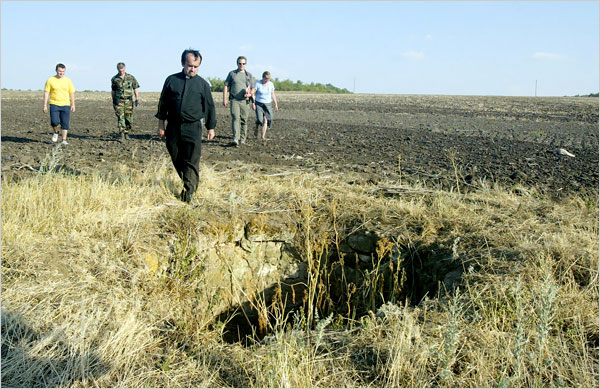
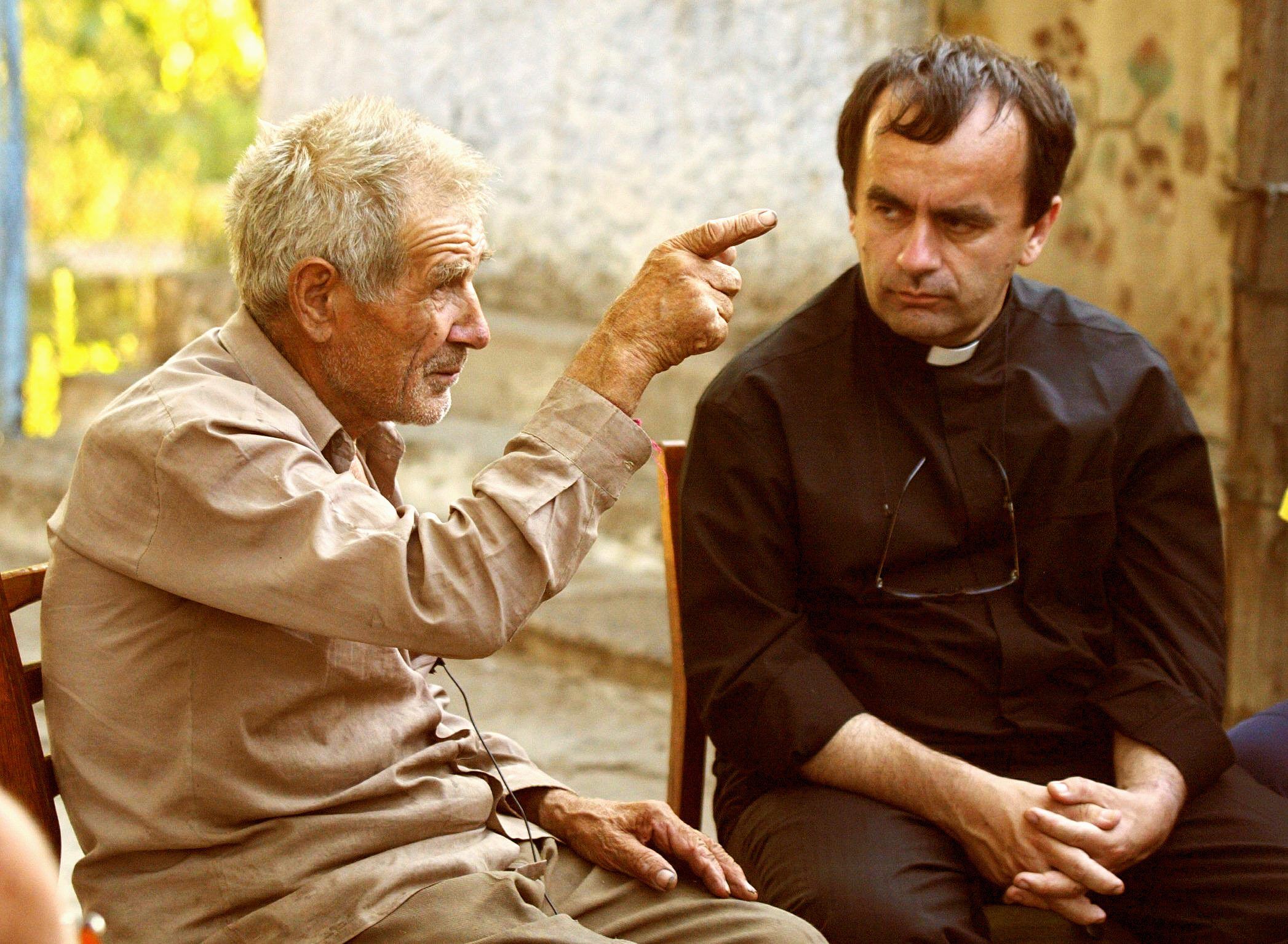
The killing fields have been slowly and meticulously uncovered since 2002, thanks to a French Roman Catholic priest who simply wanted to understand what his grandfather meant when he said that, “for others (in Rava-Ruska, just outside of Poland) it was worse.” When Father Patrick Desbois visited the town in 2002, he asked the mayor where the 18,000 Jews who had been killed in Rava-Ruska had been buried. The mayor said he did not know.
A year later, the new mayor of Rava-Ruska took the priest to a forest where over 100 villagers had gathered, waiting to tell their secret stories and help uncover the graves buried beneath their feet. Thus began the priest’s travels into the heart of the killing fields and his journey to find every mass grave hidden beneath the Ukrainian earth.
Father Desbois, author of Holocaust by Bullets: A Priest’s Journey to Uncover the Truth behind the Murder of 1.5 Million Jews, visited the Jewish Center of West Bloomfield on February 24, 2009 to present his findings in front of hundreds of Detroit area Jews. The video and photos and stories that Desbois shared brought gasps from the crowd of hundreds. Many Jews have for years wondered about their Ukrainian Jewish ancestors, trying to imagine how they had lived and died.
The answers are devastating. In the six years that the priest crisscrossed the Ukraine countryside to locate every possible grave (he has uncovered over 800 mass graves so far,) collect artifacts of rusty bullets and shell casings, skulls and bones, and record video testimonies from eyewitnesses, what he discovered was unimaginable. The elderly men and women who were children during the Holocaust pored out their stories to him, almost all of them wondering why they weren’t asked about their experiences before. They admitted that they were silent for six decades because simply no one had ever asked them what they had witnessed.
The priest and his team listened without judgment as hundreds of eyewitnesses told them what they remembered. After reading Soviet and German documents and asking questions to try to understand the details of the mass killings, he listened to stories about Jewish neighbors, acquaintances, friends, and even schoolmates who were killed publicly in front of swarms of onlookers. They were murdered brutally, individually, and often publicly, near their homes, shot into pits or in open fields, sometimes buried alive, and often within sight of the children who were condemned to remember such atrocities. 887 Ukrainian witnesses, who had been forced as children to dig graves, carry Jews, step on Jews, and sell their clothes had been traumatized as children and when asked, wanted to reveal everything before they died.
They had seen thousands of slayings by the Einsatzgruppen, mobile killing squads composed of SS and police personnel. The Nazi killers were advised by law to eliminate the Jewish people, one by one, only one bullet per Jew. The Father often repeated the horrifying refrain: “One Jew, one bullet; one bullet, one Jew.”
I am still haunted by the book and will never forget the overwhelming image that Desbois heard over and over. So many women and children and elderly men were each shot by a bullet in the back of the head, fell or pushed into graves, some without bullets and buried beneath others, then covered with dirt. Here is the memory mentioned often by these witnesses that seers the soul: the oft-repeated image of Jews alive and dead, buried together: how the “earth moved for three days.”
Why did the Father spend nine months each year and why is he still working to research unending tragedies? He is motivated by family history, an intense belief in ethics, his undying faith in God, and his fervor for remembrance. Ever since working with Mother Theresa and after studying Hebrew and Jewish history, he has devoted much of his life to working to improve relations and communications between Christians and Jews and is an advisor to the Vatican on Jewish relations. He told us how the Cain and Abel story had impacted him, especially when the Lord said to Cain, “The voice of thy brother’s blood cries to me from the ground.” Desbois told us that he works tirelessly to uncover each Jewish soul because he hears these words, “Where is your Jewish brother?”
He toils to help us bury our dead, symbolically. On the last day in December 2007 he led a group of Ukrainian Jews who drove to Rava-Ruska from Lviv, an hour away, and gathered in the snow around the grave to recite Kaddish. For Desbois, the ceremony in the woods was a high mark after his years of unbearable work and part of the reason for his efforts. The Jews from Ukraine did not just disappear as the Germans wanted. They were murdered one by one and dumped into the earth. Father Patrick said, “I want to see these people properly buried.” The Nazis had acted quickly with savage violence, hoping to exterminate every Jew, wanting the world to know nothing. Now, because of the incredible dedication of one man, we know. We know.
In a world filled with terror and inhumanity, it is comforting that there are righteous people like Father Patrick Desbois. He has devoted his life to confronting anti-Semitism and furthering Catholic-Jewish understanding, which are “acts of loving kindness.” Father Desbois said he hears these Jewish souls “crying from earth unto heaven.” Because of the efforts of one righteous man, we can now hear again the muffled cries of our brothers and sisters.
We hear them weeping loudly and clearly now.
And we will never forget them.

Defending our Lives
While Americans were buying snacks and betting on spreads for the Super Bowl, Iran’s Supreme Leader Ayatollah Ali Khamenei was calling for the death of all Jews and the destruction of the “cancerous tumor” of Israel. Alef, the website tied to the Ayatollah, claimed, It is a “jurisprudential justification to kill all the Jews and annihilate Israel, and in that, the Islamic government of Iran must take the helm.” This came a few weeks after the Grand Mufti of Jerusalem, Sheikh Mohammad Hussein, spoke at a Fatah anniversary ceremony and declared to a cheering crowd, “The hour will not come until you fight the Jews….The Jews will hide behind rocks and trees. And the rocks and trees will call out, ‘oh Muslim, servant of Allah, there is a Jew behind me. Come and kill him!’”
If you don’t think Hamen and Hitler’s descendants and their virulent anti-Semitism are back with a vengeance, you must watch the documentary, Unmasked: Judeophobia; the Threat to Civilization (available at www.unmaskedthemovie.com.) On February 6th at the Berman Center, hundreds of viewers were fortunate enough to hear Gloria Greenfield and witness her devastating film up close.
After she finished filming her powerful documentary, The Case for Israel: Democracy’s Outpost, Greenfield traveled from Israel to Europe to North America, uncovering anti-Semitism from all angles, including Christian and Islamic polemics against Jews, the proliferation of anti-Israel bias in academia and cultural institutions, misinformation campaigns and state-sanctioned denials of Israel’s right to exist. She interviewed Alan Dershowitz, Joe Lieberman, John Bolton, Natan Sharansky, Bret Stephens and Israel Deputy Prime Minister Moshe Ya’alon and many more, all to help unmask the history of anti-Semitism and its overwhelming prevalence now.
The film begins with Elie Wiesel’s words: “Since 1945, I was not as afraid as I am now” and brings all the forces, past and present, which have led to the world-wide demonizing of Jews as occupiers, murderers, and money-grubbing thieves. It highlights the connection between Hitler and today’s radical Islamists which began seven decades ago when the Grand Mufti of Palestine, Haj Amin al-Husseini, fled Germany and met with Hitler and his henchmen. His goal was to convince them to extend their exterminations to Arab countries and he thanked Hitler for his sympathy to the Palestinian cause. “The Arabs were Germany’s natural friends,” he said, “because they had the same enemies as had Germany, namely…the Jews.” The decades have only intensified the goal of complete annihilation of Jews everywhere as demonstrated by Hamas, Hezbollah, and the leaders of Iran.
Today, the prevalence of “lethal Jew hatred,” according to Gloria, is overwhelming. Jews in Europe have to protect themselves from the virulence that’s spreading and young Jewish Americans on campuses often hide their feelings for Israel for fear of reprisal. Anti-Semitism has spread from country to country, often neglected by the media. ADL’s National Director, Abraham Foxman, says that even in the United States, “When you measure hate crimes, Jews and Jewish institutions are still the number one targets. For every time there is an Islamophobic attack, there are 10 attacks on Jewish institutions.” Yet, bombings directed toward Christians and Jews around the world are casually reported, as if they’re to be expected. Wall Street Deputy Editor Bret Stephens says in the film that, “The political thinking (from Arab journalists, the Muslim Brotherhood, and men and women on the Arab street) informed by an anti-Semitic conspiracy is staggering.”
Does a movie like Unmasked: Judeophobia have the power to stir not only older Jews who understand the imminent threat but younger apathetic Jews who have never witnessed such direct hatred? There were very few people under the age of 50 at the Berman Center to watch the documentary which made me wonder what will happen when the older generation is gone and the baby boomers too old to help. Who will protect our children and grandchildren from these growing threats? How does tiny Israel and a minority of American Jews battle the overwhelming size and population of Arab countries and their undemocratic enablers like Russia and China, both more concerned about oil than human rights?
Jews who know the threats to Israel and Jews everywhere can’t wait and depend on Zionists of America (www.mizoa.org) or Stand With Us (www.standwithus.com), both sponsors of the movie along with the Holocaust Memorial Center. We must do whatever we can to bring awareness. Join Aipac, ZOA, and ADL; write your Congressmen and letters to news editors. Read Stand With Us/Honest Reporting’s excellent brochure, Learn How to Defend Israel With Your Computer, about the best websites to learn what’s happening, dispute false information online, and be heard on the Internet. Keep up with Palestinian Media Watch (www.pmw.org.il) and help Israel and fellow Jews win the PR battles which have often favored “underdog Palestinians” over “the Israeli Apartheid.”
How many times can we hear Arab leaders like Ahmadinejad, the Ayatollah, and Hussein openly and blatantly declare their desires to eradicate Israel and all Jews without being disgusted? A woman sat next to me during the film, often sighing, visibly disturbed by the horrifying hatred she witnessed. Unfortunately, we can sit and sigh and pray all we want and it won’t do any good.
It’s time to wake up. When we hear the political descendants of Hitler rallying their followers to kill all Jews, it feels like “never again” is beginning again.
Who else will defend Israel? Who else will defend our lives but us?
On a plane flight back from Dallas to Detroit, I tried to imagine a surprise party for my brother. Cramped against the window in the 31st row, wrapped in a Tempur Pedic neck pillow, I imagined my wife, children, and parents on our family room couch, waiting for Kenny to arrive. A 40th birthday party is a big event as it usually symbolizes the moment in a person’s life, smack in the middle between birth and death.
When I got up for the bathroom, I waited in line and turned to the front. As I stood there, I became mesmerized by a magazine article read by a man in an aisle seat. The top of the page read, “Surprise Party,” which was all I needed to signify the importance of this omen.
Before my brother’s 40th birthday, I still hadn’t done anything about it except donate to the JCC of Detroit’s Kenny Goldman Athletic Fund for a basketball league for children, named in his memory. I wasn’t sure whether to mark the donation, “In Memory of Kenny Goldman” or “In Honor of Kenny Goldman’s 40th Birthday.” I chose the latter and had the acknowledgement sent to my parents.
I have only been to a few surprise parties in my life. I vaguely remember 22 years ago when I went to dinner with my wife, Judy, and two good friends. Clueless, I entered our first home and was stunned when “Surprise!” rang in my ears. My sister, Leslie, and her husband had driven to Livonia from Ohio to join many of my friends and family for my 30th birthday.
Eight years later, I nearly ruined a surprise 40th birthday party for my friend, Jeff, when I told him I’d see him at his party. “What party?” he asked and I stammered a fictitious answer in response. His wife has never forgotten my carelessness and is still suspicious to invite me to any parties, surprise or other.
For my 40th birthday, Judy sent me to a yoga retreat in Western Massachusetts. For my 50th, we rented a limo bus and invited some old high school friends, ending up at a dance at my high school. We were given a scenic tour by the principal who showed us the new Media Center and we were honored with Grease, the only music the deejay could find from the 70s. I was thankful he chose music about high schoolers from the 50s rather than play the top selling single of my graduation year, 1975. I still try to forget that the Neil Sedaka song, “Love Will Keep Us Together,” sung by Captain and Tennille, won the Grammy as 1975 Record of the Year.
In my brother’s last year of life, Kim Carnes won 1982’s Record and Song of the Year with “Betty Davis Eyes,” even though John Lennon and Yoko Ono were expected to win with their song recorded before John’s slaying, “(Just Like) Starting Over.”
John and Yoko weren’t shut out that night. When their album, “Double Fantasy,” won Album of the Year, Yoko and her son, Sean, got a standing ovation. Yoko, teary-eyed, murmured, “I think John is here,” and six-year-old Sean shook his head, no, when his mom asked him if he wanted to say anything.
A few years later, Judy and I bought a John Lennon painting in California of red-haired John holding baby Sean. The painting, still hanging above the piano in our living room, is numbered 297/300, and has John’s words, “once upon a time there were no problems,” written on the right side of Sean. Sean Ono Lennon, born after I graduated in 1975, is now 33 years old.
Kenny would have been 40 years old, two days before 2008’s Christmas, but he never made it past 13. On the way home from a Detroit Tigers baseball game in July 1982, my father’s car was hit by another, less than one mile from his home. My father survived but Kenny was pronounced dead a few minutes after midnight.
On the flight from Dallas, I talked to Kenny in my mind and invited him to join me on his birthday. Hoping he was listening to me and praying that he made certain I saw the magazine article, I talked to him as if he were nestled in the overhead compartment. I still have my doubts about the afterlife but after 26 years, I have grown to believe that the dead circling the living may be more than just fantasy.
Before his birthday, I tried to stay away from sadness and thought of Kenny in his bar mitzvah video with the cameraman following him around, viewing his practical joke on our cousin. I imagined his smile as I asked him to give me some sign he was still here.
The weather on his 40th birthday was bitterly cold. I drove my wife and parents to the cemetery and after we slowly walked to his section, we found every headstone buried in white. After sweeping the snow off dozens of stones, we finally found his name and my father placed a rock with the word, “Remember,” on top of his gravestone. My mother wept as she tried to read a prayer.
The frigidity outside couldn’t stop my tears. No matter how many years go by, the loss of the life of my only brother is still unbearable.

While standing in line at the Morrow Road Haunted Trail on Friday, October 14th, Ashley Hickman of Clay Township asked if she could talk to Francis J. Sampier, the creator of the trail and director of the upcoming movie, Morrow Road. She wanted to tell him what happened to her on a summer night seven years earlier when she was just 19.
She and a friend went to the bridge at Morrow Road when the road was still a narrow dirt road and stood on the bridge at 3:30am. She turned off the car, pushed the car horn three times (part of the legend) and waited. She saw an eerie light coming toward them and then a blast of cold air came through the window. Feeling a sense of dread, she tried to start the car but it wouldn’t start. She put the foot on the gas and tried again and again and finally got the car started and took off. She said that on the next day, there were handprints all over the back of her car which only came off at a local car wash. She had not gone back to the road since that night but was so shaken by her experience that she contacted Black River Paranormal to investigate Morrow Road. Black River calls itself “a paranormal group that brings scientific thinking” into their investigations. They claim that “90% of all paranormal activity can be dismissed through investigation of the claims” but also that their “founding members have both had personal paranormal experiences while growing up which led to their interest in the paranormal.” Still haunted by memories of that night, Ashley has written about her experiences and the legend of Morrow Road for her class at Baker College.
The Morrow Road Haunted Trail is a self-guided walk-through trail which is just over a mile long, takes about an hour, and has dozens of volunteers stationed at various locations. The mission of the haunted trail is simple: to scare the living daylights out of those who travel its treacherous path.
The haunted trail is now in its fifth year of operation. It was voted Best Trail in Michigan in 2009 and 2010 and was nominated for Best Attraction in Michigan in 2009. It runs only on four Fridays and four Saturdays in October for a total of 8 nights. Francis says his goal for the trail is to help raise money for the movie and also to get food donations for a local charity. The ticket price is $18 for adults and $15 for students, which is reduced by a dollar off each ticket (up to a maximum of $3) if the customer brings canned or dry food goods. Customers are shuttled back and forth from Algonquin Middle School at 9185 Marsh Road in Clay Township to a house on Stone Road. The woods in back of the house, part of the Morrow Woods, are only a short distance from the legendary Morrow Road.
The first weekend in October was unusually warm and packed with over 300 people thrilled, scared, terrified, and ultimately relieved and satisfied. It was less busy on the second Friday because of football homecoming games in surrounding Algonac and Port Huron. After the Friday night rains had passed in the morning, the wind died down, and the temperature was relatively mild. But the rain and wind from earlier that day had to be dealt with by Sampier. He spent hours, making sure torn off branches were removed from the trail so that no one would get hurt in the nearly pitch-black darkness along the trail.
On Saturday night, October 15th, 164 people traveled to Clay Township, a few miles from Lake Huron. Adults and young children, teens and older people alike, stood in line, ready to face their darkest fears. Some had been on the trail the previous year but most had not and either heard about the trail or read about it in Fear Finder Magazine (www.fearfinder.com), a guide to haunted houses and trails in Michigan. Francis stood at the front of the line, welcoming his guests, explaining the legend of Morrow Road, about a woman who died mysteriously in 1893 while searching for her lost child.
People who love to feel fear came from all over, from Mexico, Oklahoma, California, Hungary, and other areas across southeast Michigan to check out the award winning trail. Many of those who knew about the legend lived near Morrow Road, in Marine City, Anchor Bay, New Baltimore, and Algonac. Some had visited Morrow Road recently and many had stories about their own experiences at Morrow Road. Beth from the Clay Township area told about her experience 40 years earlier when she was a teen and visited the road on a snowy winter’s night with her future husband. Her boyfriend’s old car got stuck in the snow near the famous Morrow Road Bridge. They sat in the car and saw a streak of light flying their way. She said she could remember that long flash of light like it happened last night. Yet, what was most disturbing to her about that night was the noose she saw around her future husband’s neck which he confirmed. They were freaked out by the light and noose but when they tried to move the car out of the deep snow, it didn’t move. And then, she said, her young boyfriend got out of the car and lifted it from the snow as if he were a world class weight lifter. He was finally able to get his car out of Morrow Road, away from any ghosts, away from their intense fears.
While Beth and dozens of other stood in line, waiting to see the trail, various trailers, teasers, and information about the Morrow Road movie ran along the side of the trail, including the new HD trailer (http://www.morrowroad.com/street_sign_temp.html), which won the best of the October Mitten Movie project in Royal Oak, Michigan. Every five or six minutes during the 3 ½ hour night, Francis yelled out to some of his many volunteers whose mission was simply to frighten willing participants, “Are you ready for your next victims?!”
Francis and his longtime friend and co-producer of the film, Jeff Arwady, grew up in Algonac, surrounded by the legend of the woman still searching for her baby boy. They read about it, saw it on television, and heard many of the stories from others. It was no surprise that these two cinema enthusiasts always wanted to make a movie and decided their first feature film was to be about Morrow Road. They studied the legend as well as the making and marketing of horror movies and wrote a script, made an extensive business plan, and secured a talented cast and crew which includes all three ladies and Hal Delrich, four of the five actors from the classic made-in-Michigan Sam Raimi horror film, The Evil Dead.
Sampier’s focus in the last year has been raising the money to film his horror movie. He and Jeff have spent hundreds of hours developing the business plan, getting the cast and crew, filming trailers, raising awareness for the project, developing a website (www.morrowroad.com) and Facebook page, and creating an incredible Morrow Road office in Shelby Township. Getting the right executive producers and investors is the final piece of the puzzle before finally making Morrow Road into a frightening, hypnotic, suspenseful film.
October is the true month for horror and Halloween, for scary movies, for paranormal activities, for fear and hauntings, for the dark side of the world. There are four more nights left of the Morrow Road Haunted Trail, ending two nights before Halloween, on Saturday night, October 29th.
Experience the ultimate in terror and thrills in the middle of a mile of darkness. As the Morrow Road Haunted Trail website says, “We will see you and your friends there. Have a Killer Time!”
“We survivors are bundles of contradictions,” Agi Rubin wrote in her 2006 book, Reflections, Auschwitz, Memory, and a Life Recreated, (written with Henry Greenspan, Paragon Books). “We push away the past, and we are constantly drawn back to it. When we are here, we are also there. And we are there, we are also here.”
Agi and Zoli Rubin are two survivors still able to share their past tragedies and the memories of their departed loved ones. They survived completely different horrors during World War II, met in Detroit, fell in love against the wishes of their families, and raised a family.
Though they never forgot their pasts, they were able to prosper in America, forever haunted by their losses, yet always grateful they were given a chance to meet each other and live nearly 60 years together.
It may be rare to witness such a Holocaust love story, one that has lasted as long as this one. On August 18, 2011, Agi and Zoli Rubin plan to celebrate their 60th wedding anniversary.
Agi Katz and Zoli Rubin met in Detroit after World War II. Zoli saw Agi at a party and thought she was too stuck up for him. Weeks later, Zoli saw her again outside Hudson’s Downtown store, eating a hot dog with mustard dripping off her lips and said to himself, “she is going to be my wife.”
Zoli, who had immigrated to Canada thanks to a farmer who had once been helped by Zoli’s father, had been engaged twice before but had not married. Agi, he thought, was good looking but she already had a boy friend from Ann Arbor. When she and her boyfriend and Zoli were invited to the same wedding, Agi decided not to go, unable to decide between the two young men. Her boyfriend met Zoli at the wedding and called Agi afterward to come over her house. Zoli couldn’t believe her boyfriend’s chutzpah and Agi was also not impressed either and chose the Canadian.
It was hard to find work after the war but Zoli finally found a job at the Midwest Woolen Co. on Randolph Street. The owner gave him $50 the first day when he showed the owner what a hard worker he was. And when they needed a cashier, Zoli told his boss about Agi and she was hired right away.
Zoli wanted to propose to Agi. If he could marry an American, he thought, he would have an easier time becoming an American citizen. Today, Zoli Rubin still calls his wife of nearly 60 years his “green card.”
When they eventually engaged, Agi and Zoli both got letters from their closest relatives, questioning their decisions and telling each of them to look for someone wealthier.
They never listened to their families’ requests and finally got married in Detroit on August 18, 1951.
Agi and Zoli Rubin didn’t talk much about their history for much of their married life together. However, they courageously volunteered to talk about their pasts for the Voice/Vision Holocaust Survivor Oral History, Zoli in January 1983 and Agi in December 1984. (Both can be found online at http://holocaust.umd.umich.edu/).
Zoltan was the youngest of eleven children, including his eight brothers and three sisters. In the interview, he fondly spoke about the “small village” of about 25,000 people in Czechoslovakia where he grew up. His father, a very “religious man,” ran a flourishing large farm, flour mill, and saw mill while his brother ran a chemical factory which produced toothpaste and prescription drugs. Like Abraham, Zoltan’s father kept his doors open for everyone, for people to pray in his house. And his father would always buy something from a traveling salesman because “this is his bread,” advice Zoli followed years later in his own business.
The youngest child of the Rubin family admitted he had an idyllic, nice childhood, a Jewish life with “all the freedom we wanted.” He remembered the last Seder in his home, a beautiful, sad, distant memory. “There must have been at least thirty-five, forty people. Somehow everybody came. It was…it was just beautiful. Kids running around, small children, big children.”
In the late 1930s, after children starting being deported, his brother was taken and then another older brother but his wealthy parents were considered “important” and exempted for awhile. Zoli was fortunate to get gentile papers from a friend from school that helped keep him alive. (Zoli still has the papers of citizenship and birth certificates from his friend who gave him gentile papers.) His parents were desperate for their youngest child to survive but they didn’t want to live under gentile papers.
When soldiers came to his house, his father told Zoli to hide in the Sukkah between the roofs and “kim nisht herinter,” (don’t come down,) were the last words he ever heard from his mother. His parents were taken to Zilina in Slovakia but this didn’t stop Zoli from trying to save them. Zoli got a letter of release and went to get money and jewels that his father gave a convert to hide for him upon his return. When Zoli went back to their house, he was told money and jewels were no longer there. He convinced one of his brothers to return to his home and search the basement when the German guard was at church. After three hours of searching behind the stones, a distraught Zoltan and his brother finally gave up.
Even without the extra money, Zoli was still able to get a release for his parents and brought it to Zilina. He heard his parents’ names called but another family was instead released as his parents had already been sent somewhere else. A man who called Zoli’s father Uncle Mendel had sent his parents away and took bribes for himself.
Rubin ended up joining the Slovak uprising to fight the evil he had witnessed. But the German soldiers captured him as well as many others and those without ID cards were instantly killed. A Slovak who knew Zoli threatened to tell on him but Zoli told him in a moment of exhaustion, “go ahead and tell them I’m Jewish.” Fortunately, the Slovak and Zoli were separated and his secret was safe.
After the Germans captured the soldiers, they forced the prisoners to march. Zoli held onto the protective socks his mother gave him before she was captured; to Zoli, these socks kept his mother close to him and helped keep him alive. Yet, when he was in the front of the line, he realized he was a “dead man walking,” along with another Slovak and three Frenchmen. Still, he knew the SS soldiers were always searching for cigarettes and would do just about anything for a smoke. So Zoli carried a box of cigarettes even though he didn’t smoke and flung them onto the ground. When the soldiers reached for them, Zoli walked gingerly back into the crowd of a couple hundred prisoners and soldiers. And when they finally arrived at the death camp, the Slovak and Frenchmen at the front of the line were shot dead. Zoli remembers thinking, “Somebody’s with me, somebody’s with me.”
Years later, Zoli’s granddaughter wrote in a school project that cigarettes are extremely deadly and yet, they helped keep her grandfather alive. Cigarettes, she wrote with astonishment, are able to take away life but at least for one moment, they were able to save a life.
After the war, Zoli and his surviving brother from Persia went back to his parents’ house and found the money he had searched for during the war within a few minutes. At that moment and for most of his life, Zoli has wondered, “Why didn’t I find it the first time I looked?” Living with this indescribable guilt that he failed to save his mother and father’s lives, he can barely stop the tears from dripping down his eyes.
It’s been almost 70 years but Zoli’s voice quivers when he speaks of the agonizing days and unbearable losses. He estimates that about 70 members of his extended family died but fortunately, he was able to save a remarkable photo album from his Czechoslovakian home and bring it to America. An amazing treasure trove of family photos and letters from his family’s past, it is a testament of a profound legacy. There are photos, still in excellent condition, of Zoli’s parents and siblings, aunts, uncles, nieces, and nephews. This is a picture book filled with memories and evidence that once upon a time in Europe, life was good.
Agi Rubin’s Holocaust experiences were very different than her husband’s. She spoke to the U of M interviewer in 1984 that her family was “fortunate” to have 15 out of 60 family members survive. But being transported from Munkacs in a cattle car to Auschwitz/Birkenau and barely existing amidst starvation, devastation, and death was anything but “fortunate.” Agi remembered when her little brother came home crying after his friend called him a “dirty Jew.” Agi said to the interviewer, “Little did he know than that that was his destiny: being a Jew at the age of six, he would be cremated.”
She reflected when she first saw the striped clothing at Auschwitz, how she and her family were lined up and shoved, heard the words, “schnell, schnell” (“fast” in German). She recalls how Josef Mengele took her from her mother, aunt, and brother and she ran back three times and “he threw me to the gravel ground….I just wanted to stay with, I felt guilt, I felt lonesome not being with her.” And after the third time she was pushed down by Mengele, “My mother went, let my child go, I’ll see you tomorrow and I remember my mother all my life with the wave of her little finger…”
In her book, Reflections: Auschwitz, Memory, and a Life Recreated, with Henry Greenspan, she writes how she was chosen to help sort the clothes of those who had been gassed and killed. Imagine a young girl having to sort the clothes of the dead rather than being killed herself. Imagine recognizing your aunt’s jacket in the leftover clothes and knowing that someone you love has just been exterminated, a few feet away. Imagine sorting the jewelry, shoes, hair, and clothing and realizing this was all that was left of her brother and mother.
Agi wrote about Birkenau in the summer of 1944, “I will never forget the sounds. There was singing, Ani Maanim, ‘I believe in the coming of the Messiah.’ There were shouts of farewell—parents saying goodbye to children, old people saying good-bye to their families, a whole community saying good-bye to life. The Sh’ma, ‘Hear, O Israel.’ The end of the Sh’ma. The end of everything. Silence screaming just as loud.
“I will never forget these sounds. They will always haunt me.”
Unlike her husband who goes every week to synagogue services, Agi rarely attends services anymore.
Agi’s father astoundingly survived the Holocaust but her mother didn’t. And so Agi ended her book, remembering her mother “as she looked across the mud and the agony, trying to get my attention, trying to imagine a future, trying to invoke hope, trying to bestow the only blessing that, in the end, this world allows:
‘Go, my child, go.’”
Agi and Zoli’s parents sent their children away to save them. Yet, Agi and Zoli’s devastating memories, their books and framed photographs, the letters and artwork saved from their childhood, still haunt them over 66 years later.
Even though tragedy brought Agi and Zoli together, they have persevered with little bitterness and anger. They know what they’ve lost but they are thankful for what the gifts of their lives have brought them.
The Rubins worked and lived in the United States in the Detroit area and started a family and made many friends in their over-60 years together. They raised three children together, Vicki, Amy, and Randy, and were fortunate to have been given seven grandchildren as well.
Agi and Zoli have lived a modest, devoted, and love-filled life for 60 years. After all those years together, they still talk and share and aren’t afraid to face the past horrors of their lives together. Zoli worries when Agi doesn’t feel well and Agi feels the same way.
Agi and Zoli’s parents, siblings, and extended family would have been very proud of the kind of lives they have lived after enduring such atrocities, the examples they have set for their children and grandchildren.
Zoli Rubin smiles when he says he will live to 100. He comes to Bnai Moshe synagogue usually for morning services on Monday and Thursday and Shabbat and often leads prayers for the service, even though he is over 90 years old. Though he lived through some of the most horrific years in Jewish history, he still believes in God and faithfully says Yahrzeits for every member of his family in loving memory.
In a world filled with cruel leaders, genocide, and anti-Semitism spreading around the globe, it is remarkable that two survivors have been together for 60 years. Agi and Zoli are a loving couple who have never given up on each other, their friends, their families, and who have never stopped believing in the potential goodness of people.
In her book, Agi remembered her father when he sang Ein Keloheinu and wrote, “Whenever I am at the synagogue, I hear his voice….I remember how much joy he got out of singing…he is again with me, and I am singing with him. It is the harmony of voices that makes the legacy, the way I tune myself to him, and feel his spirit still singing, through my own voice. Even now, we are singing together.”
Every year, we lose thousands of survivors. But we should be thankful for those who are still here to cherish. We can be inspired the way Agi and Zoli Rubin were, when remembering their mothers and fathers, hearing their spirits singing together.
Hear the harmony of Jewish voices rising above grief and loss.
Hear, O Israel.

“This story has truly touched me to the core of my soul. Rachel was and is a true angel. Without even knowing her, she has completely changed my life and the lives of so many others with her generosity and compassion. I can only hope to raise my children to be as kind, thoughtful and giving as Rachel was and still is. She is a true inspiration to me. What a legacy she has left behind! My thoughts, prayers, and love go out to her family during this difficult time.” Anonymous Donor, August 3, 2011
A few days before her birthday, little Rachel Beckwith decided what she wanted for her birthday. It wasn’t an iPhone or a doll or clothes. Instead, she learned from her church that millions of African kids have virtually no access to water, and so she decided to make a difference. Rachel’s family attends EastLake Community Church, a nondenominational church of about 4,000 members in a suburb of Seattle. The church held a benefit concert in September that helped raise more than $300,000 for the non-profit organization, Charity:Water, to bring clean water to the Bayaka tribe in the Central Africa Republic. And it became very clear to Rachel as she got closer to her birthday what she truly wanted.
“On June 12th 2011, I’m turning 9,” Rachel wrote on a webpage to her friends and family. “I found out that millions of people don’t live to see their 5th birthday. And why? Because they didn’t have access to clean, safe water so I’m celebrating my birthday like never before. I’m asking from everyone I know to donate to my campaign instead of gifts for my birthday. Every penny of the money raised will go directly to fund freshwater projects in developing nations. Even better, every dollar is ‘proved’ when the projects are complete, and photos and GPS coordinates are posted using Google Earth. My goal is to raise $300 by my birthday, June 12, 2011. Please consider helping me. Thank you so much!!!”
By her birthday, Rachel’s charity webpage, http://mycharitywater.org/rachels9thbirthday, had raised $220, just $80 short of her goal.
Just six weeks after her birthday, Rachel was in a car with her mother and younger sister on a Seattle interstate highway. Only a few feet away, a semi-trailer jackknifed into a logging truck, causing a chain reaction crash involving more than a dozen vehicles. The semi rear-ended the car carrying Rachel, only injuring her and not her mother and sister.
Within a few days, Rachel was taken off life support and died peacefully in her sleep.
After her accident, donations starting coming when community members publicized Rachel’s birthday wishes and took off when the story appeared on Seattle’s KING5 TV, in the Seattle Times, and on MSNBC. By Tuesday afternoon, over $200,000 was raised on her website and $331,000 when the Seattle Times ran the story. On July 25, Rachel’s mother wrote on her daughter’s website, “I am in awe of the overwhelming love to take my daughter’s dream and make it a reality. In the face of unexplainable pain you have provided undeniable hope. Thank you for your generosity! I know Rachel is smiling!” As of today, August 3, 2011, almost $800,000 has been raised and it keeps climbing.
When I read this story, I can’t help remembering when over a million Christmas cards came from all over the world for 5-year-old Noah Biorkman (https://aggman.wordpress.com/2009/11/23/a-million-wishes/), who was dying from neuroblastoma cancer. I cannot forget how his mother and father decided to give Noah one last Christmas in November, knowing he was not going to make it till December 25th. “How could we not,” I wrote then, “have our hope renewed when witnessing such affection from so many strangers? A million wishes had come to South Lyon, Michigan, all with the hope of making Christmas special for a little boy who was facing his last moments of life.
“A million wishes indelibly changed the lives of a boy and his mother and father and grandfather and grandmother and his friends. It made them realize that, as Robert Brooks said, they ‘had a friend in all of us.’”
I can’t help thinking about the 29th anniversary of my brother’s death on July 21, remembering how he, like Rachel, died after a car accident. I think about Noah and how a million wishes spread from all over the world for a little boy, giving his family the belief that there really is good in the world, even when facing the imminent death of one’s little boy from cancer.
I turn to Rachel’s website and read a few of the messages from people who donated to give kids from another side of the world the opportunity to have clean running water. “I can’t stop refreshing this site to see how it continues to grow monetarily, spiritually and lovingly,” wrote Alyssa Carrao today. “People are being touched, changed….seeds are being sown in the souls of thousands. I am so thankful to be a part of this awesome movement. I can’t imagine the pain of losing a child, but I can’t think of a better way to try and ease that pain….to know your daughter’s life and death were not in vain….I have donated twice already, but can’t help feeling called to scrape up a little bit more (God will provide). In Memory of Rachel Beckwith and In Honor of my children, Aizak (5) and Anja (3) – may they learn from your example.”
I can’t help thinking about the heartache of Rachel’s family and the tears shed for Noah and Kenny and all the other children taken away too soon from this world. But then I look at the smile on Rachel’s face and I know I must donate.
I truly hope she still hears and still sees and is touched by all who now know her name and understand the hope and love she displayed when she was alive. I take a sip of water and imagine it flowing to the darkest reaches of Africa. I close my eyes and think of thousands of people with tears in their eyes…the tears flowing together into a river of clean, clear, life-giving water.
Like many men of a certain age, I have forgotten most of my memories. I can hardly remember what I did last week or last year or who starred in which movie I can barely remember watching. As I reach my mid-50s, I connect even more to my father, who is having a harder time remembering names and moments as he gets close to the age of 80 on August 14th.
When I asked my father what he was doing when Hank Greenberg came home from the war and joined the 1945 Detroit Tigers, he remembered precisely. It was July 1, 1945 at Briggs Stadium (which later became Tiger Stadium) with 47,000 other war-weary baseball fans, the first game back since Greenberg joined the army on May 7, 1941. It was the top of the 8th inning when my father decided he couldn’t wait till the end of the game and went to the Briggs bathroom. And it was there that the thunderous applause made him realize he had missed the memorable moment when his hero, “Hammerin’ Hank Greenberg”, hit his first home run in 4 years.
In the last game of the season on September 30, 1945 Greenberg hit a grand slam to give the Tigers a 6-3 win over the St. Louis Browns and the American League pennant and then led his team to a 4-3 series win over the Chicago Cubs to win the World Series. A 14-year-old boy joyfully celebrated with an entire city the end of a World War and a hard-fought victory for his beloved Hank Greenberg and the Detroit Tigers.
There are certain moments in life you can never forget.
One of these moments for me was Sunday, June 12, 2011, an afternoon spent in Detroit with my dad after my wife, Judy, bought and gave us two tickets to the play, Ernie by Mitch Albom, at the City Theatre, a week before Father’s Day.
It was almost 66 years after the Greenberg return game in Detroit. My father was home alone after my mother left to visit my sister, brother-in-law, and niece in Columbus over the weekend. We left at 3pm to park at the Fox Theatre parking lot before the Tigers game across the street at Comerica Park ended. We went to the Hockeytown Café across from Comerica Park, the same building as the City Theatre play, sat and ate and watched the 9th inning.
The Tigers lost the game, 7-3, but we didn’t care much. We reminisced about the city in its heyday. We talked about the stores nearby such as the Hughes and Hatcher on Woodward and the theatre district down the street from the Fox Theatre. We talked about where he lived and I learned for the first time that my dad and his sister, my Aunt Selma, lived together in his teens, away from their father while their mother was in Eloise, the psychiatric facility (sometimes called an “insane asylum,”) on Michigan and Merriman. He pointed south, showing me where he and his sister lived, off Woodward Avenue. They rented a room next to a “cathouse,” something I had never known.
We reminisced about my Aunt Sylvia’s husband, Orville, and wondered when he died. My dad called his oldest sister, Helen, who still seems to remember everything and said that Orville died in 1981, three years after my dad’s youngest sister committed suicide. My dad said it was astounding that he died 20 years ago and I pointed out what was more amazing was that his death was actually 30 years ago.
30 years ago, my brother, Kenny was only 12 and played in Little League baseball. My parents drove him to his games and also took him to his bowling league. Sometimes, my father took Kenny to see the Detroit Pistons and Tigers. Kenny was a huge sports fan and loved Michigan’s college teams and Detroit’s pro teams but didn’t get to see a World Series championship because he was born a few months after Detroit won the 1968 World Series.
One of the reasons my dad and I had not gone to many Tigers games over the last 30 years is that baseball memories can be painful. It was on the night of July 20, 1982, that my dad took my brother, Kenny, to a Detroit Tigers baseball game and it was on that night, less than a mile from home, that a car crashed into the passenger door of my father’s car. And it was on that night, a few hours later, when my dad’s youngest child, his 13-year-old son, my little brother, had his last breath on this earth.
My dad and I didn’t talk about Kenny or the 1982 Tigers, two years before their next World Series championship, on this Sunday before Father’s Day. We focused on other things, although I know my dad can’t think much about the Detroit Tigers without remembering his youngest boy.
My wife, Judy, and I saw Woody Allen’s movie, Midnight in Paris, the night before the play. The movie is about longing for the past, nostalgia, and choosing to live in the joy of another era. At the Hockeytown Cafe, before the play, my father and I walked around the restaurant and stared at the heroes of decades past. In this sports museum of memories, we viewed the framed and signed photos of great hockey players like Howe, Yzerman, Lindsay, and Lidstrom. We spent time staring at each Tiger legend, Greenberg, Kaline, Trammell, Cobb, and reminiscing about some of the moments we remembered, those we cannot forget.
The play, Ernie, is stuffed with memories and nostalgia for a simpler time before the Internet, before smartphones, Twitter, Facebook, and the incessant noise from 24-hour cable news stations. When we think of Ernie Harwell, we can hear his Georgian twang, that voice that we knew more than just about any of our friends. He was like the friendly, helpful neighbor who never moved away.
We listened casually or intently, savoring the slow, steady pace of baseball. I remember listening on my friend’s lawn across the street when Ernie announced two grand slams in one game from Tiger Jim Northrup (who recently died at age 71). Most Detroiters of my age can also remember Northrup’s triple against Bob Gibson in the seventh game of the 1968 World Series to clinch the World Series.
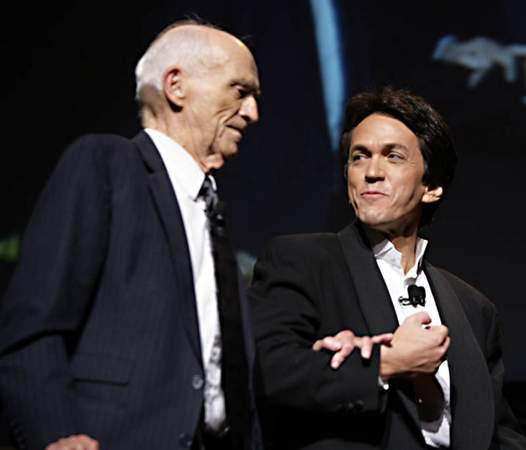
Most Detroiters didn’t get to attend the night of the fundraiser for Mitch Albom’s book, Have a Little Faith, a few weeks after Ernie’s final speech at Comerica Park. Judy and I were fortunate to be in the audience and listen when Ernie Harwell spoke to Mitch about faith and serving God and baseball and looking forward to heaven and people reaching out like roots of a tree to connect with others. I don’t think anyone there will forget that night.
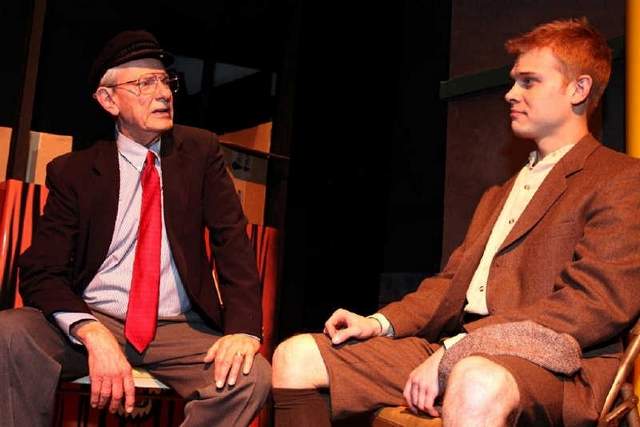
Mitch Albom’s play, Ernie, takes place in the tunnel where the players take the field on the night the then-91-year-old Harwell gave his farewell speech at Comerica Park. It stars veteran Detroit stage actor Will David Young as Harwell and newcomer T.J. Corbett as “the boy,” a mysterious figure dressed in brown knickers, talking about Harwell’s memories. The play evolves in the nine innings of Harwell’s life, and features two video screens with real Ernie Harwell calls and Major League Baseball highlights to complement the on-stage dialogue.
We heard Ernie’s real stories about his early days when he was a paperboy and had a speech impediment, when he was trained to be an announcer for the Atlanta Crackers. We heard about Babe Ruth signing his shoe, Jackie Robinson being threatened by the KKK, Ernie being traded for a player (the only trade ever of a player/announcer.) We heard and saw footage of Willie Mays, learned how George Kell helped bring Harwell to the Tigers. We lived through the tumultuous 1968 season that helped soothe the smoldering tension from the ’67 riots and saw Mark Fidrych (the Bird), who swept us all away with his enthusiasm and joy and great pitching, even if it was only for one glorious summer. We lived again through the 1984 season that ended in a world championship. We saw Kirk Gibson hit his World Series home run and listened to funny stories about Sparky Anderson. We felt Ernie’s love for his wife of 68 years, Lulu, his family, and the devotion to his religious faith. We got to hear about his firing and rehiring as well as the last day of Tiger Stadium on September 27, 1999 which he announced. We watched footage of the classic stadium that day and heard Ernie’s words.
“How do talk to a legend?” Harwell said in his farewell words to Tiger Stadium. “You do it with a lump in the throat and a tear in your eye.” He called the ballpark his “dear friend,” the “corner” of Michigan and Trumbull that he spent more time at than his home. He loved this home away from home “in sickness and in health” and cherished the baseball memories shared between fathers and sons, “from generation to generation.”
We tearfully watched and listened to the last few minutes of the play, Ernie’s actual voice and words during his final speech to the packed house at Comerica Park on September 16, 2009. It’s been less than two years since that night but we could still feel the “depth of his heart” on that “wonderful night” in the state of Michigan, where he was planning to be at the end his life’s “journey” of 92 years.
Woody Allen in Midnight in Paris dreamed of going back to a time when he could talk to the great artists and writers in a beautiful city. I dream instead of traveling 30 years in the past to Farmington Hills, Michigan on the night of August 14, 1981. I drive over to my parents’ house on a warm summer night to celebrate my dad’s 50th birthday. We have dinner with Kenny, Leslie (home after college), mom and dad, and celebrate the big birthday with ice cream cake from Baskin and Robbins. And after dinner, we go outside with the radio and listen to Ernie Harwell announce the game against the New York Yankees.
Kenny and I play catch on the front lawn while we listen to this 1-0 victory from Milt Wilcox, saved by Kevin Saucier. This 1981 team, I now know, won 9 straight games starting that night, with a cast including former college football stars Kirk Gibson and Rick Leach, and players like Steve Kemp, Aurelio Lopez, Dave Rozema, Alan Trammell, Lou Whitaker, Jack Morris, and Lance Parrish. Sports Illustrated published an article (“Let’s Give the Tigers a Great Big Hand,” Steve Wulf, August 31, 1981) about the emergence of these Tigers as a young and powerful team which featured this quote from Sparky Anderson: “I think this club is going to be great in 1983 and 1984.”
It’s now, 30 years later, that we know that Sparky, no longer with us, was dead-on with his prognostication.
Today, I am 54 years old and my dad is nearing his 80th birthday. He goes to dialysis twice a week and his weight is down to about 110 pounds. Kenny and Ernie Harwell are “loong gone,” as Ernie often said when announcing a home run.
We still have our memories though, the mementos of life, dreamsongs playing over and over in our heads. I don’t really remember if I came over my parents’ house for my dad’s 50th birthday or saw Leslie or played catch with Kenny or listened to Ernie on that particular night. But in my mind, I can still hear Ernie’s soothing voice and see my dad with his thick black hair eating ice cream cake. The number 50 on the top of the cake is green and large.
I can still picture Kenny, laughing, his left arm perched high in the air. He is thrilled to be lost in the game of catch and throws the ball back to me over and over again…over and over.


Francis J. Sampier has devoted the last six years of his life, creating a movie about a Michigan legend, with a predominantly Michigan cast and crew, to be filmed in Michigan. Unfortunately, it may end up with the designation: Not Made in Michigan.
Sampier says that if the incentives given to Michigan movie makers are pulled, he will simply move his production of Morrow Road to Georgia or Louisiana, where the film incentives are still intact. “180 jobs will be gone from Michigan, just like that,” he told me, and shooting the film will be transported to another state.
Francis is just summing up what Michael said in the famous movie classic, The Godfather, “It’s not personal. It’s strictly business.” He will do whatever it takes to get the movie made as economically as possible, whether it’s in Michigan or Louisiana.
Francis and his assistant director/composer, Jeff Arwady, have boundless energy because they believe that Morrow Road is going to be an exciting and successful movie, partially because it’s a combination horror movie and mystery/drama based on an actual legend. The development of the film began in December, 2004 and the history of its development is a lengthy one which can be found on its website, www.morrowroad.com and its Facebook page.
Creating a movie from scratch…planning it, writing the script, casting it, composing the music, securing the cinematographer, designing the set…is a truly creative and collaborative enterprise but in the end, making movies is still a business. The lengthy process of making movies can also be extremely expensive.
How much money has Sampier budgeted to film Morrow Road and make the movie a success? Let’s just say it’s a seven-digit figure.
Based on the actual late-1800s Michigan legend, Morrow Road explores the story of the end of Isabella Chartier’s life and the mysterious circumstances surrounding how she died on a search for her lost child. Many people believe that the death was so tragic that her ghost spirit remains haunting the road to this day, still searching in an eternal frustration for that impossible-to-achieve answer: what happened to her son?
Morrow Road is a southeast Michigan rural road that that until recently was entirely a dirt road. What makes the legend of Morrow Road fascinating is that there are many versions of how this legend came to be. What happened to the child? What happened to the woman? How did they disappear? Why do people claim to see orbs in the woods at night? Has anyone really seen the woman with bloody hands wandering down the road? Is there any validity from those who claim to hear a baby crying near the south bridge? There are about ten theories about what happened to the mother and child, including possible kidnapping, drowning, fire, freezing to death, and murder, among the possibilities. What keeps the legend alive is not only the mystery of the story but the many sightings of apparitions of the woman within feet of the road.
Sampier and Arwady have been fundraising for the last five years which includes their award-winning Morrow Road Haunted Trail. They have not stopped thinking and planning different ways of equity financing, as they declared in their latest open house which my wife, Judy, daughter Marlee, and I attended. Francis elaborated afterward on his website, “Open House was a huge success! Josh’s latest composition was premiered, Tobi & Josh’s collaborated mural was revealed, about 100 private invites attended. The new DVD handout was made available, and it was announced that the London Symphony Orchestra has been locked, and venture capital has begun to be received.”
Francis has investigated every aspect of the story, wrote the screenplay, and has spent hundreds of hours researching what it takes to make a successful and profitable movie. He decided to make this his first feature film not only because he lives very close to the actual Morrow Road and knew the legend but because of the potential for horror movies to be blockbusters. Think of Halloween, Carrie, The Ring, Scream, The Exorcist, Aliens, and of course, the cult classic, The Evil Dead. Think of all of the horror movies introduced virtually every week at movie theatres; remember the sudden unpredictable successes of 1999’s Blair Witch Project which cost less than $25,000 to shoot, a final budget below $750,000, and ended up grossing $249 million worldwide. Who can forget 2009’s Paranormal Activity, the supernatural horror movie which was one of the most profitable movies of all time, generating $179 million worldwide?
Francis studied horror movie marketing and realized that the popularity of Sam Raimi’s The Evil Dead is unparalleled in the “horror community.” To excite diehard horror movie fans, he approached all five cast members of The Evil Dead and signed up Rich Demanincor and all three of the original ladies of the 1981 horror cult classic, Ellen Sandweiss, Betsy Baker, and Sarah York (www.ladiesoftheevildead.com.) The last cast member, Bruce Campbell, will most likely come on board once the film is funded.
Sampier also contracted one of the best cinematographers in Michigan who worked on the movies, 8 Mile and 21 Grams. Francis signed the special effects company behind War of the Worlds and X-Men 3. He added the stunt coordinator from Batman Begins, graphic designer for The Evil Dead, and signed the cast, mostly from Michigan. In fact, Morrow Road, according to the website, is “95% a Michigan film, both crew and talent living in, or having Michigan origin.” And then to top it off, he secured the London Symphony Orchestra and for public relations, Dick Delson & Associates, the same company that represented Jaws, American Graffiti, and The Lord of the Rings, among others.
The last year or two has brought some badly-needed excitement and pride to Michigan. Many movies and TV shows have been filmed here because of the state’s film incentives. Stars such as George Clooney, Miley Cyrus, Jennifer Aniston, and Hugh Jackman have filmed and lived here and contributed to Michigan’s economy. The television show, Detroit 187, was shot on location in the Metro Detroit area and shown on ABC, displaying Michigan scenery, streets, and history. The last episode, for example, was partially filmed in the awe-inspiring Henry Ford Museum.
Three years ago, a commitment from the Michigan Legislature was made to make Michigan the next mini-Hollywood. The excitement and jobs that this generated is hard to dispute, even if it has cost the state some tax dollars. Currently, the incentives rebate up to 42 percent of an approved production’s qualified in-state expenses for a movie, TV show or other project permitted under the law. They’re considered the most generous film incentives in the nation but have been criticized by some for not being revenue neutral or adding to state coffers.
Since the incentives were launched in 2008, 199 productions of varying types have been approved by the state, and collectively they qualified for $364 million in rebates. There is controversy about whether the state can afford these tax breaks but there have been studies praising the financial results of the incentives. A recent study by Ernst & Young said the incentives created the equivalent of 3,860 full-time jobs for Michigan residents in 2010, and productions spent $531 million in the state over the past two years.
Newly elected Gov. Rick Snyder has proposed capping the incentives at $25 million annually starting in 2012. His administration seeks to curb tax credits in general as part of an effort to trim state government spending and bring the budget in line. Since his announcement, many film makers, not wanting to stay in limbo, have already left the state as have others hoping to find work in movies and television.
Ask yourself, how is this state going to grow and thrive if young people continue to leave the state? My son left after graduating college as have many of our friends’ children to find jobs and careers in other states. A friend’s son, who studied film in college and wants to make it his career, worked as a production assistant on Detroit 187 and realizes if the film incentives die, he may move to California to find work.
To help keep the film industry alive and vibrant in Michigan, Detroit Free Press columnist and author Mitch Albom has worked on modifying the film incentives to benefit the state and movie business (“Mitch Albom makes pitch to save state film incentives,” Bill Shea, Michigan Entertainment Network, March 16, 2011).The proposed measures he proposed are aimed at “increased economic benefit and fiscal return to the state from the incentives program.” Unfortunately, this proposal or any other may not be enough to change the mind of a “bean counter” like Snyder, who seems to think having a balanced budget will solve most of Michigan’s issues.
Leading a state is not just balancing a budget. Making business taxes fairer isn’t enough to bring in new businesses. Business owners are looking for good people to hire and if college graduates keep leaving the state for better opportunities, what chances do Michigan businesses have? Proponents of the “fair business tax” with no special incentives argue that leaders have been trying to diversify Michigan’s economy away from the automobile industry for years with limited success. But it is my opinion that we haven’t had enough incentives to get businesses to come here. I think we should do everything in our capacity to bring movies, clean energy, high tech, any industry with lasting potential, to get people moving here and staying here, who will make money and pay taxes. This is for the sustainable long-term benefit of Michigan and everyone who lives and works here now.
I hope that Rick Snyder doesn’t achieve what he did at Gateway Computer when he attempted to cut costs, subsequently allowing HP, Dell, and Apple to dominate the market. His tenure on the board of Gateway ran from 1991 to 2007 until Gateway was sold to the Taiwanese manufacturer, Acer Inc. on October 16, 2007. Because of his tenure at Gateway, outsourcing jobs was a campaign issue and even Snyder admitted that some jobs were outsourced. Yet, even though he was a Gateway board director, he said that outsourcing was not something he voted for.
Will Snyder let Michigan lose out in competition to other states the same way Gateway lost to HP and Apple? Will he pretend that it’s strictly business as jobs and people flee the state and cities lose population, leaving deserted factories and pothole-plagued streets? Will movies like Morrow Road be forced to leave the state along with the thousands of jobs that the entertainment industry has brought to Michigan?
I guess the good news is that Governor Snyder won’t be able to sell Michigan to Taiwan. On the other hand, anything is conceivable for the newly elected Michigan legislature which, at least until now, seems willing to let Michigan-made Morrow Road, Detroit 187, and dozens of other projects say goodbye to Michigan.
Jobs are starting to flee the state like ghosts, stuck in orbs along Morrow Road, I-75, and I-94, heading south to a warmer, friendlier climate, to states willing to do whatever it takes to thrive in the post-housing-financial-bubble-bust of the 2010s.
What a shame it would be if this is truly the end of the road.


In a world filled with millions of Facebook friends, it often seems that Israel has none. Ten European Union nations have strengthened their ties with the Palestine Liberation Organization and five Latin American countries have formally recognized the state of Palestine—“free and independent with its 1967 borders.”
Helen Thomas may be representative of much of the world when she tells “Jews to get the hell out of Palestine.” Even Time Magazine has criticized Israel in its recent article, “Israel’s Rightward Lurch Scares Some Conservatives,” (Karl Vick, Time Magazine, January, 11, 2011). Vick states that Israel’s current government is “extreme” and quotes historian Ron Pundak who calls current Israeli politics “the ugliest in the nation’s history.” “This is reminiscent,” Pundak says, “of the dark ages of different places in the world in the 1930s. Maybe not Germany, but Italy, maybe Argentina later.”
When we read Israel being de-legitimized and compared to fascist countries in the 1930s, it’s easy to wonder if Israel has any friends left. Yet, even during the Holocaust, there were some righteous Gentiles who gambled with their lives to speak out against this type of blatant anti-Semitism. One of them was a Dutch reformed pastor who was actively involved in hiding Jews, imprisoned several times during World War II. His son, Willem J.J. Glashouwer, followed in his footsteps after undergoing major brain surgery when he became a minister in Holland and then full-time President of Christians for Israel International in 1999.
“Israel is the greatest sign of hope the world has ever seen,” Glashouwer said on his website, www.c4israel.org, and its pro-Israel video on YouTube. And when I received an email petitioning the UN to indict Ahmadinejad for the “crime of incitement to genocide,” it wasn’t from ADL or the World Jewish Congress. It was from another important supporter of Israel, the Christians United for Israel (www.cufi.org.)
CUFI is not only fervently pro-Israel; its message is to “educate Christians across America about why and how they must stand up and speak up for Israel in her time of need.” The mission of CUFI is stated clearly on its home page: “We believe that the Jewish people have a right to live in their ancient land of Israel, and that the modern state of Israel is the fulfillment of this historic pledge. We maintain that there is no excuse for terrorism against Israel and that Israel has the same right as every other nation to defend her citizens from such violent attacks. We pledge to stand with our brothers and sisters in Israel and to speak out on their behalf whenever and wherever necessary until the attacks stop and they are finally living in peace and security with their neighbors.”
CUFI has a tremendous YouTube video highlighting its mission. It also focuses on colleges to develop politically-minded student leaders as “effective advocates for Israel on their college campuses,” and offers local events around the country, educating Christians about Israel. On January 26, CUFI offered a “Standing with Israel” event at the University of Detroit campus, featuring special guest speaker, Irving Roth, a Holocaust survivor and international educator, talking about his experiences and promoting a more accepting and diverse world.
Thankfully, there are hundreds of thousands of Christians who are friends of Israel, including 4,000 Christian Zionists who gathered in Washington, D.C. last July to show its supportive message to Congress. “When the world condemns Israel for defending yourself from thousands of missiles and mortar attacks, we proudly proclaim I am an Israeli,” said CUFI founder, Pastor John Hagee. “When terrorists threaten to kill you, we proudly proclaim I am an Israeli. When your allies grow weary of fighting tyranny and oppression and seek the easy way out, we stand with you and say I am an Israeli.”
Last year, Hagee presented members of Congress with a petition signed by over 100,000 American Christians, expressing solidarity with the state of Israel. This does not stop many Jews from being skeptical or at least ambivalent about evangelical Christian support of Israel, nervous about prophecies of the “end of days.” Yet, it is abundantly clear to me and to many other Jews that Israel truly does have a large number of Christian friends who stand with Israel.
If Jews feel lonely in a world pushing hard for a Palestinian nation in the tiny land of Israel or if we feel guilty when Israel does something “controversial,” we can take solace from thousands of Christians who demonstrate support and friendship for the nation of Israel.
No matter how harsh the condemnations are from so many in the world, we do still have friends. And for that, we should be grateful.

Few people seemed to notice when Iran President Mahmoud Ahmadinejad spoke on October 17th that “Grounds are being prepared for the Zionist regime to go to hell soon, and any other country supporting this regime will join it on its trip to hell as well.” He spoke of the day the United States would one day apologize and “beg” for relations with Iran because the Obama administration had become so “weakened” that it could not harm Iran in any way (“Ahmadinejad: Israel will soon go to hell,” World Jewish Congress, October 18, 2010).
Have we become so desensitized by the Iranian dictator’s rants that the Holocaust was a “Zionist myth,” Israel will be soon “wiped off the map,” and that the U.S. is too weak to stop it? Do we care that Ahmadinejad was given a hero’s welcome in Lebanon by thousands of cheering Lebanese waving giant posters of Ahmadinejad and Hezbollah flags before his meeting with Lebanon’s President Michel Suleiman?
Mahmoud might come off to us as a madman but he isn’t stupid. He is extremely popular in much of the Middle East, especially Lebanon, and is invited every year by the United Nations to say whatever he wants to the world’s “diplomats.” His Iran has the resources and power to give weapons and influence to Hamas, Hezbollah, Lebanon, Iraq, and of course, the Palestinians in Gaza and the West Bank.
According to Wall Street Journal’s foreign affairs columnist, Bret Stephens, Ahmadinejad is a “very canny, very shrewd individual” and must be taken very seriously. In his speech at the State of Israel Bonds Community Fall Event at Temple Israel, Stephens warned that many, including the Obama administration, “don’t appreciate how fanatical and hostile about Israel, and about the Jews, Israel’s enemies are.” He warns that the overwhelming mission of many in the Muslim world is not a Palestinian homeland but the “destruction of ours.”
“Israel is a democratic and free nation of ordinary people who sometimes make mistakes,” Stephens claimed, “and we are wrong to expect more.” He said that for Israel, the expectations are high and “nothing is forgiven;” on the other hand, nothing is expected from the Palestinians or Iran and “everything is forgiven.” Is that, I wonder, why few make a fuss when the strongest leader in the Islamic world claims that Israel must be destroyed?
Stephens claims the attitude in the West is that we “need to accommodate” Iran but I’m not so sure. I wonder instead whether we’re simply burned out by the wars in Afghanistan and Iraq. According to Tom Brokaw, we hardly talk about them, even in their ninth year. He writes, Afghanistan and Iraq are “the longest wars in American history,” in which 5,000 men and women have been killed, 30,000 wounded, which has cost well over “$1 trillion on combat operations and other parts of the war effort…and the end is not in sight” (“The Wars That America Forgot About,” Tom Brokaw, New York Times, October 17, 2010).
It certainly seems true that eliminating the tyrannical leader of Iraq helped make Iran and their leader that much stronger. And now, as Iran forges ahead in its race for nuclear arms, we in the West use economic sanctions, which are just about as pitiable and weak as Ahmadinejad claims. Still, what are our options? Stephens claims that “we need to weigh negative outcomes against what we know. A nuclear Iran would be a massive threat to Israel, but more importantly, a threat to the United States.”
Even if we tire of hearing the same old murderous anti-Semitism from Iran’s leader or worry about stopping his country from becoming a nuclear power, can we really afford another war that will cost more American and Israeli dollars and lives?
The U.S. is burdened with massive deficits, two wars, thousands of foreclosures, high unemployment, politicians who can’t get along, and a deep distrust by many Americans over their own government. In this environment, does it make sense to threaten Iran with war or even, as Stephens says, the better option of a military strike, targeting Iran’s three nuclear production facilities?
It’s easy to become worn out by rampaging fanaticism throughout the world, ineptitude from our elected officials, and simply get tired of getting angry. That is why so many have simply settled into a persistent state of casual complaisance, which Ahmadinejad rightly perceives as weakness.
While Iran flips its finger at the United States and strengthens its associates of terror with weapons, we can sit back in acceptance, focus on making ends meet, and hope for the best. Or we can get out of our stupor and stand behind Israel, calling out the hypocrisy of world leaders and many in the press who seem to forgive Ahmadinejad’s call for genocide against Israel.
We must demand that our “best and brightest” leaders do whatever it takes to stop Ahmadinejad’s Iran from its stated goal to wipe Israel off the map. How we do that without the ominous threat of war? That is the ultimate question.
 Aggman's Blog