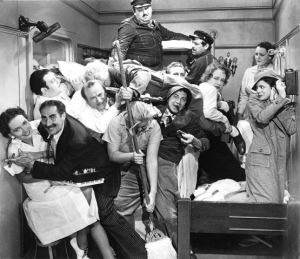
Otis B. Driftwood (Groucho Marx): What have we got for dinner?
Ship Steward: Anything you like, sir. You might have some tomato juice, orange juice, grape juice, pineapple juice…
Driftwood: Hey – turn off the juice before I get electrocuted. All right, let me have one of each. And, uh, two fried eggs, two poached eggs, two scrambled eggs, and two medium-boiled eggs.
Fiorello (Chico Marx) (requested through the door): And two hard-boiled eggs.
Driftwood: And two hard-boiled eggs.
Tomasso (Harpo Marx) (signaling another egg order with his horn honk): HONK!
Driftwood: Make that three hard-boiled eggs…and, uh, some roast beef: rare, medium, well-done, and overdone.
Fiorello (repeating his order): And two hard-boiled eggs.
Driftwood: And two hard-boiled eggs.
Tomasso: HONK (signaling an amended order)!
Driftwood: Make that three hard-boiled eggs….and, uh, eight pieces of French pastry.
Fiorello (repeating his order): And two hard-boiled eggs.
Driftwood: And two hard-boiled eggs.
Tomasso: HONK!
Driftwood: Make that three hard-boiled eggs.
Tomasso: HONK! (a shorter honk)
Driftwood: And one duck egg. Uh, have you got any stewed prunes?
Steward: Yes, sir.
Driftwood: Well, give 'em some black coffee, that'll sober 'em up!
(From Night at the Opera’s famous stateroom scene, 1935, MGM Studios)
You could say it’s a tradition for Jews to discuss, ad nauseum, “Where should we eat?” When Judy went with me for a Sunday morning MRI at Henry Ford Hospital to see if my acoustic neuroma on the left side of my brain was still 4 millimeters, I was more excited by the breakfast to follow. We had often gone together to have an omelette at the Henry Ford Cafeteria, which features choices of organic vegetables and cheese, all cooked right there in front of us, with whole grain toast, for $2.99.
We got to the cafeteria at 9:30 and found out they had closed the chef’s stations for Sunday mornings. What a disappointment!
So, where would we go for breakfast? Gest Omelettes? The Senate? Siegel’s Deli? Hercules? Leo’s? Panera? It took us five minutes of driving and then Judy said, let’s go to Seros. She likes the skillet and I like the lox platter and the omelette. Why not? We hadn’t been there since Aunt Sylvia, Al, Sharon, Mel, and Alan were in town.
I ordered the spinach and cheese omelette and Judy ordered the skillet. I had to drink a lot of water after the MRI to get the dye out of my veins but I needed some coffee also. We ordered and then my cousins, Maureen and Leon, walked in the door with another couple. A few minutes later, right after the coffee was served, my parents walked in the door and said they were meaning to call us but wasn’t this nice? What a surprise!
They sat at our table and we shmoozed about the MRI, the movie they saw yesterday that they wanted us to see, Have a Little Faith, Facebook, colonoscopies, my parents’ health, Judy’s sore shoulder, my cold that was getting better, their favorite Seros waitress, salami and eggs, the coffee, and A Serious Man, the movie they saw, featuring lots of trouble, rabbis, Yiddish, and a man who makes Larry David look like a Jew of infinite blessings.
Then, another family strolled in and sat at the table next to us and said to my mom, “Are you a Strasberger?” Well, we’re related, she said, and we found out that it was the mother of Jaymie who married Sean Strasberger, my mom’s great nephew, a few months ago. The mom and her sister, aunts, and then the grandfather, and then the uncle and soon, Jaymie arrived.
This Sunday at Seros reminded me of the stateroom scene from the Marx Brothers’ Night at the Opera in which Groucho orders some food in his stateroom and then Chico and Harpo follow and then one ship employee after another after another enter the crowded room on the ship until there is complete pandemonium and thirteen people are squeezed into a small, stuffed stateroom.
We wondered, who else was going to arrive, some more cousins, maybe friends, maybe my aunt Lil? Anything was possible.
Seros is the restaurant that we joke about concerning the average age of the customer, which I would guess is usually about 73. If AARP wanted to do a publicity event in Michigan, Seros would be the place. Seros features lots of eggs, anyway you want them, poached, fried, hard-boiled, medium-boiled, and bagels, lox, and coffee. It also offers a scene filled with many “old cockers,” as we would say in the old country, and that I mean the north side of Livonia, circa 1972.
If I were to write a sentimental book about senior citizens’ thoughts about death and living, the title might be, Sundays at Seros. Yeah, it might not sell millions of copies like Mitch Albom’s Tuesdays with Morrie, but if I included color photos of all the food options and some candid mishegoss-filled quotes from its patrons, it might just be a best seller anyway.

“I beg your pardon/I never promised you a rose garden/Along with the sunshine/There's gotta be a little rain some time/
When you take you gotta give so live and let live/So smile for a while and let's be jolly/Love shouldn't be so melancholy/Come along and share the good times while we can" From Rose Garden, lyrics by Joe South, sung by Lynn Anderson
Waltz with Bashir is a haunting and deeply troubling film about memory and war. The Israeli artist, Ari Folman, wrote and directed the movie which is an attempt to make sense of his nightmare dreams and what he had forgotten about his role in the 1982 Israeli-Lebanese war and massacre of Palestinian civilians by the Christian Phalangist militia as payback for the murder of their leader, Bashir. When I watched the DVD, almost all of it a hallucinatory memory-excursion done as a cartoon, I was struck by the loss of his memory. Ari was able to completely suppress the horrors that he witnessed from his consciousness.
Like Ari, I can barely remember that much besides a handful of memories, some photos and one Beta video tape of my brother, Kenny, who died in 1982, and I remember even less of my Aunt Shirley from California, who died almost 3 years earlier on October 18, 1979.
One of her two sons, Or-Li, wrote that he normally panics around the anniversary of her death, unable to “stop the flood of horrific memories,” but decided this year, on the 30th anniversary of her death, to instead recall “good memories of the real person my mother was.”
Thanks to Or-Li, I have been playing the images he remembers in my head. His memories include her repainting a wooden picnic table and “how she would polish the glass tops of the coffee tables in the living room while she listened to the soundtrack of West Side Story.” She loved musicals, he wrote, like Applause, which she saw in London with Lauren Bacall, “a very glamorous movie star.” She took her other son, Alan, my sister, Leslie (who just turned 50), and Or-Li to the movie, Jesus Christ Superstar, on a new big screen theatre. “It was magnificent!” Or-Li wrote.
Shirley introduced Or-Li to Shaw’s Pygmalion and Agatha Christie’s The Mousetrap, and took him to see Shakespeare’s birthplace in Stratford-upon-Avon. She was a contestant on the T.V. game show, “Split Second,” a vague memory of mine as well. She loved their antique player piano, “pumping the pedals to play the music rolls and singing along with them.” She loved books; she was nice to her parents-in-law and to our Zadeh Nuchum, who lived with Shirley’s family for awhile.
One day, she kicked Alan’s portable record player and broke her toe, which she laughed about for years. And when her family moved to Tellem Drive, a large group of ladies, former neighbors from Grenola Street, brought housewarming gifts to surprise her. She played Clobyosh and Pinochle and ate corned beef sandwiches at Zucky’s Deli in Santa Monica and loved to eat hamburgers, fries, and Coke at her local Chinese restaurant, House of Lee.
Shirley painted the master bedroom in her new house pink while the ceiling and deep shag carpeting was pure white. The dial phone in the bed room was pink, even its long connecting cord. But according to Or-Li, Shirley loved red, bringing a big red thermos to the beach while packing food and beach towels in a red plaid bag. And her station wagon was red with wood paneling.
Or-Li wrote, “I remember how she or my dad made coffee in the mornings in a stove top percolator with a glass knob on top. I loved watching and hearing the coffee percolating. I still make coffee in a percolator with a glass knob on top.”
I can imagine my aunt, the baby of the Goldman family, my mom’s dear friend who helped her meet my dad, polishing the glass top coffee table in my daydreams, waiting for the coffee to percolate. I can imagine her listening to one of her favorite songs, “Rose Garden” by Lynn Anderson, and waltzing in her pink bedroom, holding her pink telephone, talking to my mom or her other sisters or brothers, laughing the way I remember her. I remember her laugh and her smile more than anything, her face a haunting memory that wakes me from a 30-year-sleep. I imagine her waltzing with the pink cord, singing along with Lynn: “I never promised you a rose garden. There’s gotta be a little rain sometime but smile for awhile and let’s be jolly. Love shouldn’t be so melancholy. Come along and share the good times while we can.”
So in this 30th year anniversary of Shirley’s passing from this life, we should try to not be melancholy and think about the good times we shared with her and the sunshine she gave. As Shirley would have said, she never promised her family and friends a rose garden. We felt the aching sting of heartbreak in October, 1979, and it’s taken 30 years for the pinpricks of pain to wear off a little.
I can imagine my aunt waltzing into my daydreams, singing, “When you take you gotta give so live and let live…”
The transformation Diana and Scott will face is the hardest one imaginable. They will need to have more than a little faith.
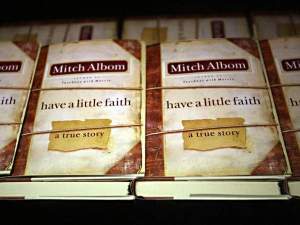
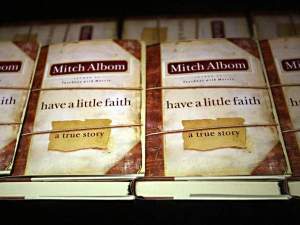
Mitch Albom’s new book, Have a Little Faith, is all about transformation. Mitch is transformed by his old rabbi’s request to do his eulogy. Henry Covington is transformed after his descent into the hell of drugs and crime by his faith in God and Jesus.
In his last days of physical life in which the pain increases as well as liquid morphine and methadone dosages, Noah Biorkman is excited by his new Transformer toys which he thinks are the “best EVER!” He is also transformed by his desire to be with his father, Scott, to have corndogs with him and to spend time with him. According to Diana, Noah was so excited to be with his dad that he asked her to give him an “extra dose of liquid morphine before he left so he could make it through.”
She writes that “when he’s awake, he talks non-stop” and walks in circles, just talking and circling, telling her he loves her “every five minutes.” They share “adult conversations that no five year old should ever have,” including what he wants to be buried with and who will get what after he dies. He decides that his Uncle Mark will get his urinals and which Diana can only react with “LOL!!”
Noah talked about Carson and says he’s waiting for him and wants to play and that he was sad that a girl he once knew “had her angel wings.” Diana wrote that the crazy thing was she “never told him that she had passed away.”
“The end is coming,” she writes, “and it’s coming fast.” It’s hard to watch, she says, knowing that there is “absolutely nothing you can do about it.” But like Rabbi Albert Lewis who believed absolutely in God and accepted that whatever happened to him was okay, Diana knows that, though it will be the “hardest thing I have ever done,” she will make it because Noah has made her strong and given her faith.
Noah’s mother knows her life will be transformed after Noah is gone, when the house is so quiet that she “wants to go crazy,” when she looks at his pictures, when she “finally opens the door to his room,” and when she “distributes the items that he has willed to certain people.” She is terrified of the finality of the transformation: “what I am going to do without him.”
I can only remember the absolute grief of my parents and the parents of Miles Levin. I imagine the grief of Rabbi Lewis and his wife when they lost their 4-year-old daughter, Rinah, and Henry Covington and his wife when their baby boy, Jerell, died.
The transformation Diana and Scott will face is the hardest one imaginable. They will need to have more than a little faith. They will need the ultimate faith that Noah is still out there somewhere, playing with his friends, covering them with his everlasting spirit.
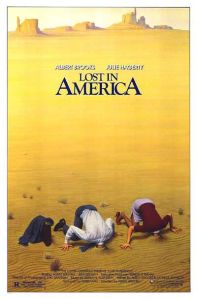
“I was on the road to nowhere. You know the road? It’s a nowhere road, it goes nowhere. You’re on it. You don’t know it. It’s a nowhere road. It just goes around in a circle.” Albert Brooks as David Howard, Lost in America, 1985, The Geffen Company
In the October 19th edition of Business Week, Peter Coy writes, “While unemployment is ravaging just about every part of the global workforce, the most enduring harm is being done to young people who can’t grab onto the first rung of the career ladder….In the U.S., the unemployment rate for 16-to24-year-olds has climbed to more than 18% from 13% a year ago. For people just starting their careers, the damage may be deep and long-lasting, potentially creating a kind of ‘lost generation.’”
When you look at Dictionary.com, the definitions of lost include “no longer to be found,” “having gone astray,” “bewildered,” “not used to good purpose,” “wasted,” “ending in defeat,” “preoccupied,” and “distraught; desperate; hopeless” as in “the lost look of a man trapped and afraid.”
That’s what is ravaging so many people today and especially young people who feel lost, trapped and afraid. When I think of lost, I can’t help but think of one of my favorite movies, Lost in America, in which David Howard (Albert Brooks), a successful advertising executive from LA gets a job disappointment and convinces his wife, Linda, that they should quit their jobs, liquidate their assets, and emulate the movie Easy Rider, spending the rest of their lives traveling around America…in a Winnebago!
Unlike so many today who don’t get to choose their career paths, Howard’s idealized, unrealistic plans soon begin to go wrong, as their “sacred nest egg” is squandered in Las Vegas and David begins to look for any job he can find, including being a crossing guard in a small town. It’s just another American dream gone to waste, lost.
For the youth of today, the American dream may already be a long lost wasted dream. “Are we condemning our children to downward mobility? Good question,” says economist Robert Samuelson (“Health Spending Condemns Youth to Future of Downward Mobility,” Robert J. Samuelson, IBD, October 14, 2009). “Considering how health spending could threaten future living standards, it ought to be center stage in the ‘reform’ debate. Instead,” he argues, “It’s ignored.”
What does Samuelson mean? He argues that rising health spending will grow far in excess of per capita GDP and consume most dollars earned by 2030. “Expanding health spending would raise taxes (to pay for government insurance), lower take-home pay (to pay for employer-provided insurance) or increase out-of-pocket medical costs.” Other drains loom as well, including higher energy prices, higher taxes, underfunded pensions, repairing aging infrastructure, and higher federal taxes to cover deficits and payments to retirees (much of it health spending). “The young’s future,” according to Samuelson, has been heavily mortgaged.”
He says the health debate has deemphasized controlling runaway spending, “much of which is ineffective.” “The chance to reorder the medical-industrial complex to restrain costs and improve care have been mostly squandered,” Samuelson states. “Some call this ‘reform’; no one should call this progress.”
“The road to downward mobility,” Robert Samuelson concludes, “is paved with good intentions.” We focus on insuring those who can’t get insured but forget what the impacts will be for our children and grandchildren, who may likely face a future of lost opportunities, as they swim in the darkness of huge costly burdens. It’s already bad for my generation to get a handle on the ever expanding health care, college, and insurance costs that are swallowing up almost everything we earn.
What’s it going to be like for our kids?
Luckily for Albert Brooks playing David Howard, he was able to come back to find another ad agency job that paid close to his magical $100,000 level. But the Reagan Mid-80s are long gone. Ad agencies are like the days from the TV show, Mad Men, a thing of the past, as are the days when one American generation lived better than the last. Now, you need to work on your computer and come up with new Google Ad Words and hope someone finds and pays for them on the Internet.
Maybe the upward mobility of dream jobs will be true for the youth of China but in the United States of America, the dreams of financial stability and success for the young may be nothing more than pipedreams.

Noah is now preparing for the day he can be an angel, playing with his friends, making sure his mother can live without him, and helping Brandon during the next baseball season.
In the bottom of the 9th inning in a historic one-game playoff against the Minnesota Twins, Brandon Inge made a diving stop of a sharp line drive off the bat of Orlando Cabrera and threw him out, possibly saving the game. In the 10th inning of the game which would determine the championship of the American League Central Division and a chance to play the New York Yankees in the MLB playoffs, Inge hit a double down the leftfield line, driving in Don Kelly and giving the Tigers a 5-4 lead and a chance to win the game. But after the Twins tied the game 5-5 in the 10th after both a poor play by Ryan Raburn and then a great throw by Ryan Raburn, Inge had another chance.
It was bases loaded with only one out and Brandon Inge was at the plate in the 12th inning. Like Tigers fans everywhere, I was rooting for a gland slam, a base hit, or just a walk. When a ball glanced against Brandon’s shirt, Inge began to walk to 1st base, thinking he was “hit by a pitch.” Even though the video replay showed the ball did hit his shirt and Brandon later said, “It hit my shirt–period,” the umpire disagreed and then Brandon hit a ground ball which turned into a fielder’s choice out at home plate. Then, Gerald Laird struck out and the Twins won the game in the bottom of the 12th inning.
"No matter what we did, it seems like it wasn't meant to be,” Inge said after the game (“Twins Complete Comeback, Beat Tigers in 12th, AP, Dave Campbell, Oct. 6, 2009). Yet, he admitted, “This is the best game, by far, that I've ever played in, no matter the outcome."
“After the devastating Tiger loss last night,” Diana Biorkman wrote, “I was restless and couldn’t sleep. Noah came and got me and told me it was time to snuggle. Then he asked me if the Tigers won. I told him that they lost and he said it was ok. I told him that Brandon was really upset on the news. He said that he was sad Brandon wasn’t happy and that he loves Brandon. I told him that Brandon loves him too and he smiled and told me that he knew that. I told him that they can go for it next year. He looked up at me in the dark and said that he was going to have fun watching Brandon from over his shoulder. I asked what he meant by that. He said that he’ll have his angel wings next year and will be able to watch over Brandon and his other friends. I told him that Brandon might need it. He told me that he already knew that which was why he was going to watch over him. He said that Brandon’s knees won’t hurt next year. He’ll be there to help.”
During the evening on the first night of the playoffs, TBS added a story filmed a few weeks ago about Brandon Inge, Noah, and some of the other critically ill children that Brandon has helped to smile. You can click on the seven minute video which is both touching and inspiring: http://mlb.mlb.com/media/video.jsp?content_id=7018401
Brandon Inge might have been sad about the loss but he knows which losses are most important. Losing a baseball game is no comparison to losing a child. On the same day as the Tigers game against the Twins, Noah’s friend, Carson, was buried. Diana didn’t tell Noah about it until the day of the funeral as she was wrestling whether to go to the funeral. When she asked Noah about it, he asked if Carson got his angel wings. Yes, his mom said, God gave him the wings and then, according to Diana, Noah “smiled and told me that I didn’t have to go to the funeral because Carson was watching over him right then. He asked me if I could feel him in the room. I told him that I couldn’t and he said that it was ok. He smiled again and said, ‘Mom—Carson’s waiting for me. He doesn’t have cancer anymore and wants to play.’”
When she asked if Carson’s mom should come to his funeral, he asked, “When I die soon?” She said yes and he said, “Mom—I’ll be dead so I don’t care if she comes or not.”
Noah is now preparing for the day he can be an angel, playing with his friends, making sure his mother can live without him, and helping Brandon during the next baseball season.
“Everyone wants to know where my strength comes from,” Diana wrote. “That’s an easy answer for me. It comes from Noah. If he can handle the dying process this well, then I can suck it up and help him through it without being a blubbering mess. He deserves that. He makes it easier. He makes it bearable.”
“And the world will be better for this/ That one man, scorned and covered with scars/ Still strove with his last ounce of courage/ To reach the unreachable star. “The Impossible Dream” from Man of La Mancha, Music by Mitch Leigh and lyrics by Joe Darion
I must have been stuck in a daydream on the last day of September. As I often do when things don’t go my way, I got flustered and frustrated when I couldn’t focus, jumping from one thing to another at work. When I learned on an email from my health insurance provider, Aetna, that blood tests taken at Henry Ford Hospital were out of network and not covered, I nearly lost my mind and called my insurance rep to help.
I was more focused on the last day of September being the last day of our company’s fiscal year, a day to ship out everything we could and collect every past due invoice possible. I forgot that September was also Pediatric Cancer Awareness Month until I got an email update about Noah’s “serious decline.” Diana, his mother, wrote that Noah became almost unconscious as his methadone was increased because of the severe pain in his right leg and foot. Steroids were increased to three times a day and Noah’s doctors started giving him liquid morphine as well. “This has been ridiculously difficult to watch,” she admitted. “Last week, he was up and walking and talking everyone’s ear off. This week, he can’t hardly get out of bed.”
Noah’s hospital, C.S. Mott, was the setting for more heartbreak in the last few weeks: Shauni, a fellow Neuroblastoma child with Noah, died two weeks ago and Alissa, a 9-year-old with a brain tumor, passed away last week. And Carson, another Neuroblastoma patient, “is declining at a more rapid pace than Noah,” according to Diana. She wrote, “Can anyone ever truly prepare you for the loss of your child?”
Who can be prepared for the worst, especially if we live our lives, hoping for impossible dreams?
I was skeptical of hopeful fantasy after reading the news about Noah and his fellow kids with cancer. Then, I read about the Michigan legislature once again ready to shut down because they couldn’t agree on a budget. How do I stay positive after reading about the demise of GM’s Saturn brand and the loss of more jobs? How do we stay hopeful in the midst of trillions of dollars wasted by the federal government while 500,000 people a month lose jobs?
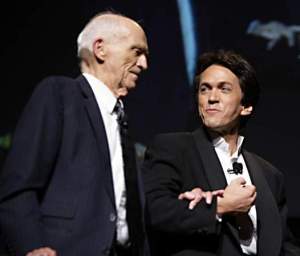
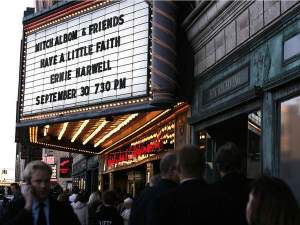
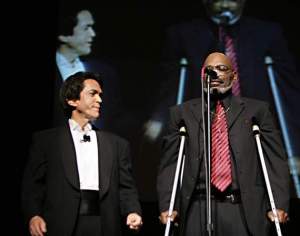
“Have a little faith,” Ken Brown told us while introducing his partner in radio, Mitch Albom, later that evening. Judy and I were fortunate to get tickets for the charity book-signing at Detroit’s Fox Theatre, introducing Mitch Albom’s latest book, Have a Little Faith. During the hours before, I was frustrated, sad, angry, and had very little hope for anything. Then, Mitch Albom walked up to the mike with one-legged Anthony “Brother Cass” Castelow, and his daughter, Myracle. Cass told us in a soft voice, when he was a petty thief and homeless, he was given a home and fed by Henry Covington, also a former drug user and thief, and how his life completely changed since then. My troubles earlier in the day seemed to disappear and became unimportant.
Judy and I went with friends Tony and Holli to get a signed copy of Mitch’s book, hear Ernie Harwell and other guests, listen to Anita Baker, laugh with Dave Barry, and contribute to some worthy causes as well. We got backstage passes which allowed us to get a few appetizers, a goody bag with a signed book and two Anita Baker CDs, and allowed Tony to walk up to Dave Barry and tell him, “I am a big fan and have read most of your books” to which Dave quipped, “I have written most of my books.” Quicker than a speeding punch-line, I thought.
After we got to our seats, we heard Ken Brown and then Cass Castelow followed by Mitch asking Pastor Henry Covington and Rabbi Harold Loss of Temple Israel questions about faith. Have a Little Faith is a book about Mitch being asked to give the eulogy for his childhood rabbi as well as the story of a former drug dealer and convict who “preaches to the poor and homeless in a decaying church with a hole in its roof.” As the book jacket describes, “Albom observes how these very different men employ faith similarly in fighting for survival: the older, suburban rabbi embracing it as death approaches; the younger, inner-city pastor relying on it to keep himself and his church afloat.”
Another man of faith took the stage and received a thunderous standing ovation. Former Detroit Tigers radio broadcaster 91-year-old Ernie Harwell, now with inoperable cancer, told stories about his early days. He mentioned Jackie Robinson stealing home for the first time and his favorite all-time moment in Game 7 of the 1968 World Series in which the Tigers finally scored and beat Bob Gibson and the St. Louis Cardinals. He also talked about his faith, his love for his “Appalachian American” wife, Lulu, and his appreciation of his long life. “I don’t know how many days I’ve got left, but let me say this,” he said in his unforgettable tremulous voice which we heard for most of our lives, “I praise God because he’s given me this time.”
The lights came on so Ernie could see just some of the thousands of Detroiters who loved him. As Ernie spoke, I looked at my cell phone to see that Detroit took a critical lead in the battle against Minnesota, 4-2 and then 7-2. I could picture Ernie calling the game but when Ernie said, “I can really know…whose arms I’m going to end up in, and what a great, great thing heaven is going to be,” Mitch Albom wrote, “a shiver spread from my chest to my fingers” (“Ernie’s words still make a night magic,” Mitch Albom, Detroit Free Press, October 4, 2009). “It is one thing to read about belief, but it is another to witness it in the face of death, spoken in a calm, serene voice….when delivered that way, how can faith not be a beautiful thing?”
How does anyone follow the most loved man in Michigan? You don’t, which sportscaster Bernie Smilovitz who subbed for Joe Dumars, admitted, wondering why Nelson Mandela wasn’t called instead of Bernie. Yet, he was a breath of humorous air, as both Mitch and Bernie told about their love of Detroiters. They also told stories about Bernie’s parents, both Holocaust survivors, and how humor has helped them survive. We could imagine Bernie’s mother with her thick eastern European Yiddish accent criticizing a restaurant’s food, saying it was worse than in Auschwitz. Oy vey. Don Rickles would have been proud of her.
Another example of someone who personifies faith is singer Kem, once homeless, drug-addicted, and destitute, who has been clean for 19 years. A complete unknown, he self-financed his first album in 2003, “Kemistry,” which became certified Gold. After Kem sang a song and talked to Mitch, Mitch’s friend and comic author, Dave Barry, was brought out for some more laughs and talk about their band, the Rock Bottom Remainders, and the night that Bruce Springsteen joined them onstage and told them if they’d get any better, they would just be “another lousy band.” After they played with the help of the “I am my Brother’s Keeper” choir from Henry’s Pilgrim Church, Anita Baker closed the night by singing an unbelievably breathtaking, no-instruments-no-back-up-singers rendition of “The Impossible Dream” from the Man of La Mancha.
The Tigers had just won the game and were one or two wins away from winning the American League Central Division. This turned out to be one great night, the night that brought a full house and raised money for S.A.Y. Detroit, A Hole in the Roof Foundation, I Am My Brother’s Keeper Ministries, and the Jewish Federation of Metro Detroit’s Jewish Assistance Project (more info for all on www.mitchalbom.com). It turned out to be one of the most moving, funny, and inspiring nights I have ever witnessed.
After listening to the amazing journeys that Henry and Cass went through from homelessness to sacredness, it’s hard to see the homeless of downtown Detroit the same way again when walking from the Leland Hotel to Comerica Park or Ford Field. Mitch, Henry, and Cass mentioned how everyone is perilously close, especially in a struggling economy, to becoming a man without shelter, lost on the streets. It is our obligation to look at everyone as one of God’s children, all worthy of respect, and kindness.
The next day before work, I read on the 1st page of the USA Today that regulators have found high concentrations of acrolein, a chemical once used in weapons that is a byproduct of burning gasoline, wood, and cigarettes, outside 15 tested schools around the country (“EPA finds toxin in air outside 15 schools,” Blake Morrison and Brad Heath, USA today, October 1, 2009). Although the average school has levels at least 100 times higher than what the government considers safe for long-term exposure, the worst school was Spain Elementary School in Detroit.
After the Time cover story about The Tragedy of Detroit this week (“Detroit—The Death—And Possible Life—of a Great City,” Daniel Okrent, Time, Sept. 24, 2009) which mentions that Detroit’s unemployment rate is 29% compared to New Orleans’ 11%, it’s hard not to feel “unbearable sorrow” about the city of my birth. After reading about the toxic chemicals outside Detroit and other cities’ school children and knowing that a five-year-old son of a friend is in agony, soon to lose his life, all I felt like doing was to “right the unrightable wrong.”
It’s wonderful to lose oneself in a daydream, imagining Brandon Inge hitting a walk-off home run in the bottom of the 9th in the World Series, leading Detroit to an incredible upset win, while his biggest fan, Noah Biorkman, watches on TV, miraculously healed, the tumors all gone from his body. It is great to imagine the Motor City returning to greatness and the unemployment rate cut in half. But we can’t live on impossible dreams.
When Anita Baker sang, “To be willing to march into Hell for a heavenly cause,” I realized that what I normally worry about and think is important is really nothing and that what’s important is “to bear” the awful truths “with unbearable sorrow, to run where the brave dare not go.”
We don’t need miracles. We just need to care about the strangers we don’t know. We need to give and help charities that are dedicated to making the world better. When Mitch Albom gave a plaque to Ernie Harwell, dedicated to the new Ernie Harwell Playroom at the S.A.Y. Detroit Family Clinic, how could you not feel overwhelmed and wanting to help? When he displayed photos of the first-ever free medical clinic solely for homeless children and their mothers which included all of Ernie’s sports memorabilia which he donated, how could you not feel grateful?
“This is my quest,” Joe Darion wrote for Don Quixote, “To follow that star, No matter how hopeless, No matter how far.” The stars aren’t that far away now. We can just take a few moments and give our time and money to help the homeless and the needy and the young children who, sadly, soon “will lie peaceful and calm.”
It is not impossible and it is not a dream. “The world will be better for this that one man, scorned and covered with scars, still strove with his last ounce of courage to reach the unreachable star.” With the help of life-givers such as Mitch Albom and Henry Covington and Rabbi Loss and Ernie Harwell, we can still reach out to the unreachable stars.
After lowering our arms down to our sides, we should not turn away from those who need us. When someone is reaching out to us with his outstretched hands, all we have to do is give a little help.
It takes one little mitzvah to make a big difference.
Even though the cancer has spread throughout Noah’s body and he is on methadone and twice-a-day steroids to lower the pain, his courage and joy and exuberance and perseverance are miracles to witness.
September is Pediatric Cancer Awareness Month. If you click on the C.S. Mott Children’s Hospital website (www.mottchildrenshospital.org), you can’t help but read that “Cancer is the leading cause of death by disease among U.S. children between infancy and age 15.” Approximately 11,000 new cases of pediatric cancer each year are expected to be diagnosed in children 0-14 years of age.
Noah Scott Biorkman, a patient at Mott Children’s Hospital, was diagnosed with Stage IV Neuroblastoma in February 2007. According to the National Cancer Institute, “Neuroblastoma is a form of cancer that starts in certain types of nerve cells found in a developing embryo or fetus. This type of cancer occurs in infants and young children. It is most often found during the first year of life.”
Noah was 2 ½ years of age in February 2007 when the neuroblastoma was first detected, only after x-rays taken when he complained of pain in his legs. After an aggressive regimen of chemotherapy, Noah went into remission in August 2007 but in September 2008, Noah relapsed with lesions in his right arm and right leg.
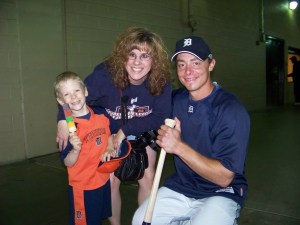
Noah has spent as much time at C.S. Mott Hospital at the University of Michigan as he has at home. On June 4th, during an autograph session at the hospital, Brandon Inge, 3rd baseman for the Detroit Tigers, signed a picture for Noah and that night, Noah saw Brandon on TV during a Tigers game and became an instant fan. Noah watched every Tigers game after that and one day after his fifth birthday, during a fundraising for Mott Children’s Hospital, Brandon gave him a signed ball.
“Then came the pain,” Noah’s mother wrote on her www.carepages.com website, “the bad scans, and the realization that Noah wasn’t going to make it.” Diana Biorkman admitted, “I asked him what he would like to do. His answer was to see Brandon again and ask him to hit a home run for him. I asked if there was anything else and he said that he would like to go to another game.”
The hospital contacted Brandon’s wife, Shani, to tell her that Noah’s health was “rapidly deteriorating” and of Noah’s wish. When Brandon was told about Noah, he wanted to come and see him and a few hours before a Tigers home game, Brandon and Shani Inge stayed at the Biorkmans’ house for over two hours.
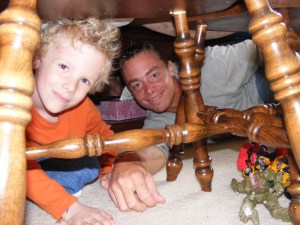
“After Noah showed Brandon his room and his basement full of toys, they played,” Diana wrote. “Brandon signed a jersey for Noah and they exchanged friendship bracelets that Brandon is still wearing. Then, they built a pillow fort with every pillow in my house. Brandon sat in one end and Noah sat in the other. They hung out together, just the two of them” and Noah offered to share his superhero tattoos with Brandon and Shani’s two kids.
That night, Brandon hit a home run during his first at-bat. Noah’s mom wrote, “Noah jumped up and down and yelled—He did it for me! He did it for me! Then he heard his name and he gave the look of wonder and turned to my mom and said, ‘I never thought I would hear my name on TV.’”
In the moments after he homered, Brandon Inge broke down into tears in the Tigers dugout. “I lost it,” Brandon said. “I was crying. That’s never happened to me during a game before.” (“Tigers’ Brandon Inge gets emotional after HR,” John Lowe , Detroit Free Press, August 30, 2009) Lowe wrote that Inge’s 25th homer of the season and 121st of his career “seemed to have ascended near the top of his all-time list because of Noah.”
The home run hit for Noah was not the first hit for an ailing child this year. On June 23, Inge visited Tommy Schomaker while he was recovering from heart-transplant surgery and that night, with “Tommy” written with a black marker on Inge’s arm, he hit a home run. “I got out of bed and jumped up and down,” Tommy said. (“Tigers’ Inge develops bond with pediatric patients,” Associated Press, September 2, 2009) “Disney couldn’t have written a better script,” Tommy’s father admitted. According to Mike Schomaker, “Kids were coming into the room with IVs, ‘Tommy, did you see your name? You’re on TV! You’re on TV!’ Then in the seventh inning, down 2-1 with one man on, Brandon hit a home run.”
Brandon Inge has made more wishes and brought more joy to kids than he can imagine although he admitted, “My wife and I don’t do any of this for the publicity.” Because of the time and money that the Inges gave to help fund a $750 million, 1.1 million square-foot hospital for women and children, the hospital at the University of Michigan proclaimed September 2nd “Brandon and Shani Inge Day.”
After the memorable home runs, Noah’s wishes continued to come true. He went to a few Tigers games, visited the Tigers clubhouse, gave 45 friendship bracelets to the entire Detroit baseball team, had his name announced on TV, was given the signed home run ball by Brandon, was featured with his mom and dad on ESPN, had a helicopter ride over Comerica Park before a game, spent more time at his home with Brandon and Shani, and was baptized a week before the golf outing in his honor.
Even though the cancer has spread throughout Noah’s body and he is on methadone and twice-a-day steroids to lower the pain, his courage and joy and exuberance and perseverance are miracles to witness.
Noah survived to make his Make-A-Wish golf outing on September 18th in Northville, Michigan. Although Brandon was in Minnesota with the Tigers that day, his wife, Shani, golfed with 103 others, all there to raise money for the Noah Scott Biorkman Foundation and Make-A-Wish. Raffled prizes included a Chris Osgood playoff hockey stick, signed jerseys from Miguel Cabrera and Brandon Inge, and the 2009 All Star bats signed and donated by Detroit Tigers All Stars, Curtis Granderson and Brandon Inge.
Diana said at the golf outing that Noah understands his body is sick and that he will die and “become an angel.” Yet, she and her family know what a gift that they have been given and what a miraculous life Noah has led.
Because of heroes like the Inges, the doctors, nurses, and aids at Mott Hospital, because of the courage of Noah’s parents and family and the support of friends, the tragedy of a little boy struck with terminal cancer has become an incredible lesson about giving and love and making wishes come true.
We don’t have to wait for the end of a boy’s life to know that angels are everywhere.

You may not like paying for banks and their million-dollar executives and mortgage companies and car companies and more health insurance. But how do you feel about us United States taxpayers paying for anti-Semitic and anti-Israeli textbooks and giving our dollars to members of Hamas so they can buy bombs and rockets to destroy our brothers and sisters in Israel? Can you define the word, “absurd”?
In this time of rising unemployment, escalating health care costs, and record deficits, it would be nice to know where our dwindling taxpayer dollars are going. Did you know that you, the U.S. taxpayer, helped contribute to $148 million last year and over $3.4 billion over the last 59 years to the United Nations Relief and Works Agency (UNRWA)?
Who is UNRWA and why should we care? Founded in 1949 as a temporary relief agency for Palestinian refugees, it has become the only agency dedicated to one group of refugees and is dedicated to serve all descendants, including grandchildren and great grandchildren, of the original 900,000 refugees in 1950. UNRWA serves Palestinian refugees in Jordan, Syria, Lebanon, the West Bank, and Gaza with its 24,000 estimated employees, four times as many as the UNHCR (U.N. High Commissioner for Refugees,) the agency dedicated to caring for 11.4 million refugees around the world.
How, you might wonder, do we know if UNRWA serves Hamas, the terrorist organization that intentionally kills Israeli citizens to achieve its announced goal of destroying the state of Israel? Peter Hansen, commission-general of UNRWA in 2004, told the Canadian Broadcasting Corp., "I am sure that there are Hamas members on the UNRWA payroll, and I don’t see that as a crime." According to Congressman Steven Rothman of New Jersey, UNRWA has employed among others Said Sayyam, Hamas Minister of Interior and Civil Affairs, Awad al-Qiq, “who led Islamic Jihad’s engineering unit that built bombs and Qassam rockets,” and Nidal Abd al-Fattah Abdallah Nazzai, “who confessed in 2002 to transporting weapons and explosives to terrorists in an UNRWA ambulance.” Likewise, schools administered by UNRWA have produced several graduates affiliated with terrorism, including Hamas Prime Minister Ismail Haniyeh, and former Hamas chief, Abd al-Azis Rantisi.
Lanny Davis, special counsel to President Bill Clinton from 1996-1998, writes, “There is indisputable evidence that anti-Semitic and anti-Israel textbooks are being used in UNRWA-sponsored schools — including texts that contain negative references to Jews and omit entirely the state of Israel from maps.” (“Time for transparence and accountability for UNRWA,” Lanny Davis, The Hill, 09/09/09)
It would be nice to know what our tax dollars to this Palestinian organization are funding but financial accountability by UNRWA is negligible. According to the UNRWA Report of the Board of Auditors for the biennium ended Dec. 31, 2005, “UNRWA does not track recording, deleting, renaming or manipulation of financial information by staff members or volunteers, and therefore has no means of detecting the alteration of financial data or other types of redirection of UNRWA funding.”
If you would like to make a difference, tell your congressman to support House Concurrent Resolution 29, sponsored by Rothman and 31 other Democratic and Republican cosponsors. Resolution 29, which in January was referred to the House Committee on Foreign Affairs, expresses “the sense of Congress that the United Nations should take immediate steps to improve the transparency and accountability of the UNRWA in the Near East to ensure that it is not providing funding, employment, or other support to terrorists.”
Resolution 29, which has been stalled since January, “strongly urges the Secretary of State to take all necessary measures to certify that United Nations Relief and Works Agency for Palestinian Refugees (UNRWA) operated in full compliance with section 301(c) of the Foreign Assistance Ace and therefore, no American taxpayer dollars are being directed to terrorists or to further terrorist propaganda.”
It’s easy to get angry about us taxpayers bailing out AIG and Fannie Mae and Chrysler and Citibank. It’s worrisome to many of us frustrated by economic stimulus packages and proposed health insurance legislation which will further put us in the hole. We are already borrowing from China and other countries to pay for our mounting debts. You may not like paying for banks and their million-dollar executives and mortgage companies and car companies and more health insurance. But how do you feel about us United States taxpayers paying for anti-Semitic and anti-Israeli textbooks and giving our dollars to members of Hamas so they can buy bombs and rockets to destroy our brothers and sisters in Israel? Can you define the word, “absurd”?
I think we could all agree with the basic premise of House Resolution 29 which states that “United States taxpayer dollars should never be used for purposes of supporting terrorist cells or activities that support terror or promote a culture of hatred at any of its locations.”
Tell your representative to take a few minutes away from health insurance debates and turn his or her attention to terrorism again. We must refuse any longer to pay for the destruction of Israel. In this time of the New Year and the high holidays, it’s the least we can do.

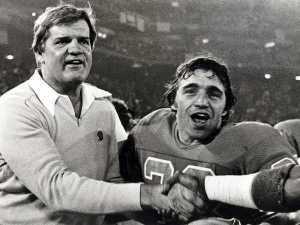
Goodbye, Monte. I can't forget that you were the Lions coach for the last three years of Kenny's life. We both put our hope and faith in you leading our football team to victorious glory. But in over 50 years of my life, after Bobby Layne, no one has been able to break the Lions curse. No Lion coach in five decades has ever found another head coaching job after leaving the Lions. Monte, you tried, and came as close as anyone to making our day but you were robbed by a simple missed field goal on the last day of 1983.
When I read that Monte Clark died, I thought of the song, “Another One Bites the Dust,” once used by the Detroit Lions as their theme song. Monte had been a right tackle for Dallas and Cleveland during his playing career and a line coach for the undefeated Miami Dolphins of 1972. When he accepted the coaching job for the Detroit Lions in 1978, he quipped, “I don’t have all the answers. If I did, I’d be a cab driver.” (Monte Clark: 1937-2009: “‘Thank God’ for him,” Detroit Free Press, Sept. 18, 2009)
I remember at age 21, being hopeful when Clark was hired, especially after he improved the team to a 7-9 record his first year. But then, the team slid to 2-14 and it wasn’t until running back Billy Sims and kicker Eddie Murray were drafted in 1980 that hope was reignited. I lost interest in football after the 1982 Super Bowl in Detroit in which I had tickets. My brother, Kenny, and I went to the game but scalped the tickets for $100 each right before it started, after sitting in a long line of cars on the snow-covered slippery Opdyke Road outside the Silverdome. A devout Lions fan, I really didn’t care that the San Francisco 49ers won their first Super Bowl over Cincinnati. I only cared because I gave up the tickets to the only Super Bowl that my brother and I could ever attend.
After Kenny died on the way home from a Detroit Tigers’ game in the summer of ’82, I cared less about the Lions but they made the playoffs anyway that year in a strike-shortened season. The next year, after the Lions started by winning one game and losing four, Coach Clark said to reporters, “See you at the cemetery.” Instead of the cemetery, the Lions actually got hot and won the next 8 out of 11 games, winning the division with a 9-7 record and making the playoffs, ready to face the San Francisco 49ers on a New Year’s Eve game on the last day of 1983.
I didn’t think much about the playoffs as I was ready to leave on a trip during Christmas week to Las Vegas with my friend, Rob, and his wife, Kim, his sister, Janet, and their Uncle Jack, who loved gambling. I was surprised that Kim would let me go with them since I had rented a basement room from them in their Oak Park house after they married in the summer of 1979. Rob spent a little more time with me than his newlywed wife after they married, both of us coming home from work to drink no-name beer, watch sports on TV, and play softball with our other guy friends. After it was strongly suggested I move to my own place and let them resume being a newlywed couple after all, I didn’t see Rob and Kim that often. But Kim forgave me enough to let me go on a trip with them three years later.
I hadn’t been to Vegas since the NLSA convention a week before Kenny’s death. But I needed to live and have fun and was happy to do something frivolous with my old friends. So we took off and visited Vegas and laughed and gambled for a couple of days, ready to leave on Thursday before the New Year. We went to the airport and packed our bags, ready to leave for Detroit. We packed our luggage, the plane was delayed, and so we waited at the airport and realized that we could fly one way to LA for $29. Maybe we could stay with Kim’s Uncle Buzzy, we thought, and then drive to San Francisco to catch the game on New Year’s Eve. We wondered what it would be like to make the Detroit Lions playoff game. Seeing the Lions on TV was rare enough but actually going to a Detroit Lions playoff game, with the team that won the Super Bowl just two years earlier: Priceless.
Uncle Jack took the next plane but Rob called his parents to pick up our luggage and we flew to LA. and rented a car. When we got there, we had no clothes so we went to a store and bought two day’s worth of shirts, pants, and underwear. Rob and I both bought the special LA underwear with horizontal flaps, the first and last time we ever saw such a product. After a night at Uncle Buzzy’s, we drove all the way up the coast, not on the scenic highway, to San Francisco and checked into a hotel not far from Candlestick Park. We walked around downtown and ended up at a small restaurant in Chinatown that had no customers. I ordered something I never ate in my life, abalone, which is supposedly some kind of sea delicacy. For me, it was the worst Chinese food I ever ate in my life and I have never ordered it again in 25 years.
The next day, we went to a store near the hotel and bought some paint and brushes and put the bed sheet on the floor and started painting the caption that was obvious to us. We colored in the lines and painted the huge headline on the bed sheet based on Clint Eastwood in Sudden Impact: “GO AHEAD, LIONS, MAKE OUR DAY!!”
We took a bus to Candlestick Park a half hour before the game, hoping to find some tickets. Rob’s brother, David, met us at the game with his girlfriend and we were lucky to find, only a few minutes before the game, six scalped tickets on the upper deck’s sixth row right on the 50 yard line for the actual ticket prices. Excited, we walked around the stadium with our huge bed sheet and were accosted by three motorcycle-jacket-wearing men who started tugging on the bed sheet. We thought: do we want to give up the sheet or act like Clint Eastwood and tell them, “Go ahead, punks, make our day.” It was an easy choice for two Jewish guys from the suburbs: the sheet slipped right out of our slippery hands.
We were just smart enough not to be on the San Francisco news and went to our seats instead. It was a perfectly sunny beautiful day and the guy sitting next to us who had lived in San Francisco his whole life said he had always been a Lions fan since he had rooted for Bobby Layne in the ‘50s. Wow, we thought, it had to be a one-in-a-million chance to find a San Francisco man rooting for the Lions.
The guy next door was more optimistic about out chances in the game than we were, especially after quarterback Gary Danielson’s 5 interceptions. But Billy Sims got hot in the 4th quarter, rushing for two Lions touchdowns and quieting the crowd and we took a 23-17 lead with seven minutes to go in the game. Rob and I looked at each other, thinking, is it possible for the Lions to win today? Joe Montana led the 49ers to a touchdown to take a one-point lead with a couple minutes to go. Yet, the Lions weren’t done and drove down the field, all the way to the San Francisco 26 yard line. We were confident in our field goal kicker, Eddie Murray, but scared to death because of Lions history. The man next to us said if Murray made the field goal, we should be silent because San Francisco fans could get really mean.
I was hoping that this field goal wasn’t going to be as disappointing as the one on November 8, 1970. I could never forget as a 13-year-old, when Tom Dempsey of the New Orleans Saints, missing a right hand, and with only half a right foot, lined up to try a 63-yard field goal. Alex Karras stood there, laughing on the defensive line, as the football sailed a record-breaking 63 yards to beat the Lions. Up to that point in my 13-year-old life, the Dempsey field goal was one of the lowest moments in my short, sports-obsessed life.
On the day before the 1984 New Year, the crowd cheered the SF defense and Rob, the guy next to us, and I prayed for mercy for Detroit, just one 43-yard kick, that’s all we wanted. Please God, just help Eddie make one little field goal. I could have asked myself another Clint Eastwood quote, “Do I feel lucky? Now, do ya, punk?”
The ball was snapped and Murray kicked it far enough but it started to push right and looked like it might come back right inside the right post. But the kick went a little to the right and the San Francisco crowd went crazy. Lions’ fans were unlucky again and I was so upset I felt like crying as the noise of the crowd seared my insides. Greg Eno summed it up on his blogspot.com website, “What sealed it for me was the now infamous camera shot of coach Clark on the sidelines, hands clasped together in prayer, face looking skyward. As soon as I saw that image, I said a four-letter word that is another way of intimating you have to use the little boys’ room—sitting down. I guess the Lions’ history of ineptitude ingrained in me the Pavlovian reaction of assuming the worst when someone from the Lions hopes—or prays—for the best.” (“Out of Bounds: Murray’s Leg Betrayed Lions at the Worst Time,” www.gregeno.blogspot.com)
Another one bites the dust, another Lions’ loss. After the game, we took a bus to the airport and took a $69 flight to Vegas and went to the Tropicana, then slept in the Vegas airport, awaiting a standby flight which was an extension of our original return flight several days earlier. Tired and bummed out after the Lions loss, we gambled a little but our hearts weren't in the New Year yet. How sweet the New Year would have been following a Lions’ playoff victory in San Francisco.
Today, it’s easy to wonder what would have happened if Murray would have made the field goal. It sure would have been a happier New Year instead of the disappointing one it became. The Lions were only one game away from the Super Bowl; maybe, just maybe, they could have won it. If Eddie made the field goal, maybe Billy Sims wouldn’t have been hurt later that year and maybe Monte wouldn’t have been fired afterward. Could Murray have remained a Lion instead of helping the Dallas Cowboys win a Super Bowl a decade later?
Personal memory is fickle. Rob asked me last week if I remembered going to a Michigan Wolverine game with him, my dad, and Kenny on Rosh Hoshanah, when Kenny made a humorous comment about a hot dog he ate. I not only didn’t remember the hot dog but I didn’t remember going to the game on Rosh Hoshanah with them. I completely erased it from my memory.
Thanks to the Internet, we can find all sorts of statistics and game replays and photos of Monte Clark and Eddie Murray, which helps bring out memories long forgotten. I vaguely remember Monte Clark praying for Eddie Murray to make the field goal but who knows what was in his heart after the missed opportunity. I can only think of his comment, “See you at the cemetery” at his earlier press conference, realizing the terrible irony today.
Goodbye, Monte. I can't forget that you were the Lions coach for the last three years of Kenny’s life. We both put our hope and faith in you leading our football team to victorious glory. But in over 50 years of my life, after Bobby Layne, no one has been able to break the Lions curse. No Lions coach in five decades has ever found another head coaching job after leaving the Lions. Monte, you tried, and came as close as anyone has to making our day but you were robbed by a simple missed field goal on the last day of 1983.
Now, after 18 regular season consecutive losses by the Detroit Lions, we have reached the lowest low in Lions’ history. So the past, including the years led by Wayne Fontes and Monte Clark, seems like the good old days. But there is no glory in remembering things past, just nostalgia for what we had and a sad longing for what we lost or never had. Today, all we can do is hope and pray for a new Lions quarterback and new Lions coach to lead us to glory in the coming years.
Better yet, we should just accept what we have and realize that we can make our own days the way we want. We have the chance to jump on a plane and go to a city we’ve never been and do something wild that we would normally never do. It’s up to us to make the year beginning tonight with Rosh Hoshanah a very good year. Even if the Lions go winless again this season, it can still be the best year of our lives.
One day in the future, if we are lucky to live a few more years, we will understand that these–yes these–are the good old days

The belief, “It’s not my money,” is the basic problem with health insurance. You get what you pay for but if you don’t feel you’re paying and someone else is footing the bill, whether it’s Aetna or Medicare or Blue Cross or the U.S. Government, you don’t care.
On August 11th, John Mackey wrote in the Wall Street Journal, “With a projected $1.8 trillion deficit for 2009, several trillions more in deficits projected over the next decade, and with both Medicare and Social Security entitlement spending about to ratchet up several notches over the next 15 years as Baby Boomers become eligible for both, we are rapidly running out of other people’s money. These deficits are simply not sustainable. They are either going to result in unprecedented new taxes and inflation, or they will bankrupt us.” (“The Whole Foods Alternative to ObamaCare: Eight things we can do to improve health care without adding to the deficit.” The Wall Street Journal, John Mackey, August 11, 2009)
When I read the editorial, I was happy that someone finally talked common sense about improving health care. While I was pleased, a lot of other people were ticked. I didn’t imagine that a CEO who is considered one of the best employers in the country would unleash such a backlash.
Russell Mokhiber of CommonDreams.org shot back two days later, “Single Payer Action is calling on all American citizens to boycott Whole Foods. Why? Because Mackey has launched a public campaign to defeat single payer national health insurance. This despite the bottom line reality that single payer is the only way to both control health care costs and cover everyone.”
The eight things that Mackey suggested were removing legal obstacles that slow the creation of high-deductible health insurance plans and health savings accounts (HSAs), equalizing tax laws so that employer-provided health insurance and individually owned insurance have the same tax benefits, repealing state laws which prevent insurance companies from competing across state lines, repealing government mandates regarding what insurance companies must cover, enacting tort reform to end the ruinous lawsuits that force doctors to pay insurance costs of hundreds of thousands of dollars per year, making costs transparent so that consumers understand what health-care treatments cost, enacting Medicare reform before it goes bankrupt, and revising tax forms to make it easier for individuals to make a voluntary, tax-deductible donation to help the millions of people who have no insurance and aren’t covered by Medicare, Medicaid, or the State Children’s Health Insurance Program.
Mackey’s suggestions on ways to improve what we already have make sense to me. Yet, many who envy Canada’s health system in which everyone gets “free” health insurance want so much more than what we have. But do supporters of “America’s Affordable Health Choices Act of 2009” really believe that the President, Congressmen, and their staffs know everything? Should we just open up our mouths and swallow their “affordable health choices” medicine like a trusting patient, like a baby taking food from her mother? Do we want government to control most every part of our lives?
As Bob Bauman from the Sovereign Society writes, “One year after the collapse of Lehman Brothers set off a series of massive Bush-Obama federal interventions in the U.S. economy, the U.S. government under President Barack Obama is now the nation’s largest lender, insurer, automaker and guarantor against risk for investors large and small.” Government spending accounts for more of our economy than at any time since World War II. It finances 9 out of 10 mortgages, owns most of GM and 80% of the biggest insurer in the world. It has bought more than $700 billion of mortgage-backed securities so far. “When you add up the roughly $11 trillion of federal debt,” writes CPA Vern Jacobs (“International Wealth Monitor,” Sept. 15, 2009), “the disputed shortfall in Social Security of as much as $13 trillion, an even larger projected deficit of almost $30 trillion for Medicare and various additional unfunded federal obligations, the total estimates of total federal obligations range from $65 trillion to $100+trillion.” Add more debt from more government-paid health insurance and the only word to describe all of this is “staggering.”
I am not one of those people claiming that we have the world’s best health system. As president and part owner of a small business, I despise being forced to make the tough choices of insurance for a small business. I have envied my Canadian counterpart in Toronto for years because he doesn’t have to insure his employees; the government does. He doesn’t have to choose from costly health insurance plans, deciding on whether to pay 15 or 20% more every year just to get the same coverage. He doesn’t need to get involved and take the heat for choosing one plan over another.
Health care costs in the United States have been out of control for years. But do I trust Congress to reduce costs and make our bloated, inefficient, and sometimes high-quality health system better and less costly? Do pigs fly? Is the federal deficit going down? Answer yes to either and you can be assured that the health care legislation that you will swallow will taste like delicious cough syrup. Answer no and it will be like swallowing a gallon of the Go Lightly concoction I had to swallow on Labor Day in prepping for my colonoscopy. It took four hours of sipping 10 ounces every twenty minutes until I floated in and out of the bathroom, sickened by the nauseating drink and its ugly aftermath.
The next day was easy. I went to Henry Ford Hospital and was put to sleep on some strong anesthetics and woke an hour later with the good news that the polyps the last gastro doctor found three years ago were gone. How much did the procedure cost? How should I know? Although I haven’t met my $2000 deductible on my Aetna health insurance yet, I wasn’t too worried. It’s not my money, I thought.
The belief, “It’s not my money,” is the basic problem with health insurance. You get what you pay for but if you don’t feel you’re paying and someone else is footing the bill, whether it’s Aetna or Medicare or Blue Cross or the U.S. government, you don’t care.
Now add millions of American citizens (and arguably, non-citizens) who will now get “free” health insurance sponsored by you-know-who, the U.S. taxpayer, and I can guarantee you many more years of health cost inflation five times the rate of overall inflation, the way it has been for the last two decades. Although I didn’t like Congressman Joe Wilson yelling, “You Lie!” at the President after he said that no illegal aliens will be covered, I thought the same exact thing when Obama said, “I will not sign a plan that adds one dime to our deficits either now or in the future. Period.”
The heartbeat goes on and much of society accepts it, hoping that they will get more goodies from the government. People who don’t have insurance might get lucky and get something they didn’t have before. People with pre-existing medical conditions might not get shut out after all, but who knows for sure? Many people who now have health insurance are scared of what they might wind up with from their employers or from Congress.
Health care in the United States is such a complicated fiscal monster that is so screwed up. You have to ask yourself: How is our current Congress, the one that has an incredibly low approval rating, going to fix it? This is not Canada or Great Britain that has had shared health care for years and has kept the free market down, doctor’s salaries far below American doctors, and kept the medical inflation rate low. On the other hand, the reported waits for desired health care services are often far longer than ours in the United States.
It might take a legitimate consortium of conservatives, moderates, and liberals, doctors, health insurance directors, business owners, Congress, and even attorneys to get together and figure out the ten best ways to make our health care system more affordable, able to insure people who need and want it, while keeping people from going bankrupt after paying their medical bills.
Many of our elected representatives don’t seem to care how we’re going to pay for all the debts we have. They act like it’s still the good-old-days, when the United States was rich. But now, we are basically broke and spending someone else’s money faster than ever, drowning in debt and still wanting to make sure that everyone gets the ultimate in health care at all times.
This should be the motto of our Congress: “Swallow this but don’t call us in the morning. You can have all the health insurance you want for no extra cost. Hey, if birds can fly, why can’t pigs? If pigs can fly, why can’t we?”
 Aggman's Blog