
Noah may have been given a short life but he’s been given deeply loving parents and friends, doctors who gave him everything they had to keep him healthy and alive, a wonderful, life-loving spirit, and now, a hero who was able to give him more than he ever dreamed.
The day after my 24th wedding anniversary, I picked up my father and brought him to work with me, glad to spend a few hours with him in at his old workplace, Hardware Sales. As he sat in my office, I received an email from Diana, who worked for our company a few years earlier. I showed it to my father, who knew Diana and also knew of the life-threatening illness of her son. When he read that the cancer had progressed rapidly and that Noah had “four-five weeks at best,” his eyes welled up with tears. My father was stunned at Diana’s courage and couldn’t imagine what she was going through. When I tried to comment, the words didn’t come. As in too many times in the past, our words were replaced by tears.
Then, I began to think of small moments of lightness that can help sustain a parent who has lost a child. I thought of what my parents told me after they went to the Kenny Goldman League championship games on June 14th, exactly 25 years to the day that Judy and I first met. They told me how they sat and watched one of the championship games between an undefeated team and one with one loss. A black couple sitting next to them asked which one of the basketball players was my parents’ grandson. My mom and dad answered that their son wasn’t playing, that their son was Kenny Goldman, whom the league was named after. My father said that they could see the tears in their eyes as they admitted they read about Kenny and were deeply touched by Kenny’s parents being there with them. My mom and dad became more than passive watchers, transfixed by their sudden bond with this couple. As the close game neared its end, my parents felt guilty that they were rooting for the underdog team that the black couple’s son played for. But that didn’t stop them from cheering when the son drove to the basket and sank a shot with a few seconds left to win the championship.
The boy’s league shirt had the number 23 on the back of it, the date in December Kenny was born.
Was it destiny, I thought when I heard the story? Was Kenny there, helping Number 23 sink the game-winning basket? Were my parents there because they needed to see that game and meet that family? Who knows?
Who knows why a little boy is struck down by an automobile at age 13? Who knows why a little boy has interminable cancer so young?
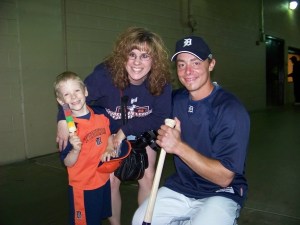
All we know are the moments that make life and death meaningful. When I read Diana’s words, I could feel her sadness but also her excitement about Brandon Inge’s visit. She wrote on Wednesday, “Noah has a special visitor coming to visit him on Friday. Noah has been asking for Brandon Inge to come and see him. He wants to ask Brandon to hit a home run just for him. The hospital contacted him and he is coming to visit Noah on Friday. He is so excited and can’t wait to show him his room and where he hung his picture and show him his toys. Also, he wants to play baseball with Brandon. As long as the steroid is still working, we are going to let him do whatever he wants. Also, we are letting Noah spend the time with just him and Brandon. Brandon is his friend and we aren’t getting in the middle of that. We aren’t having anyone else at the house and we want this to be a special moment just for Noah. Of course, I will have the video camera running if they play baseball. That will be priceless!!!”
I thought of the legend of Babe Ruth telling a boy who was dying that he was going to hit a home run for him and did. But Brandon Inge was a normal ball player, a 3rd baseman known for fielding who surprisingly made the MLB All Star game this year for his first time. Yet, Brandon was no Babe Ruth, and he was hurting besides. His knees have been hurting but that hasn’t stopped him from wanting to play.
When Friday night came, I looked on my cell phone to see if possibly Brandon Inge had hit a home run. I smiled when I saw that he hit one in the second inning, leading the Tigers to a win over Tampa Bay, and I wondered if that home run was for Brandon. I emailed Diana that night and she wrote back at 10:00pm, “Yes, that was for little man. He came over today and stayed for two hours. It was way cool!!”
At 11:25 that night, Katrina Hancock from Channel 4 News said that Brandon Inge had hit the home run for “Noah, a child at Mott Children’s Hospital.” The next day, John Lowe wrote on freep.com and next day in the Sunday Free Press, “In the moments after he homered Friday night, Brandon Inge broke down in the Tigers' dugout. ‘I lost it,’ he said. ‘I was crying. That's never happened to me during a game before.’” (“Tigers’ Brandon Inge gets emotional after HR,” John Lowe, Detroit Free Press, August 30, 2009). He wrote that Inge wept because he was thinking of a “5-year-old named Noah” and that Noah had asked Inge to hit a home run for him while Inge spent 2 hours entertaining Noah. Inge’s 25th homer of the season and 121st of his career, Lowe wrote, “seemed to have ascended near the top of his all-time list because of Noah.”
On Sunday, Diana recapped Noah’s three months with Brandon Inge to her friends and on the Carepages website. She wrote that Noah met Brandon Inge on Wednesday, June 4th during an autograph session at the hospital and signed a picture for Noah that now hangs on his wall and how that night, he saw Brandon on TV and became a fan. She wrote that on June 7th, their friendship began when Brandon took Noah into the clubhouse to meet the team and the coach, Jim Leyland, and “Brandon said that Noah was ‘totally awesome’ while in the clubhouse with him.” Noah watched every Tigers game after that and “when Brandon didn’t get on base, he would get mad and yell at the TV.” Diana wrote that Noah attended Brandon’s fundraiser on July 9th, one day after Noah’s 5th birthday, and that Brandon was happy to see Noah and gave him a signed ball. “Then came the pain,” she admitted,” the bad scans, and the realization that Noah wasn’t going to make it.” She wrote, “I asked him what he would like to do. His answer was to see Brandon again and ask him to hit a home run for him. I asked if there was anything else and he said that he would like to go to another game.”
Diana wrote that the hospital contacted Brandon’s wife, Shani, and let them know that Noah’s health was “rapidly deteriorating” and of Noah’s wish. She said when Brandon found out, he “instantly wanted to come and see him.” On Friday, August 28th, Brandon and Shani stayed at their house for over two hours in the afternoon before the game. Diana wrote, “After Noah showed Brandon his room and his basement full of toys, they played. Brandon signed a jersey for Noah and they exchanged friendship bracelets that Brandon is still wearing. Then, they built a pillow fort with every pillow in my house. Brandon sat in one end and Noah sat in the other. They hung out together, just the two of them” and Noah offered to share his superhero tattoos with Brandon and Shani’s two kids.
That night, when Brandon hit the home run during his first at-bat, “Noah jumped up and down and yelled – He did it for me! He did it for me! Then he heard his name and he gave the look of wonder and turned to my mom and said, ‘I never thought I would hear my name on TV.’”
I thought of Ruth and remembered Maddie photographed by the Detroit Free Press with her hero, Kris Draper, and then Maddie and her dad in a tear-jerking bear-hug photograph at a Red Wings game two months before she died.
The day after the home run for Noah, I went to the Tigers game with my son, a gift for his 23rd birthday, and we surprised him when his two high school friends joined him. After that same game, Diana wrote, “thanks again to Brandon and Shani, Scott and I were able to grant Noah his final wish—we went to what will most likely be his last game.” Brandon gave Noah and his parents a suite to sit in and made sure that Noah’s name was on TV again. And finally, Diana added, “waiting for Noah was the homerun ball that he hit Friday with a special note for Noah.”
Noah may have been given a short life but he’s been touched with deeply loving parents and friends, doctors who gave him everything they had to keep him healthy and alive, a wonderful, life-loving spirit, and now, a hero who was able to give him more than he ever dreamed. Thanks to Brandon and Shani Inge, Diana wrote, “we were able to give Noah the three things that he wanted. He saw Brandon again, asked for the homerun (and got it), and went to another game. How can you put into words how much that means to Noah, my family and us? I can’t. All we can say is – Thank you Shani. Thank you Brandon.”
I have been thinking how Noah is lucky to have a cast of heroes surrounding him. I have also been thinking of another hero who, before he died two years ago, touched thousands with his inspiring words. Less than two months before he died, when he and his family realized his chemotherapy was no longer effective, Miles Levin still wanted to keep fighting because “life is the most breathtakingly amazing thing I could ever imagine.” He wrote, “The growth that my having and dying from cancer creates in the lives of so many thousands of people overshadows and outweighs most personal grief.”
I wondered if the story of a baseball player’s gift of friendship with an exuberant little boy named Noah would be enough for his friends and family to “overshadow and outweigh personal grief.”
I kept thinking of the words of Miles Levin written 55 days before he died, “All good things must end….Whatever it is, it’s going to end, and when it does, if you can say, ‘I enjoyed that,’ that’s as much as you can be given, so let that be enough.”
Noah has been an inspiring gift to his parents, his family, and all his friends. He has touched the hearts and lifted the spirits of the Inges and thousands of others. He enjoyed every day of life that he was given. And he will never be forgotten.
Let that be enough.



The EPA, Syngenta, and the president of the American Council on Science and Health believe that current levels of the weed killer, atrazine, in our water supply are acceptable and that our tap water is safe. What if they’re wrong?
When the New York Times printed its controversial article (“Debating How Much Weed Killer is Safe in Your Water Glass,” Charles Duhigg, August 23, 2009, NY Times,) Elizabeth Whelan was livid. Whelan, the president of the American Council on Science and Health (ACSH.org), answered immediately on the HealthFactsandFears.com website, “How much ‘weed killer’ in your water is safe? Well, how much arsenic in your natural baked potato is safe? (Arsenic occurs naturally in potatoes.)” (“NYT Terrifies Over ‘Weed Killers’ in Water,” Elizabeth M. Whelan, August 22, 2009, ACSH.org).
What was the controversial chemical in weed killers sprayed all over lawns, golf courses, and corn fields that had Whelan up in arms? Atrazine, that’s what.
If you said “huh?” here is a quiz for the basic atrazine novice:
A. What is atrazine anyways?
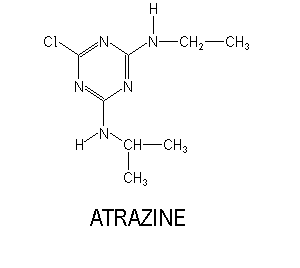
- An organic compound consisting of an s-triazine-ring
- The most widely used herbicide with over 75 million pounds sprayed per year in the U.S.
- The “most common chemical contaminant of ground and surface water in the United States,” according to U.C. Berkley scientist, Tyrone Hayes
- A chemical used in the production of dyes and explosives
- A teratogen and an estrogen disruptor, according to Tyrone Hayes
- A product sold under various brand names such as AAtrex and most commonly used on corn in farming states but also on sugar cane and Christmas trees
- “Even at concentrations meeting current federal standards,” according to the New York Times, “the chemical may be associated with birth defects, low birth weights and menstrual problems.”
- Banned in 2004 in the European Union because of its “persistent groundwater contamination”
- Made predominantly by Swiss company Syngenta AG but banned in its home country, Switzerland
- All of the Above
If you answered 10, you are as smart as a 5th Grader, but hopefully you’re not one of the “estimated 33 million Americans” who “have been exposed to atrazine through their taps,” according to Duhigg.
Why was Whelan so upset with the New York Times? Duhigg quoted Linda S. Birnbaum, director of the National Institute of Environmental Health Services, a division of the Department of Health and Human Services, who said, “I’m very concerned about the general population’s exposure to atrazine. We don’t know really know what these chemicals do to fetuses or prepubescent children.” According to Duhigg, “Forty percent of the nation’s community water systems violated the Safe Drinking Water Act at least once last year, according to a Times analysis of E.P.A. data, and dozens of chemicals have detected at unsafe levels in drinking water.” And a Government Accountability Office report in January said that “the E.P.A’s system for assessing toxic chemicals was broken.”
Whelan was angry that the Times was scaring its readers with “all the news that’s fit to scare.” I can’t deny that after reading this article and numerous others about atrazine, it’s easy to be frightened. But this article was not brand new information that came out of nowhere. In 2004, the National Resources Defense Council wrote: “EPA Cut Private Deal with Manufacturers: Under the deal, the EPA will adopt no regulatory restrictions on atrazine use, and more than 96 percent of the streams that the EPA has identified as being at highest risk from atrazine contamination will remain untested by Syngenta. Nor will the EPA take any steps to protect those streams. The EPA has found that atrazine is toxic to some species in water at levels as low as 2.16 parts per billion (ppb). Under the new agreement, however, Syngenta will only be required to take additional steps, such as increased monitoring, when a stream exceeds a "level of concern" — apparently a range from 10 to 20 ppb — over a vaguely defined "prolonged period," and only then for the most contaminated of the 40 monitored streams.”
Here is what was written in the International Journal of Occupational and Environmental Health in 2006: “Atrazine is a common agricultural herbicide with endocrine disruptor activity. There is evidence that it interferes with reproduction and development, and may cause cancer. Although the U.S. Environmental Protection Agency (EPA) approved its continued use in October 2003, that same month the European Union (EU) announced a ban of atrazine because of ubiquitous and unpreventable water contamination. The authors reviewed regulatory procedures and government documents, and report efforts by the manufacturer of atrazine, Syngenta, to influence the U.S. atrazine assessment, by submitting flawed scientific data as evidence of no harm, and by meeting repeatedly and privately with EPA to negotiate the government's regulatory approach. Many of the details of these negotiations continue to be withheld from the public, despite EPA regulations and federal open-government laws that require such decisions to be made in the open.” (Sass JB, Colagelo A, 2006 July-September, 260-7.)
So should we follow Elizabeth Whelan and the proponents of tap water who tell us not to worry, that most tap water is fine? Instead, they tell us to take vaccines for the swine flu or as Elizabeth warns, we shouldn’t give “top priority to a bogus risk…it is completely counter-productive, distracting us from the real public health hazards we face today.”
Elizabeth must hate Tyrone Hayes whose website, www.atrazinelovers.com, is made for skeptics like Whelan. “Atrazine chemically castrates and feminizes wildlife and reduces immune function in both wildlife and laboratory rodents,” he writes. According to Hayes, atrazine induces breast and prostrate cancer, induces abortion, causes neural damage and inhibits immune cells that themselves kill cancer. According to studies referred by Hayes, men exposed to atrazine in a Syngenta facility in Louisiana developed prostate cancer 8.4 times the rate of unexposed factory workers and women whose well water was contaminated with atrazine were more likely to develop breast cancer compared to women in the same area who didn’t drink well water. Hayes also claims that “atrazine destroys cells in the brain and causes behavioral disorders.”
So should we not be concerned about this chemical sprayed over our corn, sugar and trees that travels through our groundwater into our pipes because the EPA says it’s safe at its normal levels? Should we not be worried that it’s banned in Europe but is still used in mammoth amounts in the United States? Should we not mind that Syngenta fails to monitor most towns and withholds its information from the public or that it spends millions of dollars each year lobbying Congress? I guess we should put our heads in the ground, as long as the ground is not sprayed with atrazine.
Tell this to parents who have kids with unexplained cancers. As the New York Times writes, “The E.P.A. has not cautioned pregnant women about the potential risks of atrazine so that they can consider using inexpensive home filtration systems.” How should we explain why a child has a tumor without wondering about carcinogenic chemicals in his mother’s drinking water, in the air she breathes, or the food she eats? According to Duhigg, “five epidemiological studies published in peer-reviewed journals have found evidence suggesting that small amounts of atrazine in drinking water, including levels considered safe by federal standards may be associated with birth defects—including skull and facial malformations and misshapen limbs—as well as low birth weights in newborns and premature births.”
Don’t tell this to Diana who doesn’t have time to think about why her son had neuroblastoma or why the incidences of neuroblastoma in children ages 1-4 rose 16% from 1999 to 2005 (National Program for Cancer Registries). She can only focus on doing the best she can to make him comfortable in his last weeks of life. When she received Noah’s latest bone marrow report, the percent of his marrow that was lit up with cancer had gone from 5% to 40% in a few weeks.
Noah’s mother wrote, “Because of his marrow progression, we have maybe four-five weeks—at best. Without good marrow, his body will start to shut down.” Right now, she and her son wait for Noah’s hero, Brandon Inge, from the Tigers, to come and play with Brandon. If A is for atrazine, B is for Brandon, whom Noah hopes will hit a home run for him in a Tigers game soon. Too bad Brandon is not a miracle man able to cure the cancer that has spread so fast in little Noah’s body. But to Noah, he is his favorite Tiger hero and is what he has to live for.
Waiting for a hero to show up and being free from pain for a little while is easing the hell of cancer for Noah. “For now,” Diana writes, “all is calm. Noah walking and playing and not having any pain is nothing short of a miracle!!”
Here is another miracle: if members of the EPA and Elizabeth Whelan and the board of directors of Syngenta AG would stop for a moment and take seriously the potential dangers of atrazine. Why can’t they consider the studies of Berkley researcher, Tyrone Hayes, who has an entire website devoted to the dangers of atrazine (under the sarcastic web address, www.atrazinelovers.com)? Why can’t they admit that Professor Cory-Slechta from the University of Rochester and who serves on the E.P.A’s science advisory board may have a point when she says, “The way the E.P.A. tests chemicals can vastly underestimate risks” and “There’s still a huge amount we don’t know about atrazine.” Whelan should at least accept the possibility that Syngenta acts like the makers of cigarettes and asbestos did when they said that their products were safe and effective.
Why should Americans be subjected to a chemical banned in the country that produces it? Why should pregnant mothers and the rest of us be allowed to be guinea pigs for controversial chemicals like atrazine? The EPA needs to protect Americans from the chemicals that may be dangerous at low levels or at least force its manufacturers to test local water levels and inform the public of the potential dangers.
There is something, thankfully, we all can do without help from government agencies if we can afford to. Using a carbon-filter water purifier at home or buying filtered water in large containers such as the five-gallon variety (found at Whole Foods, Absopure, and other outlets) protects against toxic chemicals like atrazine. We can also write to the EPA, Congress, Syngenta, and join the Atrazine Lovers Network which has updated info on atrazine and what is being done to combat its proliferation.
Whatever we do now, however, won’t help children who are dying from cancer or their parents who are suffering. And nor will anything else such as willpower, as the mother of Miles Levin who died from cancer two years ago, wrote in her Carepages update. “All of them (children with cancer) had wills of steel (and hearts of gold),” she wrote, “and yet, in the end, after enduring brutality for the purpose of survival…..none of that strength and determination meant squat….When you look up the word ‘powerless’ in the dictionary, it shows the picture of a mom or dad whose child has cancer.” (“To Whom it May Concern,” Nancy Levin, www.carepages.com, August 26, 2009)
I don’t care about the manufacturers of atrazine or the EPA or the president of the American Council of Science and Health. Those who make excuses for chemicals that are possible carcinogens are charlatans selling nothing but the status quo and hope.
Now, we are left to hope that chemical concoctions like atrazine are safe at current levels. We are left to wonder what could have caused the cancer of a little boy like Noah as we consider frightening words from Tyrone Hayes: “Perhaps most important, based on laboratory rodent studies, exposures to atrazine (and other pesticides) may have their greatest effects, before individuals are even born. Several studies in laboratory rats and even in humans are now showing that exposure to pollutants in the womb can contribute to diseases such as cancer, immune suppression and learning disabilities later in life.”
We can pray that our children or future grandchildren or siblings or parents or we ourselves will not be stricken by the destruction of cancer. And we can mourn for children like Noah and Miles who never had a chance to experience normal adult lives.
Maybe atrazine or chemicals like them have nothing to do with the death of children. Or maybe they do. Consider the words of scientist Tyrone Hayes, when he says, “keep in mind that many of the studies showing the inhibition of immune cells (including the cells that kill cancer) by atrazine were conducted using human cells. Given that approximately one million people per day and 60% of all Americans are exposed to atrazine, this is a concern.”
Given that atrazine travels fast in our water system, lasts for decades, affects hormones, reduces sperm, and causes devastating damage to fish, wildlife, lab rodents and very possibly humans, we better be concerned.
God help us if we’re not.



Yes, the “good old glory days” may be elevated in our imaginations but they really were good because most of our fathers were employed, we had comfortable homes to sit and watch TV, and we laughed at funny political satires like Rocky and Bullwinkle.
When Melissa Brandts and her husband were exploring Lake Minnewanka in Banff National Park-Canada, they stopped for a timed picture of the two of them. They had their camera timed to snap and before it did, a squirrel “popped right into our shot!” according to Melissa. “A once in a lifetime moment! We were laughing about this little guy for days!!” she wrote.
When I saw this photo submitted to National Geographic in the Good News Network’s Top Ten list, I immediately thought, Thank God. Rocket “Rocky” J. Squirrel has returned.
And boy is it time for the flying squirrel to come back to us. The modern world is just too fast and crazy for me, with its new Android software from Google and faster twittering on the Palm Pre. Should I get the new Blackberry Tour or keep my Pearl? Is Miley headed for a Brittney future after her pole dance on the Teen Awards? Will someone actually fire a semi-automatic rifle at the next Town hall meeting on government health care reform legislation? And is “Cash for Clunkers” on its way out after government funding ends? And then I find myself wondering who will be next to die after Walter Cronkite and now Don Hewitt, the creator of 60 Minutes.
Wouldn’t it be nice to once again witness a familiar scene from the past like this one?
Bullwinkle: “Hey Rocky, watch me pull a rabbit out of my hat.”
Rocky: “Again?”
Bullwinkle: “Presto!”
Lion: “ROAR!!!”
Bullwinkle: “Oops, wrong hat.”
Ahh, the glory of nostalgia, the nostalgia that hundreds of thousands of Michiganders got to feel at the Woodward Dream Cruise last Saturday. As I sat on my folding traveling chair next to three friends on the sidewalk of Woodward north of Ten Mile Road, staring as hundreds of old cars went by, I thought back to the glory days. I returned briefly to the time when I drove my ’68 Ford Custom, a real live clunker that peeled off yellow paint faster than the skin of an orange. When Rick Sherman saw a 1968 Catalina drive by, he yelled out, “I’ve been going to this Dream Cruise for years and I finally got to see my car drive by.” Yes, Rick used to own a brown Catalina which we fondly called the Brown Bomber, possibly referring to the hole in the floor in front of the second row seats. When I crawled into his back seat then, I began to think of Fred Flintstone sticking his feet underneath his wooden car for propulsion.
The good old days, when GM, Ford, and Chrysler made “real cars,” though they had lousy paint jobs and no air bags for safety and rear wheel drive for extra spinning in the snow and they poured lots of lead into the air. Nevertheless, the “Big 3” were titans and Detroit was still a powerhouse city with lots of people and prestige even throughout the tumultuous riots of ’67.
American cars were exciting, were colorful and fun and dangerous, kind of like cell phone and Internet companies now…fast growing, with big security problems but changing fast. Today, new models of cell phones come out monthly like cars. Who can keep track of all the models and all the whiz-bang features? Our kids are so much more sophisticated and “in” than we are, as we “old clunkers” sit by the side of the road, watching the cars go by.
Joey, who has been working for GM for over two decades as an engineer, had to tell me which models went by. A car connoisseur who knows alot about the history of cars, he waits along with thousands of others for announcements of their futures at GM. He can only guess if the “new GM” will be successful in its new structure, financed by the government and American tax dollars. Like the rest of Detroiters, he and the rest of us hope for the best, but who can be sure of anything these days?
On my way to work, I pass by the empty GM building on Schoolcraft and Levan and the Ford Transmission plant further down Levan that had three cars in its parking lot a few days ago. These huge buildings, like so many in the Detroit area, are ghosts of glory days, when our area was thriving and cars were exciting and dangerous, before we worried about huge health care costs and didn’t think we’d ever need a phone to wear on our belts. We opened our real mail daily and couldn’t imagine hearing a noise from below and getting a text or email message on a phone immediately from a friend or cousin from another side of the country.
We came home and watched TV and laughed at Mr. Know-It-All, learned history from Peabody and Sherman and got our fairy tales “fractured” and then thought about the Cold War with the Soviet Union. I couldn’t tell where Iraq and Afghanistan were on the map, let alone imagine any American there. I laughed at bad guys like Boris Badanoff and Natasha Fatale and cheered Dudley-Do-Right and Captain Peter “Wrongway” Peachfuzz, who (thanks to Wikipedia,) was captain of the S.S. Guppy.
Yes, the “good old glory days” may be elevated in our imaginations but they really were good because most of our fathers were employed, we had comfortable homes to sit and watch TV, and we laughed at funny political satires like Rocky and Bullwinkle.
Yet, today, even though unemployment is too high, too many buildings are vacant ghosts, the federal government’s debt is ballooning, and the world is awfully scary, we can still sit by the side of the road and watch cars go by. We can laugh with our family and friends, we can learn incredibly pointless trivia on the Internet such as every conceivable detail of the Rocky and Bullwinkle series, and we can look on our cell phones to see every detail of a Major League Baseball game, live.
While I sat with my friends while our wives, mostly uninterested in passing muscle cars, chatted outside Rick’s Living Modes store, I kept looking at the live details of the Detroit Lions preseason game and the Detroit Tigers regular season game. Thanks to the Internet on my Blackberry cell phone, I was like Ray Lane and Ernie Harwell, telling my friends the latest field goal, touchdown, and home run, keeping them tuned to the scores. By the end of the night, the Tigers had lost in extra innings but the Lions came back to win in the last minute, 27-26. If you exclude them losing every regular season football game in their record-breaking 0-wins-16-loss-season last year, they have won five games in a row and may end up being known as the Preseason Champions.
Is the glass half full or half empty? That is the question. I would say half-full for the Lions because a new year is coming. For GM, it is half full because maybe, just maybe, a strong lean-and-mean car company will rise again. For Rocket “Rocky” J. Squirrel, it is definitely half full. Just look at the squirrel in the photo and imagine him wearing Rocky’s hat, looking right into the camera at Bullwinkle, and saying in that high-pitched squirrelly voice, “Hey Bullwinkle, we’re in real trouble now!”
Then we can imagine being Bullwinkle and shouting back, “Oh good, Rocky! I hate that artificial kind!”




I know my father and I may not travel together again but we will always have Cooperstown and Springfield and Canastota and Terryville. We will always have the photos. We will always have our memories of Greenberg, Morris, Isiah, Ali, Louis, and Bing.
Procrastinators like me like to say, “One of these days, I will….” Fill in the blank: I will travel the world, write my great American novel, enjoy a week in Hawaii with my wife, play golf every week, learn to really relax. I really mean it when I say it but time erodes the best of hopes.
Last summer, when returning home from Rhode Island with Judy and the kids, as we drove through the rolling hills of New England and New York, I noticed the same signs I had noticed on the way there, wondering out loud about visiting the Basketball Hall of Fame in Springfield, the Baseball Hall of Fame in Cooperstown, and the Boxing Hall of Fame in Canastota. All three of these signs popped up along the trip, on the same stretch of highway, all within a few hours of driving. I said to Judy, Ilana, and Marlee, if they didn’t want to stop and visit, I might come back one day with my dad. “One of these days,” I said, I will book a flight to Hartford, stop and see our branch, and then drive back over the next few days and visit each one of the Hall of Fames on the way to the Syracuse branch.
I wasn’t interested in seeing the halls myself but instead, thought it might be nice to travel with my dad and reminisce about the great sports heroes that we watched together as I grew up. This could be our little “field of dreams” together.
I told my father my idea and he was excited and willing to go. But the fall came and went and then the winter and I told him maybe we would go sometime in the spring. Then, spring evaporated and summer came and his lymphoma doctor called my dad a “miracle” because he hadn’t started dialysis yet. He had had a small tube surgically implanted in his wrist so he would be ready for dialysis at any time, if his creatinine levels would become abnormally high.
When his nephrologist told my dad that he really should begin dialysis soon, which would require him to sit at a clinic three days a week, I realized I couldn’t wait much longer. So I booked two flights on Southwest, one heading to Hartford on the first Monday in August, one heading back from Albany on the Thursday afterward. I was proud of myself for turning “one of these days” into reality, for booking tickets on Southwest for the first Monday in August, following my Aunt Helen’s 90th birthday party the Saturday before. But I was unsure what health emergency or family tragedy might halt the trip I booked.
A family tragedy did happen soon after I made plans for our road trip together. On July 9th, my aunt Selma died just a few weeks before her older sister’s birthday party and before our trip. My parents traveled to California for the funeral and stayed there for a few days with the family. My father was extremely close to Selma and had been ever since she took care of him when their mother was hospitalized at Eloise. And at Helen’s birthday party, he could barely say a few words in toasting his sister Helen, so soon after the loss of their beloved sister.
Two days after the party, my father and I woke early Monday morning and left our homes by 4:30, yet still ending up in a long line at the airport’s security scanner. We flew through Baltimore and landed in the late morning and went to visit the Hartford branch of IDN. Since my father stopped working full time fifteen years ago, he remained happy to talk to IDN employees and get his mind back into products, sales, slow moving inventory, and servicing customers. Even though he hasn’t worked full time for the company in 15 years, it is still in many ways, “his baby,” and so he is very interested in how the company is doing and how we will survive this economic “great recession”. Besides, he still gets health insurance from the company, so he has a more than vested interest in the success or at least survival of IDN-Hardware Sales. And in this difficult economic period, survival can no longer be taken for granted.
My father enjoyed giving his opinions and seeing new sales opportunities and was excited to hear about the new commercial door and hardware sales that Don, our New England salesman, was generating. After we visited the branch, we checked into the Hampton Inn in Enfield, Connecticut, ate at a local restaurant and took a walk. The area was a lot like Novi, Michigan, inhabited by many major national chains but there were a few local stores and restaurants that we hadn’t seen before.
When we returned to the hotel room, we sat in our beds and watched Boy Interrupted, an HBO documentary about a suicide of a 15-year-old boy, Evan Scott Perry, who suffered from bi-polar disorder, written and directed by his parents, Dana and Hart Perry. One of the most powerful and moving films I have ever seen, Boy Interrupted became more haunting as I watched it with my dad, who survived the institutionalization of his mother, the suicide of his younger sister, and the death of his 13-year-old son. We watched together, mostly in silence and tears. As Shakespeare wrote (in a quote from the www.perryfilms.com website), “Give sorrow words; the grief that does not speak whispers o’er the fraught heart and bids it break.”
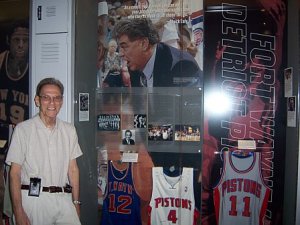
The next day, thankfully, was destined not to be sad but to be adventurous and fun, with a lot of driving and sight-seeing. We took the Kia Rio that we rented (which makes the Honda Civic look gigantic) and my new Garmin GPS device that I brought from home and set out first to the Basketball Hall of Fame in Springfield, Mass. We looked at fifty years of basketball legends including Coach Chuck Daly and owner Bill Davidson from the Pistons who had both recently died and had been inducted into the Hall of Fame. We reminisced about real old-timers like Bill Russell and ex-Piston-now-Detroit-mayor Dave Bing, who now has his toughest job, trying to keep Detroit from economic extinction. We talked about the Zollner Pistons from Fort Wayne, Isiah Thomas and Joe Dumars, listened to video tape of boisterous ex-University-of-Detroit-and-ex-Piston-coach and now ESPN announcer Dick Vitale, who with Bill Davidson, was elected last year to the hall. And we witnessed the huge poster of Michael Jordan, stretching his long arms along two walls. Jordan will join the hall on September 11th, when he is finally elected to the 2009 Hall of Fame.
After basketball, we jogged back down I-91 south and wound our way with the help of the GPS to the little old house of the Lock Museum of America in Terryville (which could be called “nowwheresville”), Connecticut. Only open four days a week from 1:30-4:30pm, we had to time it just right and we did. An old lady who had worked for GM when it had a plant in Connecticut was the only one working at the Lock Museum. She played us a tape recorded message that led us from one cabinet of old cabinet locks to another of safe deposit locks and another of rim locks, bit keys, mortise locks, and then to a cabinet of 150-year-old padlocks from Eagle and Wilson Bohannon (whose owner, Dick Tway, was a great friend of my dad before his sudden death 20 years ago.)
The Museum, though small, was still impressive in its scope of products from old companies in Connecticut that made locks and hardware, such as Sargent, Corbin, and Yale (all owned now by the international conglomerate, Assa Abloy,) Stanley, and many no longer in existence. Much of the museum can only be appreciated by people like my dad and I who worked in the lock business for much of our lives. It resembles a small Henry Ford Museum with lots of old, cool stuff but in the size of Motown’s little Hitsville USA on Grand Boulevard.
From the Lock Museum, I entered the address in the GPS of the Baseball Hall of Fame in Cooperstown, NY. I turned down the wrong street at first and the GPS “recalculated” the new directions through the sloping tree-lined streets of Connecticut to the rolling hills off the highway on the Massachusetts Turnpike through the winding roads along the lakes in midstate New York, and then along beautiful Lake Otsego to the main street in Cooperstown. The ride lasted over three hours but the scenery made it seem quicker than it was.
We arrived at the Baseball Hall of Fame around 6 p.m. amidst a pretty large crowd outside the front entrance. We looked at all the plaques of the Hall of Famers and talked about local favorites George Kell, Al Kaline, Ty Cobb, and Hank Greenberg. Hank Aaron and Babe Ruth had their own special commemorative rooms while Barry Bonds and Pete Rose were found on a couple of lists but besides that, you wouldn’t know that these two were record breakers. What was special about walking through the Hall of Fame was getting a sense of over 100 years of baseball history and remembering moments that some of these legends triggered. I heard once again about my father’s memories of different ball players and what Hank Greenberg meant to Detroiters and Jews alike.
We both remembered the 1971 All Star Game, the only All Star Game we ever attended, and the last All Star game at Tiger Stadium (the other two were in 1941 and 1951 when it was called Briggs Stadium.) It turned out to be the only game the American League won between 1962 and 1983 and it was decided, 6-4, with home runs. In fact, six home runs altogether were hit by future Hall of Famers Willie Stargell, Johnny Bench, Harmon Killebrew, Hank Aaron, Reggie Jackson, and Roberto Clemente in his final All-Star Game at-bat (against Detroit Tiger Mickey Lolich who was awarded the save that day). Lolich, Kaline, Bill Freehan, and Norm Cash, all Detroit legends from the 1968 World Series Championship, played and helped create an indelible memory for those who saw the game. But what was most memorable to me at age 14 was the towering home run from Reggie Jackson that climbed way over my head in the right field stands and ended up hitting a light standard on the roof of the stadium, estimated to be 520 feet from home plate.
My father took more digital photos while he told me more baseball memories. After two hours or so, we left and wandered along Lake Otsego and ate at a restaurant right along the water. When he left, darkness had descended and we were dependent on the GPS to take us to the Utica Red Roof Inn. We went on the darkened back roads, through farm lands, and one lane highways and somehow an hour later, after a couple of wrong turns and recalculations, finally landed at our destination.
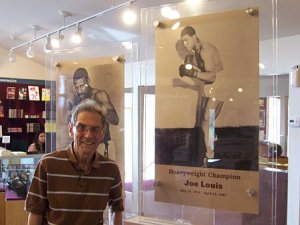
The next morning, we headed to Canastota, right off the New York Throughway, and parked outside the International Boxing Hall of Fame, which comprises two separate buildings along the interstate. We waited in our car until someone opened the door and had the place pretty much to ourselves. Once again, I learned about a sport that was huge before World War II and stayed pretty strong until the ‘70s and petered out after Mike Tyson. But who can forget Ali-Frazier, Sugar Ray Robinson and Leonard or the Raging Bull (which I only knew from the Scorsese-DeNiro movie)? Detroiters remember Tommy Hearns and know the legend of Joe Louis. Joe was the one athlete who had made African Americans and Detroiters proud and then against Max Schmeling, he united the entire United States, black and white, in its quest to defeat a man who was a hero of Hitler and Nazi Germany. I snapped a photo of my dad in front of the Joe Louis exhibit.
The Boxing Hall of Fame displayed its proudest possession, the actual boxing ring from Madison Square Garden used for every fight there between 1925 and 2007, including the legendary Championship fight (still called “the fight of the century”) between undefeated Joe Frazier and undefeated Muhammed Ali on March 8, 1971. My dad and I sat and watched the replay of the entire fight right outside the actual ring. We couldn’t remember beforehand that Frazier persevered that night but lost the next two fights to Ali in 1974 and in Manilla in October, 1975, when I started college. As we watched the intense fight on the monitor between Ali and Frazier, I tried to remember if we watched it together in the living room in our Livonia house on Rensellor, when I was 14 and my dad only 39, 13 years younger than I am today. I just couldn’t remember.
After the Boxing Hall of Fame, it was time to head to Syracuse and visit our Syracuse branch. We were in a meditative frame of mind when we spent a few hours with John, Kelly, and Tracy at the branch and later, became tired after all the driving, walking, and talking and as my father mentioned, his 77-year-old energy level was not it was a decade or two ago. When we got back to the motel, we walked down the Utica street to a local restaurant and ate outside on its patio. The temperature was a perfect 78, the breeze was comforting, and the food and wine we shared was a nice way to cap a memorable trip.
After we left from the Albany airport the next morning, I began remembering other trips my father and I took together. I remembered traveling with my mother and sister to California a couple of times to visit my three aunts and their families, once on a two-day train trip that kept us up almost the entire trip as we were seated right next to the railcar door which was open and loud the entire trip. As I drifted off, my dad had my iPod and was listening to some my classical music and softer songs. While he had his headphones on, I vaguely remembered Pointe Pelee in Canada, Kensington Lake, Toronto, and the trip to Nippersink in Wisconsin with Kenny, Leslie and my parents, a tough trip because Kenny was sick with stomach aches and vomiting. I remembered going with my dad to NLSA (National Locksmith Supplier Association) conventions, some with my sister, brother, and mom, and some without. Only my father and I went to NLSA in Las Vegas just a week before the accident but my memories of that trip were hazy and disjointed, almost completely severed and replaced by the tragedy of July, 1982.
Over the last few years, my dad and I traveled a few times together on “work trips” to check on the branches but we didn’t take time to do anything personal for ourselves. Although I remembered the guilt he felt remembering how he chose meetings at NLSA instead of going to Disneyworld with my mom, Leslie, Kenny, and me, I really wasn’t much better. I dutifully went to the conventions and IDN meetings and for many years, missed Judy’s birthday and our anniversary, simply because the meetings fell on those days. When I finally asked if the meeting dates could be changed, they were.
“Ask and you will receive,” the popular saying says. I asked if I could stay home with my wife for her birthday and anniversary and it finally happened and now, I make sure to actually take the days off work to be with her. I asked to travel once more with my dad to visit the sports memories of our past and I received it. When we came back home from our trip, my sister who was visiting my parents asked if I could bring Judy and the girls to celebrate my father’s birthday a week early before she, Bruce, and Karenna had to return to Columbus. I said okay and we shared a gift that Judy, Leslie, and my mom purchased when we were gone.
My dad opened up his new iPod Touch, the newfangled music gadget that has all the latest bells and whistles. He was excited to download all of his CDs and other music on it so he could listen at home, when walking, or when traveling. But when he couldn’t figure out exactly how to work the iPod Touch (as Marlee warned), he exchanged it for an iPod Nano and now, he’s content. (And so is Apple, capturing three generations of consumers.) So if my dad and I ever get a chance to travel together again, I will bring my old iPod Classic given to me from my youngest daughter after she got an iPod Touch and he will bring his new iPod Nano and we will listen to our favorite music, together, but apart.
I know we may not travel together again but we will always have Cooperstown and Springfield and Canastota and Terryville. We will always have the photos. We will always have our memories of Greenberg, Morris, Isiah, Ali, Louis, and Bing. We will always have the memories of working together, the successful times and the exasperating ones. We will always have the memory of watching Boy Interrupted together and sharing stories about my family, the aunts and uncles and grandparents and cousins and brother. I will always have my father’s stories and he will always have the knowledge that his oldest son wanted to spend a few days with him, just the two of them, before it was too late.
I don’t have to regret forgetting one of my “one of these days.”
Nor will I ever forget how lucky I am to have my father.


How do you deal with the certain death of your child? How do you accept the inevitable loss? Diana will need to summon the type of courage that allowed Jeanne Daman, a Belgium Catholic, help nearly 2,000 Jews in hiding while acting as a weapons courier for the Belgium resistance, all before she turned 27.
Sometimes, I wonder about the meaning of coincidence or if what arrives at the same time is meant instead to be significant and meaningful.
On the day of my father’s 78th birthday, when I arrived from lunch at work, I received among other mail a calendar from the United States Holocaust Museum (www.ushmm.org). Before I opened it, I read my incoming email and noticed another Noah Update from his mother, Diana, knowing that reading the email and opening the pages of the calendar would both bring a flurry of emotions.
I tore open the What You Do Matters Calendar which has 12 pages of “Ordinary People, Extraordinary Acts” and read of acts of great heroism and photos mostly about people I had never heard of. These include Alice Goldberger, who after losing her whole family, “became parent, advocate, and counselor of 24 traumatized child survivors, some as young as four,” and Alexander Bogen who led the Jewish resistance unit Nekamah (“Revenge”) in the forests of Belarus, who “sketched his comrades in battles and life in the Vilnius ghetto, ensuring that evidence of their brave struggle would live on.” I was struck by the mitzvahs of these unsung heroes who had helped their fellow human beings during and after the most horrific moments in human history.
The sudden glimpse again of the Holocaust gave me the courage to read Diana’s update, knowing that she was certain to find out more about Noah after the doctor’s tests. She started with the “good news” that Noah came home, was excited to use his own bathroom and to go down the stairs, and that he “had to touch everything in the house. He kept saying—Look at this! And I forgot about that! It was fun to watch him be excited about his stuff.” Then, he went fishing with his grandparents and his Uncle Mark, raced down the aisles of Wal-Mart where his grandmother works, and will stay this weekend with his mom at a friend’s house and “play with his friends, Evan and Ally, on the beach in the dirt.”
Then, Diana went on to the “really crappy news” that the cancer has rapidly spread through Noah’s bones, that the MIBG scan lit up on every bone and that Noah’s “spine was lit up like a Christmas tree.” The cancer is his “spine, head, arms, legs, pelvis, hips, and collarbone and well you get it.” Dr. Yanik said that there were two options, to send him home on true hospice which would give Noah 1-2 weeks to live or to keep his blood counts up with transfusions and heavy pain medication, which would give Noah 4-8 weeks more of life. Diana and Scott chose the latter.
How do you deal with the certain death of your child? How do you accept the inevitable loss? Diana will need to summon the type of courage that allowed Jeanne Daman, a Belgium Catholic, to help nearly 2,000 Jews in hiding while acting as a weapons courier for the Belgium resistance, all before she turned 27.
Diana focuses instead on what she has now. “For this weekend,” she writes, “I am going to play with my son and enjoy watching his smiling and laughing face having fun in the sun and dirt. This weekend will be the weekend that I will hold in my memory for the rest of my life.”
An ordinary mother never chose these extraordinary circumstances but she has courageously handled the worst that a parent can face.
Diana will give Noah every little mitzvah she can for the rest of his life.

"Sen. Arlen Specter, facing more jeers and taunts during another town hall meeting Wednesday, sought to defuse tensions about health care reform debate with a few jokes." Associated Press, August 11, 2009
More than a few hundred Pennsylvania citizens came to a Town Hall meeting to let Senator Arlen Specter know what they thought about the Congressional Health Care bill. This time, Specter was ready for the angry rants.
Katy Abram (stay-at-home mother from Lebanon): You have awakened a sleeping giant! I don't want this country turning into Russia, turning into a socialized country!
Senator Spector: I don’t know about turning into Russia, but did you hear the one about George W. Bush? George W. Bush was walking through an airport last week, when he saw an old man with white hair, a long white beard, wearing a long white robe and holding a staff.
He walked up to the man, who was staring at the ceiling, and said, "Excuse me sir, aren't you Moses?" The man stood perfectly still and continued to stare at the ceiling, saying nothing.
Again George W asked, a little louder this time, "Excuse me sir, aren't you Moses?"
Again the old man stared at the ceiling motionless without saying a word.
George W tried a third time, louder yet. "Excuse me sir, aren't you Moses?" Again, no movement or words from the old man.
He continued to stare at the ceiling.
One of George W's aides asked him if there was a problem and George W said, "Either this man is deaf or extremely rude. I have asked him 3 times if he was Moses, and he has not answered me yet."
To which the man, still staring at the ceiling finally replied, "I can hear you and yes, I am Moses, but the last time I spoke to a bush, I spent 40 years wandering in the wilderness."
Sam Spritzer (franchise owner of a McDonald’s Restaurant): Don’t blame it on George. This plan is going to kill small businesses like ours. How are we going to be able to pay for the higher taxes and higher costs of health insurance for our employees?
Senator Specter: Did you say you worked for McDonald’s? Talking about fast food, did you hear the one about kosher food in a mental institution? Morris Cohen was a patient in a mental institution and he argued long and hard that he must be served only kosher food.
Finally, sick of arguing with him and unable to avoid the extra work and expense, the director of the institution acquiesced and for much expense he had kosher meals specially prepared daily.
Some time later, on the Sabbath, the director was strolling around the grounds, when he came upon Cohen sitting in a chair and smoking a cigar.
"Wait a minute, Cohen," he said. "I thought you were so religious that we had to bring in special food for you. And now you are smoking on the Sabbath!! What a hypocrite!!!"
"But doctor," Cohen replied. "Did you forget? I'm meshuggah."
Lisa Redmond: You guys in Congress, all you want to do is soak the people who can afford health insurance and give it to people who can’t!!
Senator Specter: You have a point about the rich and poor. By the way, did you hear this one about health insurance for the rich?
Lord Rothchild was dying from a serious illness. A poor Jew comes and tells him that he has the cure.
"What is it"? Asks Rothchild.
"It is simple," says the poor man. "Move to our community and I'm sure you will recuperate."
"How are you so sure?"
"Because no rich man ever died in our part of town," says the poor man.
Joey Lebowitz (former insurance rep for AIG): The way it’s going, we’re all going to have to pay a fortune to be able to get to see the doctor we want! We’ll be put on endless waiting lists like in Canada!!
Senator Spector: That reminds me about the doctor who charges a fortune. An elderly Jewish man has just moved to a new town, when he is taken ill and decides that he needs to see a doctor. In the waiting room at the surgery, he tries to find out a bit about the doctor.
He asks the man sitting next to him if the doctor is a specialist. The man replies that the doctor specializes in everything. The Jewish man thinks about this and looks nervous. He asks the man if the doctor's fees are expensive. The man says: "Well, he is and he isn't. You see, he charges you one thousand dollars for your first visit." The Jewish man looks even more worried now and exclaims in amazement, "A thousand dollars?" The man replies, "Yes, but all your visits after that for the rest of your life are free!"
The Jewish man thinks about this, and then gets called by the nurse to go in to see the doctor. On entering the doctor's office he says casually, "Hello doctor, here I am again!"
Sarah Palin (ex-Governor-now-citizen from Alaska): What gives you liberals in Congress the right to decide who will live or die? You are going to force me to stand in front of a “death panel” to argue for the life of my baby with Down Syndrome!!
Senator Specter: Come on, Sarah. Do you really think we’re going to decide who dies? Which reminds me of the one about a guy who has to bury his wife. Sadly, slowly, Duved Krekman entered the headquarters of the Lantsmon's Philanthropic League. He trudged into the office of the Executive Secretary and sighed, "Glaser, I'm here." He sat down. "I have to make arrangements for the League to bury my wife."
"Krekman!" exclaimed Mr. Glaser. "Don't you remember? We buried your darling wife two years ago!"
Mr. Krekman nodded. "I remember, I remember. That was my first wife. I'm here about my second."
"Second? Mazel tov! I didn't know you remarried."
Sarah Palin: Krekman remarried his dead wife? What a schmuck!
I get ready to send a reply to Diana, maybe Miles’ words, “Keep fighting,” or “We’re praying for you,” or “Stay strong,” but all words seem trite, absolutely useless. No child should have to suffer like this.
Less people lost their jobs last month. The stock market has risen as the fear of economic depression decelerated. John Hughes, director of two of my favorite films from the ‘80s, Ferris Bueller’s Day Off and Planes, Trains, and Automobiles, suddenly died at age 59 of a heart attack.
None of this matters when you wake up to an email like this: “Since my last update, things have continued to deteriorate rapidly for little man. When his arm isn’t hurting, his leg is hurting. When his leg isn’t hurting, his head is hurting. We have him on enough pain medications to choke a horse and still he continues to be in pain.”
Diana wrote the update about five-year-old Noah and sent it to her friends and family at 1:50 a.m. I’m on the list and found it first thing in the morning, learning more excruciating details about Noah’s descent into the hell of cancer.
Scott and Diana met with Noah’s Palliative Care team who told them that Noah knows what’s happening to him. He knows the truth that he is dying.
“They also feel that he is scared of being without us,” Diana wrote. “He freaks out if he can’t physically see me. I have to tell him where I am going and exactly how long I will be gone. His best friend, Christine, has been here often and he cries every time that she leaves. He wants her with him all of the time. He has told me that he loves me more times than I can tell you. I keep reassuring him that I am here for him. I hold him or sit and hold his hand. I just want to make sure he knows he is loved and not alone. When he sleeps, I cry. When he is awake, I try to treat him like I always have.”
I get ready to send a reply to Diana, maybe Miles’ words, “Keep fighting,” or “We’re praying for you,” or “Stay strong,” but all words seem trite, absolutely useless. No child should have to suffer like this. I stare at the words from Noah’s mother. “Yeah, this is more difficult than I could ever give accurate words to, but figuring out how to live without him is going to be much harder.”
I sit quietly at my work desk, unable to move. I think of Nancy Levin approaching the two-year anniversary this month of the death of her son, Miles. I imagine the agony she has suffered for the last four years and what Diana and Scott will soon have to bear when their only child is taken from them.
There are no words to accurately describe the unbearable.
No words. None.
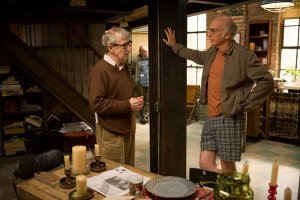
"I happen to hate New Years celebrations. Everybody's desperate to have fun trying to celebrate in some pathetic little way. Celebrate what, a step closer to the grave? That's why I can't say enough times, whatever love you can get and give, whatever happiness you can filtch or provide, every temporary measure of grace — whatever works!"
– Boris Yelnikoff (played by Larry David) in Whatever Works, Woody Allen, 2009
For those of us in Michigan expecting that all three Detroit car companies are doomed to extinction, Ford Motor Company came through for us, like a slumping Tiger hitter erupting after four one-run games. Ford actually made a profit in the second quarter, even if it was due to an accounting credit for debt reduction. Hey, it was still a profit and not a measly one either: $2.3-billion dollars is not chicken feed. As Larry David would have said in one of his “Curb Your Enthusiasm” episodes on HBO: “That Ford profit was pretty good. Pretty, pretty, pretty good.”
Not too hot, not too cold, not great but not bad either. If Ford couldn’t make profit just by selling cars, at least they did it by cutting costs and reducing debt. As Woody Allen would say in his latest movie, “whatever works.”
We hear very little about the banks that continue to fail, including seven last week, making the 2009 count 64 so far. If Larry David were an economic reporter, he would be screaming for all of us to wake up. But he’s not and the newspapers and news channels aren’t really in the business of reporting. They are more excited that the stock market has risen from the depths of March, much of it because companies have relentlessly reduced employee counts and other costs, as their sales continued to suffer compared to last year. And the second quarter numbers for many companies were better than the measly expectations that they had set for their analysts. Wall Street still plays the game of “beat the expectations” and make the numbers seem not quite as terrible as expected. If you can make people think pretty good instead of awful, you’re a temporary winner.
Winning a little seems to work a lot these days; not that there’s anything wrong with that. Think of Larry, a bald, misanthropic, sarcastic wiseguy who was not very successful as a standup comic, making a TV “show about nothing” for nine years with his successful comedian/friend Jerry Seinfeld, becoming a multi-millionaire and then starting a “sitcom” on HBO based on one page written sketches surrounded by adlibs from Larry and his friends. Nine years later, he is ready to bring the 7th season to HBO, including the original Seinfeld cast, Meg Ryan, and many of the regulars from last season. Not only that but the 61 year was invited to star for the first time in a movie, written and directed by Woody Allen. Not bad for a grumpy 61-year-old man who doesn’t act. In fact, I would say that it’s prêt-ty, prêt-ty, prêt-ty good.
Compared to what we all went through last year, we can be a little bit thankful. The crooked mayor of Detroit was replaced by former Piston, Dave Bing, a businessman with calm integrity who is actually trying to fix the fiscal problems that have plagued Detroit for years. And to make things a little better for Detroit and Michigan, California has been getting much of the bad press. And as Gail Collins wrote (“Things Can Always Be Worse,” July 24, New York Times), “No matter what dreadful embarrassment your state is facing, you can always console yourself by remembering that you do not live in New Jersey. On Thursday, a vast corruption sweep there netted three mayors, two state assemblymen, five rabbis and a guy who had allegedly been running an organ-trafficking business that has left swathes of the population of Moldova walking around with only one kidney.” If anyone can make us forget Kwame and his band of lawless cohorts, it’s the real-life successors to Tony Soprano.
See, it’s not so bad after all. GM and Chrysler are off the hot seat for awhile, out of bankruptcy, and Ford is looking more and more like they are here to stay for the next decade and beyond. This won’t make up for the 15.1% unemployment rate in Michigan, which doesn’t include the ones who gave up and part-timers who want to be full-timers. Nor does it stop the coming state budget battles and the coming tax increases for companies and individuals. But for now, the stock market is slightly better with companies like Apple still selling millions of iPhones with billions of applications while others are actually reporting improved sales and profits. And many analysts and economists really do believe the economy may have finally bottomed. Pretty, pretty good.
Even if the economy is still weak for a long time, our happiness is still locked up in our attitudes. We can grump and moan as if we were Larry David about stimulus packages, cap and trade, health care legislation, new taxes, and ballooning deficits. Or we can simply be thankful for whoever is working and whatever is working.
Unfortunately, Larry didn’t help Woody make Whatever Works work. Woody Allen’s latest movie, Whatever Works, has been a critical and box office disappointment so far, earning $4,136,295 in 35 days and garnishing relatively mediocre and some lousy reviews. But that didn’t stop Judy, four friends, and I from laughing at many of its lines. I thought the movie had some moments of good old-fashioned Woody-Larry laughter and even though it was pretty forgettable, it was also kind of enjoyable. Like the stock market and the companies thought to be in deep trouble, the movie was really not that bad.
In the movie, Boris Yelnikoff, in his familiar Larry David whine, says, "People make life so much worse than it has to be and believe me, it's a nightmare without their help." He could have been speaking for the movie or the economy or the government, all nightmares to some degree or another. But I’d rather have the attitude of Larry in his TV show, raging against the absurdities of daily existence but once in a while, sitting back and admitting, even amidst all the meshugenas with their mishigoss, it’s all good; it’s all still pretty, pretty, pretty good.
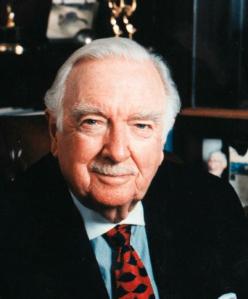
The world since Cronkite’s last broadcast on the CBS Evening News March 6, 1981 has changed radically. Memories about those days are sometimes exhilarating, sometimes heartbreaking.
On Saturday night, my cousin’s 24-year-old son was married. His family and friends weathered the weird winds and cool July weather at Eagle Eye Golf Course to hear Sean and Jamie recite their vows. Many of us danced for hours inside, celebrating marriage, one of the best passages of life, while I wondered if the afterlife spirit of Sean’s Uncle Mike partying with his family was just another crazy fantasy.
The next night, Judy and I attended Shiva for a friend’s mother a few hours before another cousin held Shiva for his mom in California. I remembered the words of my aunt Selma when she called me after finishing my book, Outlive Me, and could imagine her voice cracking when she said how touched she was by my words. As I mourned with my friends and for my aunt Selma, I drifted onto the words that surrounded the Mourner’s Kaddish: “All things pass. Everything that lives must die.”
As my friends and cousins get older, many of them are taking on the sad, new role of orphans. Meanwhile, those we grew up with continue to disappear. Johnny Carson’s sidekick, Ed McMahon, who kept us company for many decades on the Tonight Show, died a few weeks ago. And the news anchorman who kept us calm and sane as the world drifted into tragedy left his mortal life a few nights ago.
40 years ago today, Walter Cronkite stayed on television for 18 hours during the first flight to the moon. After his first seven tumultuous years as the news anchor, he had been the nation’s most popular broadcaster for both Kennedy assassinations, two elections, and the Vietnam War, helping us weather the ravages to our nation with a calm, steady voice. But he was giddy as a schoolboy when Neil Armstrong took his first “one giant leap for mankind” step on the moon and after being nearly speechless, Walter said, “Man on the moon. Oh boy!”
Cronkite was the same age then as I am now but didn’t make it to the 40th anniversary of that moment. He lived a long life but died at 92, just a few days before the momentous memorial of the lunar landing. Unlike the evident pain he displayed when removing his horn-rimmed glasses to tell us that “President Kennedy died at 1 P.M. Central Standard Time, 2 o’clock Eastern Standard Time, some 38 minutes ago” on November 22, 1963, Americans on July 20, 1969 could feel his joy and wonder at our conquest of space. We could share his thrill at the wondrous possibilities of mankind.
A simple newsman, “Uncle Walt” influenced his country in good times and bad. Sports columnist Drew Sharp admitted, “I immersed myself in the Apollo space program because Cronkite called it man’s greatest adventure. And when Neil Armstrong first set foot on the moon 40 years ago Monday, the ‘anchor desk’ was set up in our living room for my broadcast into a tape recorder.” (“Cronkite gave sports writer a new dream,” Drew Sharp, Detroit Free Press, July 19, 2009)
Cronkite ended his CBS broadcasts from 1962 through 1981 the same way every evening. When his steady voice boldly said, “And that’s the way it is,” no one could deny it. Unlike the supposed “reality TV” of today, Cronkite’s news reports were true reality TV. Kennedy’s funeral procession, the Kent State killings, the revelations of Watergate, and the daily death tolls of the Vietnam War were our reality, mostly unfiltered by the types of 24-hour-news talking heads that pollute our minds today.
The world since Cronkite’s last broadcast on the CBS Evening News March 6, 1981 has changed radically. Memories about those days are sometimes exhilarating, sometimes heartbreaking. 40 years ago, I watched the landing on the moon with my parents and my sister as my little brother, Kenny, crawled on the family room carpet, less than seven months old. 13 years later, on the exact same day as the landing, I received a call from a policeman to come to Botsford Hospital. I rushed out the door of my apartment as if I were in my own personal rocket, flying in my car like I was going to a planet I never wanted to visit. I felt like I was drifting without gravity when my mother and I heard from the doctor just after midnight that my dad was okay but my brother, Kenny, had died.
The day of July 20, 1982 became my family’s Kennedy assassination, our 9/11, our Katrina. When a child, a son or brother, is snuffed out from existence, suddenly, without warning, there are no words to capture the horror. There are no words to make it better or to take away the pain. That’s just the way it is.
Today, on the 27th anniversary of the car accident that changed my life, a five-year-old is facing the devastating effects of the cancer that is ravaging his little body. Diana wrote in an email to her family and friends that Noah is in extreme agony and on constant pain killers. His legions are larger and brighter and traveling, there are new spots on his skull, collarbone, and scapula, left leg, and pelvic bone, and there are cancer cells back in his bone marrow. His doctor wants to focus on pain management now and advises the family from California and Arizona to visit him now.
Noah, on two doses of morphine, woke up today as “happy as can be,” “playing with his Transformers and giving the hospital staff a hard time.” But morphine cannot take away the inevitable reality. Diana wrote, “It has been extremely difficult to know that after two and a half years the inevitable is staring me square in the face—I can’t do anything to save my son. To make it worse, I have to watch the pain in him and watch the changes in him. To make it even WORSE, it’s happening faster than any of us could imagine. A month ago, he was considered stable. Now, the cancer growth is out of control.”
Walter Cronkite lived a long, meaningful life, 40 years beyond the age I am today. But Kenny was robbed after 13 ½ years by a young girl in a car passing through a blinking red light and Noah probably won’t make it till the end of the year because of a rare cancer that is overwhelming his little body.
Yes, all things pass. Everything that lives must die. But no matter how much I want to believe that there are reasons for everything, I can’t.
And that’s the way it is.

We always wish for the savior to come from somewhere to rescue our loved ones from pain and suffering. But life, though often mysterious, is not always what we wish.
July 10th was a big day for GM. It emerged from the depths of bankruptcy faster than anyone expected, saved from extinction. The new GM is approximately 60% owned by the U.S. government and most of the old GM’s assets were sold to a new company owned mainly by the U.S. government as well. So now, we taxpayers can say we are the proud owners of billions of dollars of “toxic assets” once owned by GM, Fannie Mae, Freddie Mac, AIG, Citigroup, and lots of other bailed out and bankrupt banks. And we can proudly proclaim that we just borrowed from the Chinese and other countries with cash to save another of our once-world-class companies.
We are the saviors, my friend, which is nearly as ironic as the Blackberry that saved skier Mr. Fitzherbert (“Skier saved from death plunge by Blackberry,” Telegraph.co.uk, June 29, 2009) after he fell into a crevasse after skiing down a glacier in the Matterhorn and Monterosa peaks. After falling 70 feet, he “became stuck like a cork in a bottle between the walls” because “fortunately, the extra inches of the Blackberry were enough to block the fall.” What a great commercial for Blackberry! It saved a live and still worked after the accident as Fitzherbert used it to call his wife during the 10 days he spent in the hospital.
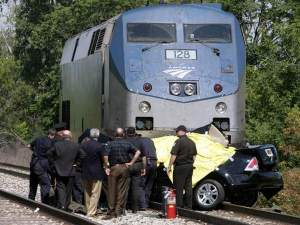
Five young people weren’t so lucky. When a 19-old-driver who had just had his driver’s license suspended the day before because of six violations in two years passed an SUV and skirted around the crossing gates and flashing lights to cross train tracks in Canton, an Amtrak train collided with his Ford Fusion and shoved it for almost a mile. Five young people, including a 14-year-old girl, were killed. The mother of the girl, who identified the ring given her at birth, said, “I feel I’m to blame (“Families mourn 5 after car crashes with Amtrak train,” Detroit Free Press, Amber Hunt, July 10, 2009) because she warned her daughter to come home fast instead of going to the beach that day.
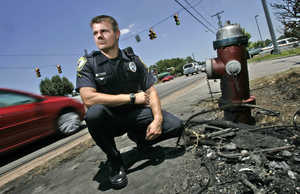
It’s too late to wish that there were saviors, to hope that the driver’s parents would have taken his car or that someone would have jumped in front of him and shouted that a train was only a few feet away. It’s too late to dream of heroes like the two men who braved a burning car to save a stranger last week (“Somebody had to get that woman out,” The State.com, July 1, 2009.) When a car hit a utility pole and was struck by a downed power line and in flames in Forest Acres, South Carolina, a crowd of around 70 gawkers stoop around, afraid to go near the fire, downed power lines, and blinding flash of light. But two men wouldn’t stand by.
Traffic cop Jason Whittle, who was driving nearby, said, “I just couldn’t stand by and watch while someone burned to death,” and Michael Samuels Sr. who came running from his job at a nearby cleaners admitted, “People were shouting. ‘Don’t touch the car! Don’t touch the car!’ But somebody had to get that woman out. My heart told me to go.” Neither of them spoke but together, the two saved Marylin Luther before her Ford Focus became a fireball-blinding black smoke. Marylin, whose daughter has cancer and who passed out before hitting the utility pole, said, “God bless those two men who pulled me out.”
There are lots of heroes in Noah Biorkman’s life. After finishing a first round of the experimental drug, ABT-751, feeling horrible stomach cramping and leg pain didn’t stop Noah and his parents from celebrating Noah’s 5th birthday. He went to a party at the hospital clinic and to the Toledo Zoo, even though he had to wear a mask while walking by the animals. And then he got to meet the Detroit Tigers at a charity fundraiser sponsored by Carlos Guillen and Brandon Inge, who had just made the MLB All Star Team. Before the event, a blood test confirmed that his platelet count was only 18 compared to the 150-300 normal range. That day his right arm hurt him and all he did, according to his mother, was “whine and scream.” But that night, Noah was overjoyed to see his hero, Brandon Inge, and got to talk to him and get a souvenir baseball.
After the birthday celebrations, Diana wrote that all she hoped was the ABT would stabilize the cancer and that it would stop spreading. All we can hope for is a miracle that will save Noah from the neuroblastoma that has consumed his body.
In a time filled with heroes, saviors, and strange accidents, it is never the right time to lose someone close. A few hours before the new GM emerged from bankruptcy, my aunt Selma died. My cousin Ann wrote this about my father’s older sister, “Her passing means that there is one less innocent in the world in which we live. My mom still believed that people were good, trustworthy and family and friends were everything. She rarely complained about the indignities of life and always wished and felt that others could feel how much she loved them….I personally have never met or known anyone as strong, resilient or forgiving as my mom. The world was better for having her and is, for me, less for losing her.” My aunt had the timeless qualities of constant love and kindness which only a few in the world exemplify. Every January 3rd since I can remember, she called from California to wish me happy birthday and find out how her relatives in Michigan were feeling.
We always wish for the savior to come from somewhere to rescue our loved ones from pain and suffering. But life, though often mysterious, is not always what we wish. In an instant, five young kids are suddenly robbed of life from a train, one is rescued from a burning car by two strangers, another saved by a cellphone against the ice, a legendary company is saved by the taxpayers, and a five-year-old fights on with the help of her doctors and her courageous mother who will simply not stop fighting for his life.
Sometimes, the struggles against death aren’t enough and those we love evaporate into the dark night. But those who survive can tell us what we need to hear. Here are the heartfelt and hopeful words that my cousin, whom I will always call Annie, wrote to her family and friends, “My mom and I hope this brief email finds you all well and brings a smile and tear to you all because one without the other is incomplete. A life as special as that of my mom is worth mourning and celebrating. My mom, book in hand, is now traveling the world, seeing all the things she read about, wondered about and laughed about. I hope she visits each of you as she has wanted for many years. For now she is just waking up putting on her walking shoes and beginning her new adventure. She sends her love.”

 Aggman's Blog