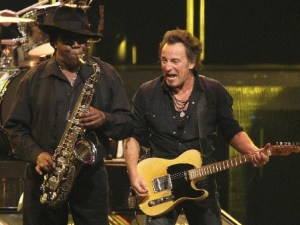
“Baby this town rips the bones from your back, It’s a death trap, it’s a suicide rap
,We gotta get out while we’re young, ‘Cause tramps like us, baby we were born to run.”
Born to Run, Bruce Springsteen, 1975
I almost forgot the power of rock and roll. It had been so many years since I’d been to a rock concert that I couldn’t turn down a friend who, after his wife turned him down, invited me to see the Boss at the Palace.
Before I married, I went to a lot of rock concerts. I remembered when my cousin Bob, my friend Scott, and I crossed the Detroit-Windsor Bridge at exactly 6:00am on the morning of July 17th, 1980 the night after a Who concert at CNE Stadium, Toronto. Unable to get a hotel room anywhere in the city and after giving up trying to catch some sleep in my compact Fiat Strada, I drove us home, staying awake on pure adrenalin and a large bag of salty peanuts. When we entered Detroit, I joked that we could take a turn off the bridge to the Detroit Ren Cen and visit the Republican Convention on its last day in Detroit. Maybe we’d see Ronald Reagan on the elevator.
Going to a rock concert at fifty years of age is like my dad listening to Jumping Jack Flash in 1968. My dad was not a fan of the Stones before ’68 or after. But I was a Stones and a Springsteen fan then and haven’t stopped listening to Springsteen since my high school graduation.
Flash back 32 years to my senior year of high school when I graduated in June of 1975, five years before the Republican convention at the Joe Louis Arena. I knew I was going to college in Detroit but that’s all I knew, being an unsure 18-year-old with a summer job and plenty of time to burn while listening to records in my basement bedroom.
I had heard about “Born to Run,” the new Bruce Springsteen album, after it was released on August 25, 1975. After I listened to the title song on FM radio, I bought the album and spent a lot of nights listening to its eight tracks, including “Thunder Road,” Tenth Avenue Freeze-Out,” “Night,” “Backstreets,” “Meeting Across the River,” “She’s the One,” and “Jungle Land.” I was a music junkie, imagining myself a rock star, strumming my guitar, screaming out lyrics to a thunderous audience. There was no “Guitar Hero” video game then but that didn’t stop me from learning the lyrics to most of Bruce’s songs, especially “Born to Run”:
“In the day we sweat it out in the streets of a runaway American dream
At night we ride through mansions of glory in suicide machines
Sprung from cages out on highway 9,
Chrome wheeled, fuel injected
And steppin’ out over the line
Baby this town rips the bones from your back
It’s a death trap, it’s a suicide rap
We gotta get out while we’re young
‘Cause tramps like us, baby we were born to run.”
“Born to Run” was the perfect teenager song, filled with rebellion, passion, speed, suicide, and escape, and made my heart beat faster than my middle-aged heart can handle today. When the legendary riff erupted in an encore at the Palace on November 5th, 2007, I acted like a high school kid again and couldn’t believe that I still remembered most of the words. Actually, for much of Bruce’s “Magic Tour” concert return to the Detroit area, I stood and swayed and sang and shouted and clapped. I didn’t feel all that much different from the 18-year-old high school graduate who first fell for the Boss.
My mind flew back to the night of October 4th, 1975, when my buddies and I drove without tickets to the Palace in downtown Detroit to witness what Time and Newsweek both put on their covers 23 days later, the dawning of a rock and roll legend. We liked the album but we hadn’t been to concerts before and didn’t know what to expect. The rumor was that Bruce put on a great show, but to novices like us, what did that mean?
We got our tickets and when the doors opened, we raced to the closest seats we could find. It was general admission only and the first to arrive were the luckiest. We stood up most of the night, not knowing songs like “Rosalita”, but knew that we had to be at one of the greatest concerts ever. The passion and intensity increased through the night until the four encores 3 ½ hours later, when we left, looking at each other like, “Do you believe what we just witnessed?”
In the back lights of memory, I think this was the greatest concert night of my life, better than the 1980 Who concert, better even than 2007’s Bruce revival.
The 2007 Bruce was a close second to the 1975 Bruce. The “Magic Tour” concert was about an hour less so the lights could rise faster and the baby-boomers could get out of the parking lot quickly to get home and go to bed. Much of the audience, many even older than me, had to get up early the next morning for work.
But that didn’t stop Tony and I and the two middle-aged women to my right from standing up much of the night, dancing in our singular spots and singing out loud to the newest songs from his latest CD, Magic, all the way back to oldies like “The River”. The two women on my right introduced themselves to me as Pam and Jill from Grand Rapids, ironically the same names as two of my wife’s best friends. I wasn’t interested in my next-door neighbors as I was in my own world, listening to some of my favorite music. But that didn’t stop Jill from bumping into me when she danced and yelling into my right ear with her booze-tinged breath. I wanted to yell at her to mind her own business but she was drunk and I had little room to stand or breathe in the air’s overwhelming beer-breath.
Bruce started with “Radio Nowhere” from his new album, Magic, and played a few more from the album, including “Livin’ in the Future,” a favorite of mine. He did a rare “Jackson Cage” from the 1980 album, The River, and favorites, “She’s the One,” and “Tunnel of Love.” A young boy had a handwritten note that said, “Ramrod please,” and Springsteen honored the request because the boy had “been rocking all night. My kid’s 16, he’d be asleep by now.” I was thrilled that the girls next door to me left for at least 30 minutes to get more beer but when Jill came back to her seat, she stood and fell into me and down to the ground. If it were a boxing match, I would have been happy with the knockout but a few fans and I pulled her from the ground. She thanked us by tilting to the side and throwing up as she made her way up the aisle’s stairs with her friend. I wondered how they were going to drive back to Grand Rapids and hoped that they’d sleep in their car until morning to spare unsuspecting drivers from these drunks.
When they were gone, I focused on the last songs of the night, including “Badlands,” the double encore of “Born to Run” and “Dancing in the Dark,” and the final song, “American Land,” in which the lyrics were displayed on the big screen above, while the audience sang along.
Tony apologized for the unlucky seats but even with the drunk women, it was still a great concert and well worth attending. How many times in a middle-aged life, can you let your hair down and act like a kid? Of course, I have almost no hair left to let down but that didn’t stop me from acting like I did when I had my long-dark-brown-afro-haircut, circa 1975, like Michael Jackson.
Springsteen, unlike Michael Jackson, hasn’t changed all that much in the last thirty-some years. He still rocks like he did when he was a kid; he still writes, sings, and plays great, uplifting music. He is still a high-energy performer who has aged but hardly looks his age. And I would argue that his newest albums are just about as good as his earliest.
No matter how many years go by, Bruce makes us feel that we are still, weary legs and all, born to run.

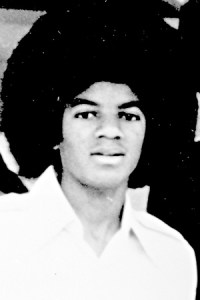
Beat me, hate me
You can never break me
Will me, thrill me
You can never kill me
Jew me, sue me
Everybody do me
Kick me, kike me
Don’t you black or white me
All I wanna say is that
They don’t really care about us
All I wanna say is that
They don’t really care about us.
(“They Don’t Care about Us,” Michael Jackson, 1996, Epic Records)
The “King of Pop,” Michael Jackson, wrote this angry song in 1995 and released it in 1996 along with two videos by Spike Lee, helping it become a top ten hit across Europe. The anti-Semitic lyrics caused controversy in the U.S and helped limit the song’s sales as it only reached Billboard’s Number 30. In the media’s nonstop blitzkrieg following the death of Michael Jackson at age 50 before his 50-date European tour, this song was skipped in favor of popular videos of Motown’s Jackson Five, “Thriller,” and all the other big hits over Jackson’s 42-year-career. As Mitch Albom wrote (“We’re Wacko in How We View Jacko”, Detroit Free Press, June 28, 2009) “Four days ago—when he was still alive—Jackson was perceived as a desperate, grotesque, off-the-radar, once-great-performer turned weird, pathetic, possibly criminal and unable to sell records the way he did. A day later, he was a world-healer, a joy-spreader, a one-of-a-kind man of magic.” Fellow celebrity, 62-year-old Farrah Fawcett, who died of cancer the same day, was nearly forgotten in the endless-Michael-media-buzz. Governor Sanford leaving his South Carolina Governor’s Mansion for five days to be with his Argentina mistress was yesterday’s news. And TV pitchman Billy Mays, who was seen on more stations and commercials than anyone else, had a day or so before his death from a sudden heart attack, also at the age of 50.
The Monday morning after Michael’s death began with more media excited consternation. Bernie Madoff testified in a New York court that he couldn’t explain his “mistake” and his “error of judgment” in defrauding unsuspecting investors of billions of dollars and said he felt ashamed and miserable about it. This didn’t dissuade the judge from giving Madoff the maximum sentence of 150 years in prison. Yet, the money Madoff stole from investors will almost certainly not be returned to them this year, next year, or at all in the next 150 years. And while Madoff rots in prison, the other crooked fraud purveyors including mortgage brokers, bankers, and other financial wizards who garnished trillions of dollars of losses for millions of people and nearly brought down the entire financial system won’t be put in prison anytime soon. Madoff turned himself in while many of the other crooks are back to work, not concerned about their questionable financial tricks of the past. The beat goes on, or as Michael might have said to all of the harbingers of financial destruction, “Beat it! Just beat it!”
We live in an absurd, paradoxical time. The economy is supposedly getting better because the stock market has stabilized and the University of Michigan reported three consecutive months of improved “consumer confidence”. Yet, over 600,000 jobs were shed again last month as the national unemployment rate surpassed 9.4% and Michigan’s surpassed 14%. As Bob Herbert pointed out (“No Recovery in Sight,” New York Times, June 27, 2009), “There are now more than five unemployed workers for every job opening in the United States. The ranks of the poor are growing, welfare rolls are rising and young American men on a broad front are falling into an abyss of joblessness.” Counting the unemployed, part-timers who want to work full-time, and those who stopped trying to find work, the “underutilized” workers in May amounted to 29.37 million. According to the Center for Labor Market Studies at Northeastern University in Boston, “Nearly 30 million working-age individuals were underutilized in May 2009, the largest number in our nation’s history.”
No wonder Detroit councilwoman Monica Conyers, wife of Congressman John Conyers, must have felt desperate enough to avoid poverty by accepting bribes in the $1.2-billion Synagro sludge-hauling deal (“Conyers took cash and jewelry, ex-aide says,” Detroit Free Press, June 29, 2009.) Who could blame her if she had to break some laws to get a $10,000 “finder’s fee” from Greektown entrepreneur, Dimitrios Papas, and some cash and jewelry from the owner of a Southfield pawnshop who wanted to relocate and expand his store? And who could blame her husband, Congressman John, from suddenly supporting a controversial hazardous waste injection well in Romulus that Papas’ company was seeking to operate? Coleman Young had to be smiling up above, knowing the legacy of Detroit corruption he wallowed in was still alive and well, even after the reign of Kwame Kilpatrick.
While we talk about absurdity, it’s stunning to know that the largest decrepit building in the country, the 3.5-million-square-foot, 43-building Packard Plant complex, which hasn’t made a Packard in over 50 years, burns every week or so, causing Detroit firefighters and their rigs endless hours of battling the blazes from expanding (“Tallying up Detroit’s absurdities,” Bill McGraw, Detroit Free Press, June 29, 2009.) “We’re here about every week,” said Deputy Chief Reginald Amos while Battalion Chief Greg Best said, “This place is a death trap.” Who owns this complex “filled with collapsing ceilings, crumbling walls, gaping holes, tons of garbage, tens of thousands of dumped items, two-story-tall roof trees and loads of graffiti?” A company called Bioresource which hasn’t paid city taxes since it bought the plant in 1987, hasn’t filed an annual report since 2000, and was declared dissolved by the state in 2003.
The entire economic calamity in our state doesn’t stop Michigan’s universities from raising tuition rates again by over 5% while the state’s economy decays. They are as out of touch as the United States government which continues to print trillions of dollars and spend even more, with no limits. Nothing stops the spending spree which accelerated in the Bush years and has grown even more astronomically since Obama’s election in January. All of the TARP, TALF, stimulus packages, automotive company buyouts, Cap and Trade bills, and health-care-for-all legislations add more and more debt while attempting to fix the economy short term. Yet, the housing and auto markets have barely budged and the impact on employment has been negligible so far.
No matter how bad it is in the rest of the country, it’s worse in Detroit. In an excellent article in Sunday’s New York Times (“G.M., Detroit and the Fall of the Black Middle Class,” Jonathon Mahler, June 28, 2009), Mahler visits the Pontiac Assembly Center in Pontiac, Michigan (Plant 6) and employee Marvin Powell, a church-going auto worker, before we learn that the plant will be closing around October 1st. The article is about the decline of the American automotive industry and its affects on the middle class, especially the black middle class.
Michael Jackson, of course, didn’t have to worry about economic survival as his family made lots of money in Motown and Jackson made millions more in the disco era and then in the MTV 80s. He worked for Motown in its later years of glory and then made history in the music industry’s most lucrative years, becoming the best selling pop star of his generation. Like GM, Michael was king then, while the auto and music world were dominated by just a handful of companies. Then, the years of Neverland came and the skin color changes and the physical pain doused with prescription pain killers, then the trials of child abuse and eventual acquittal of charges. The last few years didn’t get any better for Jackson.
Like Madoff, Michael lived in glory and torment. Today, Madoff tells the judge, “How do you excuse lying and deceiving thousands of investors? I live in an almost tormented state now thinking about all of the pain and suffering I've created.” Madoff, like Michael before him, was supposedly tormented from the shame of his incredible fraud but his suffering came because he caused so much pain for thousands of people.
The absurdity is beginning to ease. Conyers has quit as Detroit Councilwoman, Governor Sanford is still clinging to his Governor’s office, Madoff is set for 3 more lives in jail, pitchman Billy Mays (viewed on television 400 times a week) is dead, and Jackson is gone but certainly never forgotten. The world has changed so fast in the last 50 years but it seemed to change even faster in the last week.
When I was on a European cruise last week with my family, I didn’t know that Jackson was scheduled to tour there. But I knew that Spain’s unemployment was higher than Michigan’s and that pick-pockets and thieves were everywhere. I felt like I was back in Detroit as we bought two door alarms and a special pick-proof wallet to wear. After three days in Italy, we docked in the Southern Riviera in France and walking around a street market near the shore, Kyle found three old postcards from the heyday of Detroit, when postcards cost one cent each. I bought the General Motors Building on West Grand Boulevard, the Michigan Central Station, and the “Heart of Detroit” for a combined 14 dollars (or ten euros.) On the back of the “Heart of Detroit” postcard was written, “In the heart of the city is Campus Martius surrounded by the most modern of Detroit’s office buildings—the Penobscot building, the Union Trust Building and the National Bank of Detroit with the City Hall in the foreground.” Imagine a time when Detroit was a thriving metropolis and GM its invincible leader.
I felt saddened that I had to find the glory days of Detroit in France. It is stunning to see how far that Detroit has fallen in my lifetime. Today, as one of Powell’s co-workers told Mahler of the New York Times, “People are worried about everything right now.” When Powell was asked how to prepare for the paralyzing notion of losing the one job he has known, Powell said, “You’ve got to have the mind-set that you can achieve greatness.”
I would take quiet, courageous survival rather than greatness. I’d be happy for a simple quest for normality instead of absurdity. In the midst of all of this decay and death, I’m afraid it’s as good as we’re going to get.





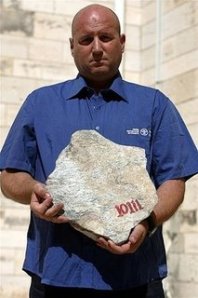
Did you ever feel really badly when you took something you weren’t supposed to? This story is a lesson in guilt, atonement, and forgiveness, involving one really big rock.
JERUSALEM (AFP) – A guilt-ridden New Yorker has returned a massive marble stone he took from an excavation site in Jerusalem's Old City 12 years ago, Israel's Antiquities Authority said on Tuesday. The 21-kilo (46-pound) piece of 9th century marble column disappeared from an Israeli Antiquities Authority (IAA) dig in 1997. Several weeks ago the authority received an email from a priest in New York State who requested forgiveness on behalf of a member of his congregation. "The fellow confessed to me that 12 years ago he took a stone from Jerusalem and his conscience has bothered him ever since. I wish to return the stone to Israel and hope that you will forgive the man for his transgression," the cleric wrote, according to a statement from the IAA. The stone was returned this week with a letter from the "thief," who said he was given it by an Israeli tour guide during a visit to Israel. "Only later did I realize that he probably took the stone from the excavation without permission," wrote the man, whose name has not been released. "For the past twelve years since then, rather than remind me of the prayer for Jerusalem, I am reminded of the mistake I made when I removed the stone from its proper place in Israel. I am asking for your forgiveness." Shay Bar Tura, deputy director of the IAA unit for the prevention of antiquities theft, said no legal action would be taken "because of the unique case of sincerity and the fact that the item was ultimately returned." (“Guilt-ridden New Yorker returns stolen rock to Israel,” Yahoo News, June 2, 2009)
Man with Stone: Father, I must confess a horrible sin. I feel absolutely terrible.
Father: What happened, my son? Did you cheat on your wife? Did you murder your next door neighbor?
Man with Stone: Worse, I took a valuable possession 12 years ago and it’s been haunting me ever since. I must confess to this crime once and for all.
Father: What did you steal, your mother-in-law’s diamond ring? Your best friend’s car?
Man with Stone: No, I took a valuable rock, a really big rock.
Father: A rock? Was it a piece of the tablets of the Ten Commandments? Was it the stone with the sword in it?
Man with Stone: It was a 46 pound rock an Israeli tour guide gave me as a souvenir.
Father: What? He didn’t give you permission to take it?
Man with Stone: Not that I remember; that’s why I feel so bad. And I have had 12 years of sleepless nights because of it.
Father: Look, I have some connections. Let me call my contacts in Israel. For now, just say 12 Hail Mary’s and an Amidah for good measure. Do you have your cell by chance?
Man with Stone: Sure, but I don’t have the international plan.
Father: Okay, I’ll call collect. Shay, my man, vus machs da?
Shay Bar Tura (Director of IAA unit for the prevention of antiquities theft): Not much, papa. What can I do you out of?
Father: Shay, I got a problem. One of my congregants took something from your land a few years ago and he really feels badly about it. Here, Stoneman, you tell Shay.
Man with Stone: For the past twelve years, rather than remind me of the prayer for Jerusalem, I am reminded of the mistake I made when I removed the stone from its proper place in Israel. I am asking for your forgiveness.
Shay: Well, only God can forgive you for your indiscretion, but I can tell you that with your unique case of sincerity, I am willing to let bygones be bygones. Keep the rock.
Man with Stone: I can’t keep it. I’ve been carrying it metaphorically for 144 months and the weight is killing me. I have to send it back. Should I send it UPS or Fed Ex? Do you want it Next Day Air?
Shay: How much does it weigh?
Man with Stone: 46 pounds.
Shay: 46 pounds? Are you kidding me? How were you planning to package this up? In a box? Cellophane wrap? I’m telling you now; we have plenty of stones here, just like that one. So just keep the stone, please. It’s my pleasure.
Man with Stone: No way. It has to go back. I’ll pay any price and ship anyway to get it off my back.
Shay: Please, Stoneman, keep the fakakta rock.
Man with Stone: Shay, with all sincerity, I just can’t. I have to get it off my chest today.
Shay: Oy vehzmir. I’ll send you a UPS pick-up slip over the internet. Let me get Haim, my receiving manager, to give you the info. Is the Father still there?
Father: Yes, Shay.
Shay: Father, you and Stoneman have really done a mitzvah. But can I ask you next time, if you or any of your congregants are given a 46 pound stone, just say no. Just say no way.
Seven days later, the marble stone is received by Haim Shchupak in a tattered box, the rock sticking straight out. Luckily, the receiving clerk’s hand is not cut open. Haim calls the man with the stone.
Man with Stone: Hello?
Haim: Stoneman, I got the rock. What kind of fershlugina box did you use anyway?
Man with Stone: I don’t know. I got it from my garage.
Haim: Well, I had my head inspector take a digital photo of the stone, so you know it’s now back in good hands. You can see how delighted I am that we have the missing stone.
Man with Stone: Thanks a lot. I really appreciate it and tell Shay I am so happy that Israel is not suing me for First Degree Meditated Theft. I have learned my lesson and will never, ever steal stones again. By the way, if anyone asks, I have never seen that missing yellow torn parchment with the squiggly lines of words I can’t decipher. I know nothing.


The White House’s statement was: “Today will rank as another historic day for the company—the end of an old General Motors and the beginning of a new one.” Talk about putting bright, shiny red lipstick on a pig destined for slaughter.
I keep thinking of the quote from Hamlet: “Something is rotten in the state of Denmark.” But today, the rot from the economic dumpster is coming from the state of Michigan and the city of Detroit.
When I was born in 1957, General Motors was the American iconic company, more powerful and dominant than any other in the world. The automotive industry was gigantic and the city of Detroit its hub and wheel. Today, General Motors, trading under 75 cents per share, is making history by declaring bankruptcy in New York (not Detroit) courts.
The White House’s statement was: “Today will rank as another historic day for the company—the end of an old General Motors and the beginning of a new one.” Talk about putting bright, shiny red lipstick on a pig destined for slaughter. The new media term for GM is Government Motors because the government will own 60% of the “new” company, followed by the UAW, and last and certainly least, the bond holders. But the stock market is excited on this historic day as GM leaves the Dow, to be replaced by tech king, Cisco, because the Chinese economy had its third "bettter" month in a row. Oil and commodity stocks like gold and steel are on the rise again, which is one of the big factors that killed GM two years ago as high gas prices and rising steel costs followed by the collapse of the banks that provided car loans, put the double whammy on GM's large and profitable vehicles. And you can add another interesting twist to this scenario: a CNBC commentator mentioned that the investment banks should make lots of money handling the bankruptcies of GM and Chrysler.
What a world. In just the last few weeks, Visteon Corp. and Metaldyne Corp. which together employ thousands of workers in Michigan, filed for bankruptcy protection, two more bankrupt automotive suppliers. Dealerships are being closed at record rates, automotive suppliers are entering more bankruptcies, unemployment and foreclosures are still on the rise; but there are enough media-termed “green shoots” to make the investment community excited that the economy has bottomed and happy days will be here again.
65 years ago, on June 6th at Omaha Beach, Detroit helped propel the United States army on D-Day with its vehicles and weapons. General Eisenhower, “who commanded 3 million soldiers to Europe, said the weapons he valued most were the Jeep, 2 ½ ton truck, bulldozer and transport plane—all partly or fully made in Detroit.” (“When Detroit stood at attention,” Detroit Free Press, Sunday May 31, 2009) According to the Free Press, Stalin told Roosevelt three months before the Germans surrendered, “Detroit is winning the war.”
Even with new government ownership, I wouldn’t bet that GM and Chrysler are ready to become part of the U.S. military just yet. Don’t bet on anything except difficult years of more debt, lots of worry from employees, retirees, and customers, and continued uncertainty about when or where this will end. No one knows.
Automotive analyst David Cole said bluntly that Michigan could enter a “depression” if GM’s stay in bankruptcy goes beyond 90 days. Governor Granholm answered with “It’s depressing enough with what’s happening today” but that she says eventually we’ll see a new Chrysler, new GM, and “ultimately a new Michigan.”
Like our government leaders, we can put our heads in the sand and pretend that the massive debt structure begun as an agreement with the UAW in 1950 didn’t explode and eventually help suffocate GM. We can hope that the wounded company will still have enough to pay 650,000 retirees benefits including billions of dollars of health care costs. We can fantasize that each U.S. household doesn’t owe “$546,668 each, besides mortgages, car loans, credit cards, and other debt” (“What We Owe: $64 Trillion, and Counting,” Investors Business Daily, Monday, June 1, 2009) or that the stimulus plans and bailouts (including for GM and Chrysler) “pushed into the budget by President Obama and congressional Democrats” won’t “add $9 trillion to our national debt over the next 10 years alone.”
It’s comforting to imagine better days ahead: the economy growing again, debts reduced, gold and oil coming back down to earth, and the American consumer once again healthy and spending money on cars and homes. But don’t be fooled by glimmers of hope based on optimistic fantasies when the largest Michigan company is in the dumpster. Yes, we can soothe our fears by rooting for the Detroit Red Wings, a strong, first class organization, owned by a Detroiter who built a 50-year-old company that grew because of its cheap pizzas. But green shoots cannot ease the cries of Michiganders who have lost their jobs, their money, and their hopes for a better future.
A new book written by a man about his experience with his gay partner in the idyllic western Michigan lakeside city of Saugatuck is titled, At Least in the City Someone Would Hear Me Scream. If it were instead about the domestic auto industry, the title would have been, “Can’t Someone in the World Hear us Scream?”
We Michiganders are hunkered down in our homes, condos, apartments, and streets, waiting, praying for something good to eventually come. We just hope the silent screams will someday end.

Do you ever sit back and watch some poor parent have to deal with his screaming, crying kid throwing a temper tantrum for everyone to see? It’s a pleasure to know as a parent that you have lived through that tremulous period of life and can now empathize with other parents facing the scourge of their monstrous kids.
“Do you see this?” I asked Judy sitting next to me at Shabbat services. No, what, she asked. “The two kids are kissing and hugging and now they’re chasing each other around the stage.” She saw the chasing part but missed the real entertainment before it.
The rabbi sitting a few rows back walked up behind us and said, I hope you don’t write about this in your blog. I laughed. Why would I write about something as mundane as a plethora of little kids rising to the bimah on Saturday morning? I had witnessed a spectacle that woke me from my 2 1/2-hour-Hebrew-prayer-induced-semi-snooze but unless I video taped it and showed it on America’s Funniest Videos or on YouTube, the shenanigans would soon be forgotten.
After the services, I laughed to the rabbi, saying I thought it was kind of cute. Heck, the boy and girl were maybe 4 or 5 years old and yeah, they didn’t understand the sanctity of Shabbat services or being a few feet from the Torah scrolls, but kids will be kids, I thought. I wasn’t sure if the rabbi was joking or serious when he said he didn’t think it was cute at all.
This was the same rabbi who officiated years before a mock marriage ceremony of my son’s friend to my son, dressed in his friend’s mother’s dress and shoes. They were learning about Jewish rituals and what better way to learn than to participate in a semi-actual wedding a few years before same-sex marriage became legal in Massachusetts. We took a video tape of the occasion and laughed at the dress and shoes that Bev Yost donated to Kyle to wear for the big occasion. I mean it was the synagogue’s executive director’s son who was getting married to ours and she was the executive director’s wife. Kyle, agreeing to be his friend’s fictitious “wife,” didn’t mind being the big husky kid in a dress and high heels, looking a little like Rudy Giuliani in drag.
Of course, we were all a part of the educational service which wasn’t intended to be funny. But how can you not laugh at a boy dressed in drag? I still have photos of my brother, Kenny, dressed as a girl in a Halloween party at the Palace for the Detroit Pistons first home game in 1981. It’s hard not to laugh at it, even if the laughter kind stings a little bit now.
Kids don’t always mean to be funny when they get in trouble, but years later, we can laugh at their antics. It wasn’t supposed to be funny, for instance, when I opened the door to my dad’s car in the first year of the Kennedy administration, sat on the front seat, and pulled the transmission lever into reverse. The car started moving until it smacked my great grandfather’s car and left a big dent in both. My great grandfather didn’t find the actions of his great grandson very cute when he got the car repair estimate. Neither he nor my parents wanted to pay for it, and I certainly didn’t have enough money in my piggy bank to get both cars fixed.
I was not a very good kid, as reported to me over the years. I slept poorly, had bouts of colic, had unruly tonsils, rocked back and forth in the car, and liked to bite people. My cousin, Jeff, said recently he remembered sticking his finger in front of my mouth to test me and I fell for the trick, taking a big chunk out of his knuckle. And I became infamous around my neighbors when a neighbor boy talking to my parents suddenly burst out screaming. It turned out that I sunk my teeth into his tush (buttocks, rear end, or whatever word suits your fancy.) When I asked my parents how old I was, they thought I was maybe five or six. I thought, jeez, how could I be that bad in kindergarten? I had always thought I bit people when I was younger than two but grew out of my Dracula-themed need.
At least, I didn’t take a chunk out of a boy on the bimah at the synagogue.
I can think of a lot of good Yiddish words for trouble-making kids like me or the two smoochers at shul. How about this? I was a pisher who acted like a shmendrick with a lot of chutzpah as I noshed on some tuches.
Do you ever sit back and watch some poor parent have to deal with his screaming, crying kid throwing a temper tantrum for everyone to see? It’s a pleasure to know as a parent that you have lived through that tremulous period of life and can now empathize with other parents facing the scourge of their monstrous kids.
Now, I just sit back and laugh at the trouble makers and pretend it’s a scene from America’s Funniest Videos or wait for the day when I have to be subjected to a grandparent’s nightmare: an embarrassing grandchild, driving the adults nuts, without any shame or guilt.
When I’m 64, I will make sure I’m wearing a baseball cap and when the moment comes when my grandson does something stupid, slide the bill down over my eyes and say to myself like Colonel Klink from Hogan’s Heroes: “I see nothing. Whose kid is that anyways?”


Can you picture this on your computer or cellphone? “The United States Government is following you on Twitter. You reached 48 miles per hour today on a 40-mile-per-hour road. You owe $150 which you can pay at www.ustreasury.gov. And don’t forget the Hershey’s KitKat bar you just snuck past the remote camera. That’s 80 calories over your lunch snack allowance which will cost another $60, payable to us. And we still show you are overdue for your swine flu virus shot and your tetanus shot. You have 10 days to comply. Have a nice day.”
I just got my third notice that someone is “following me on Twitter.” I didn’t know what I was getting into when I signed up on the advice of a friend who wrote that I could follow his comedy club schedule and his meetings with “comics and celebrities.”
I was curious about being the voyeur but I don’t think I like being followed. I still haven’t tweeted yet.
The only twitter I ever heard about was Conway until this new form of internet time-wasting became well known. The definitions of the word, “twitter,” are to “utter a succession of small, tremulous sounds, as a bird,” to “talk lightly and rapidly, esp. of trivial matters; chatter,” to “titter; giggle,” and to “tremble with excitement or the like; be in a flutter.”
It seems to me that the name is accurate. Twitter is limited to 140 characters of fluttering, chattering, giggling triviality. If I downloaded the TwitterBerry for my BlackBerry, I could let you know when I ate my lunch, took a nap, went to the bathroom, or answered an email. I know you must be trembling with excitement at the prospect of knowing every trivial detail about my life, but this is what the world has come to.
Because Oprah tweeted “FEELING REALLY 21st CENTURY” and other celebrities tweet to feel watched and goo-goo’d at, the rest of the chattering classes follow. A woman tweeted, “Cisco just offered me a job! Now I have to weight the utility of a fatty paycheck against the daily commute to San Jose and hating the work.” And even the mammoth and influential General Electric began its own “Tweet Squad” site this month. (“Managing the Tweets,” Business Week, June 1, 2009) It’s enough to make you turn back nostalgically to the time when a simple email was fast and exciting. Now, the young would call basic email “snail mail.”
Everything’s an overwhelming, hyperkinetic race. It’s not enough to be overwhelmed by the succession of Chrysler bankrolled by the U.S. government going Chapter 11 and GM pushed the same direction with another $30 billion of taxpayer money. It’s not enough to hear Bill Gross from PIMCO say that the United States will probably lose its AAA credit rating or that AIG’s government installed CEO, Ed Liddy, will step down. (I guess the $1 per year salary is too much for what he’s done.)
The amount of news and information comes fast and furiously. Who has time to be nervous about the astronomical debt the U.S. is accumulating or the way the government keeps pushing into business and health care and our private lives. Is freedom a thing of the past? Is Communist China copying us or are we copying them? When a court can force a mother to give her child another round of vomiting-inducing chemotherapy because it’s the most doctor-accepted way to save him, I know that we have finally reached the status of China.
Well, that didn’t take long, did it? Daniel Hauser, who has Hodgkin’s lymphoma, and his mother are on the run from the “authorities” because they are terrified of getting more of the violent side effects from more rounds of chemo and want to find something less toxic to try. Anyone who thinks that someone should be forced to take chemo obviously has no idea what chemo does. Even though chemo can often save a young child’s life, it usually has devastating and debilitating side effects, such as renal failure. (“Don’t judge the chemo kid,” Rahul K. Parikh, M.D. www.salon.com.)
Now, the United States is helping to run General Motors, the courts dictate medical treatment for a child, American taxpayers pay the bills for the largest insurance company, and cars will be forced to get better mileage no matter how many more deaths by car accidents are caused. You would think there would be nothing but furious chatter about what’s going on, but what is everybody focused on? Twitter, Facebook, celebrity watches and all sorts of other mindless ways to escape.
Can you picture this on your computer or cellphone? “The United States Government is watching you on Twitter. You reached 48 miles per hour today on a 40-mile-per-hour road. You owe $150 which you can pay at www.ustreasury.gov. And don’t forget the Hershey’s KitKat bar you just snuck past the remote camera. That’s 80 calories over your lunch snack allowance. Another $60, payable to us. And we still show you are overdue for your swine flu virus shot and your tetanus shot. You have 10 days to comply. Have a nice day.”
It’s enough to make me, the modern electronically challenged American, become an orthodox Jew. Then, I can plead religious autonomy and skip all the useless vaccines mandated by the government. I can turn off my cell phone and electronic gadgets and focus on reading and praying on Saturday. I can leave all electronic messages out of my life and reach inside myself and let the world go.
As Thoreau wrote in Walden, “Most of the luxuries and many of the so-called comforts of life are not only not indispensable, but positive hindrances to the elevation of mankind.” On this first night of the Sabbath, I should stop chattering and end this writing and pay no more attention to all this useless information.
I can leave all the trivial chatter behind and go outside and focus instead on the twittering of birds. Like listening to a lovely Hebrew melody sung by a cantor or an Italian song by Andrea Bocelli, I can close my eyes and just listen.
I will twitter the time away, understanding no words except the timeless magic of the music of birds. This is the way twittering was meant to be.

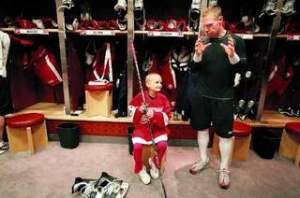


“IN MEMORY OF MADDIE—People in Michigan—even those who don’t listen to country music—have a special place in their hearts for Rodney Atkins, and it’s all because of Maddie Trudel. The 7-year-old St. Clair girl, whose struggle with bone cancer was chronicled in a series of Free Press articles in 2006, was an Atkins fan, and she told the Free Press ‘If You’re Going Through Hell (Before the Devil Even Knows)’ was her favorite song.” Detroit Free Press, Greg Crawford, May 14, 2009, Play 13
It hit me 11 days before Memorial Day. There was that photo in the Free Press I hadn’t seen in over two years of smiling little Maddie in a Red Wings jersey with her arms draped around her dad Paul at a Red Wings exhibition game in 2006.
Maybe it was because her favorite Wing, Kris Draper, had just returned to help lift the Red Wings to a 4-3 win in Game 7 of the Semi-Finals against the Anaheim Ducks. Maybe it was because Rodney Atkins was coming back to Detroit to play in the Downtown Hoedown, the same Atkins who played for Maddie a month before her death in her C.S. Mott’s Hospital room and then dedicated his performance in a benefit concert for the Make-A-Wish Foundation to the memory of Maddie. I became haunted again by the little girl as I had been in the summer and fall of 2006.
I had started writing a poem about Maddie after she died on November 26, 2006 but I only got through a few stanzas. My daughter, Marlee, 11 at the time, finished a poem about Maddie and sent it to her father.
After a series of powerful articles in 2006 written by Jeff Seidel in the Detroit Free Press, many in the metropolitan area of Detroit became connected to this little girl with the beautiful smile and incredible courage. We felt her trip through hellish pain, the intense love between father and daughter, and were lifted by her joy when she dressed like Cinderella at Disney World.
When I read that she fell asleep for the last time in her pink Princess nightgown under a Red Wings jersey, I felt like a balloon with the air sucked out. Jeff Seidel wrote, “For several months, Paul Trudel showed Maddie how to live life while dancing away from death. But the end was near. He had one last lesson to teach his daughter, the hardest one of all—how to let go and soar with the angels.” (“MADELEINE ROSE TRUDEL/1999-2006: Pain, love filled Maddie’s final days,” Detroit Free Press, Jeff Seidel, November 27, 2006)
After viewing the photo again, I began to wonder if Paul would attend the Allison DuBois “Till We Meet Again” tour the coming Sunday. I started to imagine that he would join Judy, Ilana, Marlee, and me in the audience and hear comforting words from Maddie or from Maddie’s mother, Alison, who died four years before Maddie.
Ilana and Marlee had wanted me to get tickets a few months earlier to see the real Allison DuBois, the psychic who is the inspiration for the NBC television series, Medium. Like me, they have watched the show from its beginning which shows Allison played by Patricia Arquette, helping to solve murder mysteries for the district attorney in Phoenix. She dreams, sees ghosts, hears words from beyond, all for the purpose of finding missing children and bringing justice for families of murdered victims.
The real Allison DuBois was scheduled to visit Unity of Toledo on Executive Parkway. On Sunday, after we drove over an hour to get there, we entered and passed by the Metaphysical Library in the church, took our seats and waited for something special from the great beyond. Allison sat on one chair for over two hours as we tried twisting our necks to see her while she furiously scribbled notes and pictures after audience members voiced names of their loved ones whom had passed.
Allison connected to a daughter who was tragically killed by a drunk driver in Medina, Ohio two years before on the day of her parents’ 25th anniversary. She said that the pain that the mother felt helped block the daughter’s happiness from coming through. The mother said that her daughter hated alcohol and was vehemently opposed to driving after drinking. Allison said that her daughter may have had a premonition that she would eventually die the way she did and yet, she kept seeing hundreds of colorful balloons rising to the sky in honor of her daughter.
Another woman asked if she should leave her husband after 19 years. Allison wouldn’t say she should leave but told her that her husband was distant and “had many secrets.” Another woman who lost both of her sisters mentioned that her sister’s hair dresser was the same as Allison’s. Another asked how her daughter had died in a bathtub but Allison said it was an accident and that she was shown a head hurting. The woman vehemently answered that the coroner found no head injuries and ruled the death “unsolved.” The confrontation between them was enough to compel Allison to take a 10-minute break.
DuBois said the dead have the same personalities as they do in their lives and that they often are viewed as if they are at their peak ages, usually younger than when they died. She said that the dead often visit us with a phone call with no one on the line, or when lights flicker and electronic gadgets magically turn on by themselves. She said that smokers still smoke in the afterlife and people who love to eat still eat in heaven. Puzzled, I wondered if she meant some kind of metaphysical smoke and isn’t a smoking habit just a physical desire of the body?
A woman whose dad died of bone cancer three years earlier asked about him. Allison said he was still the life of the party and heard the words that he was “the luckiest man in the world.” When a woman rose and told Allison about her sister who died in a car accident after drinking, Allison read how her sister was the trouble maker of the family and liked to take chances. She could hear the word, “stupid,” repeated from the dead sibling, describing herself. Allison told the sister still living that she was always the good girl, conscious and cautious, and that her dead sister lived on the edge. She apologized for the gently sarcastic words that came from her sister on the other side. Her sister asked, “Who’s the Angel Now?”
Judy, Marlee, and Ilana kept asking me to raise my hand to ask about Kenny. Marlee wanted to know if it was Kenny whom she dreamt about every night about four years ago, often waking her in the middle of the night. She wanted to know if he was still watching her and also what she was going to do in her life. Would she be an actress, psychologist, photographer, singer-songwriter, or fashion magazine editor? She wanted to see if the medium could give her some answers.
I told Marlee that many of the people in the audience had lost loved ones recently and needed to find comfort. But I raised my hands anyways as they asked me to, prepared to ask a number of questions: Is Kenny still 13 in his state of energy? Does he ever follow the woman whose car took his life? Does he know that I write about him and does he hover over the young kids playing basketball with his name on their shirts? How does someone smoke in the great beyond anyways? Instead of being content in the afterlife, aren’t those who were angry and abusive in life still that way in the great sky above?
After two hours and fifteen minutes, the session ended before I was called. I was never read by Allison and went home, a little disappointed. I hoped for certain details that confirmed something beyond what we knew. Judy and I both felt a little uneasy and unconvinced by the whole scene and left with a certain feeling of uncertainty. Who knows what the truth is after we die?
I am by nature skeptical but I have heard enough during the readings from Allison, Rebecca Rosen, and John Edward to know that spirits of the dead may be with us after they die. The psychic mediums are absolutely convinced that our dead loved ones stay with us. DuBois writes in her book, Don’t Kiss Them Good-Bye, “I don’t like to say good-bye because it’s too final. I like to say, ‘Till we meet again.’”
Paul Trudel told his daughter before she died, “You will come out of your body and turn. You will see yourself in the room and me, and they you’ll turn back over and you will see a tunnel and light. You will be drawn to it. You won’t walk. You will be pulled to it. You will feel the love of God, the light is God. And at the end of the tunnel, you will see everybody who knows you, waiting for you.”
It is comforting to feel after a psychic reading that Paul is right. But still, there is a lot that seems hokey and somewhat of a magic trick to a medium’s reading. Allison knows she is a celebrity with her own TV show and sometimes acts like it. She has certain rules and doesn’t like to be contradicted. She said if she admits to a misreading or mistake, how does that make the others who just got comfort from her reading feel? I don’t know but I wonder, doesn’t that make what she says a little suspect? Yet, I still wanted to be called on and see if she could hear or see something about Kenny or my cousin Mike or uncle Sid that was undeniably true and could give me the certainty I needed that Kenny and the others are still alive in some form of spirit.
This is the secret of these readings and it’s why the lost and lonely pay a lot to hear glimpses from beyond. It is the business of belief, the belief that our loved ones’ bodies die but not their souls. That is the clear message and one that I have kind of believed in for many years. I still have some doubts but I listen to mediums because it brings me what it brings others, the sense that all things pass but all things last; that we aren’t going anywhere, even in death.
In one of Allison’s readings, she kept hearing the song by Lee Ann Womack, “I Hope You Dance,” with its chorus, “Promise me that you’ll give faith a fighting chance, And when you get the choice to sit it out or dance. Dance…I hope you dance.” Maddie danced away from death as long as she could but her father with complete faith in God promised her, “You are going to heaven. It’s paradise.”
When she died, Seidel wrote, “Trudel wrapped his daughter in her favorite blanket and carried her down the stairs, outside to the van.” He drove her to the funeral home where “he placed her on a cot, with a pillow, sheet and blanket. He spent more than a half-hour with her. He kissed her on the lips, nose and forehead over and over. ‘I love you,’ he said. ‘I’m going to miss you.’”
What keeps Paul and the bereaved alive and hopeful is the prayer that someday, the missing will end and we will meet our lost loved ones again. But today, what gives me comfort is imagining Maddie as a little dancing angel holding a big red balloon, dancing with the young girl from Medina with a green balloon, the “luckiest man in the world” father with a blue balloon, the “stupid” girl who is now an angel with a yellow balloon, and my brother Kenny with a turquoise balloon.
In my imagination, I see them all dancing together in a parade of balloons, floating peacefully amidst the clouds, watching us. In this week before Memorial Day, we need to have faith that one day, we will hold them again and be able to dance with our angels.

Dear Dad, Thank you for coming into Mrs. Oljace’s class to tell us about your writing. It was surprising to me because even as your own daughter I haven’t read or heard much of your writing. I was actually shocked myself at how good of a writer you actually are. Personally, you presented and read better than I ever expected you would. Thanks. XO, Marlee
Mrs. Oljace’s 7th Grade ELA Class, 3rd Hour, 4/18/08
When I was asked by Mrs. Oljace to come back to Dunckel Middle School and read some of my poems to her new seventh graders, I was hesitant. The day last April spent in front of my daughter Marlee’s class and three other ELA (English Language Arts) classes was meaningful. I understood then how tiring yet inspiring it is to stand in front of almost 100 seventh graders throughout one day, telling them writing is more than a worthless exercise to be avoided at all costs. Still, I knew it wouldn’t be easy to read more poems to a new group of seventh graders, including one about my brother who died six weeks after completing seventh grade.
I wasn’t sure what to do but after reading again some of the heartfelt and thankful responses from the seventh grade class of 2008, I acquiesced, figuring: what’s one day in my life?
I brought my two books, picked a few poems in them, brought a couple of recent essays and signed in at the front office of Dunckel, where Judy volunteers most every Monday morning. I picked up my name tag and proceeded to Room 110, just a few minutes early.
The kids came in and one girl yelled out, “Hi, Mr. Goldman.” It didn’t hurt that my name was written on the blackboard, and that Mrs. Oljace had prepped her students with, “It is nice to actually have an adult address the class who likes to write.” She said she was proud that a parent would actually take time to write and then read to her students. For me, it was one of the few times that I have ever read my writings aloud to any audience. So the need was mutual.
Last year, I read my autobiographical essay, “Fifth Grade,” and poems “Down,” “Safa,” and “Kenny’s Song,” among others. This year, I decided to read a couple of poems, “Nightmare with Shoes” and “A Bad Poem,” written during college, followed it up with “Pass Away” written three years after Kenny’s death, and “Severance,” about firing an outside salesperson 13 years ago. Looking for something relevant, I read “The End of the World,” written during the last avian flu scare (instead of the current swine flu scare) and then read “Am I Getting Old,” an essay about going to a rock concert with Marlee. I also read to two classes “Eloise,” the poem about my grandmother who lived the last fifteen years of her life in a mental institution, and “A Mother’s Courage,” an essay about a mother fighting for the life of her son with cancer.
One kid asked, “Do you write any funny poems?” I admitted that I had written a couple of funny poems and some satirical essays but as I mentioned to them, writing for me was a therapeutic way to express my most compelling thoughts and feelings. If you want comedy, I thought, watch The Office or 30 Rock on TV.
After the readings, the students asked questions, then spent a few minutes trying to write their own poems, and some of them read their poems in front of the class. I was never good writing a poem within a short deadline and empathized with those who struggled to come up with words. One girl read a two line poem about how school sucks and another wrote a poem that complained about how mean and ugly another student (not in the same room) was. Other students read poems about dancing, the Red Wings, soccer, irritation, one wrote about the loss of her baby brother, another about her grandfather’s death, and a girl wrote a touching poem to her father about the sadness she felt during her father’s very long travels away from home.
I mentioned how kids now listen to poetry in hip-hop songs like Eminem’s and write more than ever, with instant messaging and texting. I said that some texts are similar to poems. (Maybe one day we’ll read the Collected Love and Text Poems of Kwame Kilpatrick.) But most importantly, I wanted the kids to know that writing doesn’t have to be boring and meaningless. It can instead be a way to express what’s most hidden and a way to survive life after school.
I wanted to tell the girl that school might suck now but later on, it may become your most cherished memory. Wait till you are working in a droll office or unemployed or fighting just to earn a paycheck. Who knows what will be when these seventh graders are working in the “real world?” Will GM or Chrysler still exist? Will most jobs be done for online companies? Are U.S. companies going to survive, competing against China?
For now, these kids can stay in their sheltered worlds, not worried about the future of the economy and whether they will be able to survive. They can text and watch TV and talk on their cell phones and listen to their iPods without fear. But when they graduate, being able to write is not only critical for a future job but is one way to navigate the world and to understand oneself.
Seventh grade is the point right in the middle of middle school, between being newly scared after elementary school and being prepped for high school. Hormones start raging, puberty advances, disrespect between kids often escalates. There’s a mad sequence of bar and bat mitzvahs throughout the year and little romances begin and end. Teachers play a tug-of-war with their students as they walk into class, just aching to leave at the end of the day to play soccer or baseball, go to music or dance classes. I told the students I didn’t like to write in seventh grade but began to enjoy and take pride in my writing in tenth grade.
I don’t remember much about seventh grade except my bar mitzvah and making a record album in band. I do remember my brother’s bar mitzvah in the beginning of 1982, at the end of Kenny’s winter break during seventh grade, because I have watched the video tape over the years and can remember some of Kenny’s best friends from East Middle School on Middlebelt in Farmington Hills. It’s strange to think that my daughter, Marlee, is in a Farmington Hills middle school less than three miles away. Last year, in seventh grade, she wrote that she was “shocked” that I “presented and read better” than she ever expected I would. This year, she was excited that I was doing it again and wanted to read all the students’ letters before I did.
Last year, I rushed through a reading of “Kenny’s Song,” to avoid any voice-cracking and this year, I read “Pass Away” even faster. When I read, I didn’t think about seventh grade being Kenny’s last grade 27 years ago. I didn’t dwell on the fact that the kids were the same age Kenny was before he died. Nevertheless, many kids wrote to me how touched they were by the poem, “Pass Away,” and were inspired enough to write for themselves. One student wrote, “You inspired me to write some poetry, and you taught me that poetry can be about anything you want it to be, and that nobody can grade what you really feel.” She’s right. Nobody can grade what your really feel or think or write to yourself.
I wish Kenny had a chance to write some poems and stories that we could still cherish to this day. And I wish that many of these kids can become good writers so that they can express what’s deep inside them and always be able to tell their own stories.
Last year, I wrote letters to Mrs. Oljace’s classes and wrote in each one of them, “Each of your lives is a gift. Cherish your life, enjoy yourself every day, and share what you think and feel with others, both in speech and in writing. Tell your story. Each of you has something unique to say, songs and stories to be told, so don’t be afraid to say it.”
I believe it now more than ever. I also wrote to the seventh graders last year, “As you know by hearing my poems about the loss of friends and loved ones, you can’t take life for granted. Make every day count.”
As I think about Marlee growing up and Kenny never growing up and think of Mrs. Oljace’s seventh graders passing their way from children to young adults, I just want to stop each and every one of them in the hallway on their way to class and say it again, “Make every day count. Make every day count!”

Last month, Diana wrote, “Cancer is a crazy thing. What works for one kid might not work for another. That is a painful lesson that most of us parents learn through this process. You follow your instincts and you have to trust in your faith and yourself. In the end, that is the only thing that gets you through each day.”
Noah was given a new experimental drug a few weeks before Mother’s Day. The drug, named MLN8237, is given on a three week cycle, for seven days straight, then off for two weeks. Scans are taken every six weeks, blood counts on days 1, 4, and 7 during the week of the medicine, once a week on the weeks off the drug.
His mother, Diana, wrote that “this is a hard process.” The drug is a stronger version of Valium, which will make Noah sleep longer than his already-long twelve hours a night. His counts will drop but hopefully, the drug “will stabilize the rest of of the disease and keep it from spreading.” Dr. Mody and Dr. Yanik from the the University of Michigan C.S. Mott Children’s Hospital believe that within the next 3-5 years, MLN8237 may be used as standard protocol for newly diagnosed kids with Neuroblastoma.
Diana prays that Noah will make it to 5 and then live for at least another 3-5 years. 25 months ago on www.carepages.com, she wrote that “Noah finished his second round of chemo.” Since then, she has been fighting the daily battles of a mother dedicated to giving her son the best, longest life that she can. The cycle is this: another round of chemo and another prayer for life.
Noah’s mother works for Pella and somehow manages to work between 40-70 hours a week while taking care of Noah. She doesn’t complain. She is thankful for every moment she gets to spend with her little boy who loves dressing up as Spiderman. Noah sees himself as the young, courageous superhero, fighting against Cancer, the bad guy. His mom, herself a courageous hero, is just happy to be a mother on Mother’s Day, able to devote her life to a boy who would not be here without her.
Diana was told two years ago that Noah would probably not survive beyond the next six months. She listened sadly to the advice of that cancer doctor and then went to another doctor from U of M who told her not to give up. Dr. Yanik promised to do everything in his power to save her son’s life.
Last month, Diana wrote, “Cancer is a crazy thing. What works for one kid might not work for another. That is a painful lesson that most of us parents learn through this process. You follow your instincts and you have to trust in your faith and yourself. In the end, that is the only thing that gets you through each day.”
Diana usually ends her www.carepages.com entries with “Thank you for the prayers. Keep them coming!” On this Mother’s Day, pray for mothers like Diana who have to battle to keep their kids alive. Pray that she will get a Mother’s Day gift that so many other parents take for granted, which is simply to have a healthy child.

Losing enough times can cure the most addicted of gamblers, or at least it did with me. I realized then and there that I disliked losing a lot more than I liked winning, and that was the lesson that has stuck with me to this day.
Before the 135th Kentucky Derby, Steve Janus from www.BetFirms.com wrote about Mine That Bird, “Lowest rated horse in the field by any standards. Stay away.”
Anyone who bet with Bet Firms might want their money back.
When the 8th horse of the race came from far behind the pack and slithered and slipped away against the rail, passing every horse and winning the Kentucky Derby by 6 ¾ lengths, the announcers were stunned. Calvin Borel had just pulled off one of the greatest upset victories in Derby history, on a Canadian gelding that cost $9500 and was trailered with a pickup truck by his broken-legged trainer, Chip Wooley, who drove 21 hours from his New Mexico home.
What makes horse racing fun is the sheer randomness of it. Anyone who bet on the 8-16-2 Trifecta is now a lot wealthier than before because the odds against this wager were extraordinarily high. My son, Kyle, who drove to the Derby with his Kentucky-born friend from Bain, certainly didn’t pick this 50-1 shot although his mom liked the name of the 9th horse, Join in the Dance, who was 49-1, and asked Kyle to bet on it for her. Although Join in the Dance led for much of the race, Mine That Bird flew right past Dance.
The thousands who bet on other horses weren’t dancing when the Bird won. But my old Kentucky memories were. Mind you, I have only been to Kentucky once when two college friends and I drove straight through to Daytona Beach in 1978 for spring break and drove back a few days later. We noticed the signs for Kentucky and thought of horses but still, we never stopped.
The summer before Daytona was my fling at the harness race track. I had always been adamant against betting on horse races when my friend, Jeff, told me how he and his dad visited the tracks in the 70s, Hazel Park, Detroit Race Course, or Northville, to bet on horses. When he asked me to join them, I refused, saying I didn’t want to get suckered into it. Losing money just didn’t sound fun to me. But Jeff said, I could bet only $2 dollars and it was fun to guess the winner, whether winning or losing. After many times saying no, I finally said, what the hell? I’ll see what all the fuss is about.
I don’t remember the first race I bet on but I know I bet on a long shot because of the horse’s name and the $2 I bet turned into over $100. Jeff said I must be skilled at picking horses and I believed him, thinking maybe I do have the right knack.
I went a few more times to the Hazel Park Harness Raceway on 9 Mile Road and Dequindre with my friends, Jeff and Rob. In our college days, this was something to do, a way to escape the humdrum lives of college students living at home. So what if our friends got to party at U of M, MSU, and Western. We had Wayne State and could drive ourselves to the track at night.
We began to go more often and I started studying the horses more than the college homework I was supposed to be studying. I studied the odds of each horse, the jockey’s history, how many races each had one, what the horses did on their last races, did they come from behind or lead from the start, how was the name, who was the trainer, how old were they, what did the experts say. Should I bet on the winner or be conservative and just bet on one horse to show? Should I bet on the Perfecta or Trifecta and should I box it? The questions haunted my brain and I needed every minute to decide how I should wager the precious little money I had that Rob and I had earned by cutting grass in the spring-to-fall season for about 30 customers. We lived at home, were on college scholarships, and had some extra dollars in our pockets to waste on horse-racing.
I won a few times at the track and started studying the horses and began to feel like the knowledge was really paying off. Rob had other things to do at night but he was willing to give me money to chip in with me on my bets. Since he trusted me and realized that I had been accumulating horse-racing wisdom, he said we could split the winnings.
I went most every night in the summer and fall, roaming the beer-stained floors, parading around with the rest of the bettors. I went back and forth to the betting window, won a few times, but started to lose some confidence along the way. The wins started getting rarer and the losses a little more. I didn’t keep track of my bets at the track, but I started leaving with less money than I brought. And a few times, I had to tell Rob that I lost his money again. Finally, I advised him not to give me more money until I proved it was worth it.
One night at Hazel, I began to look around. I watched the men around me, their saddened eyes and their haunted looks. I could see they were simply hooked and realized they didn’t know why they were doing what they were doing. They just had to bet. Even now, I cannot forget the haunted look of a gambler's addiction.
I went to the last race of the night and said that this was it. If I won, I would come again. If I lost, it was goodbye Hazel Park. I bet every last dollar I had, leaving nothing for food or gas. My bet was for “all the marbles.” I wagered it all.
And the race began. I stood and cheered for my horse to win. I had picked it based on all the knowledge I had accumulated, the odds, the name, the last three races, the sloppiness of the track, and, not to take any more chances, I bet on the favorite and thought, how could I lose?
Easy. A long shot won, a horse I didn’t even consider, a horse like Mine That Bird. Mine was in the running but at the end slipped away into the back of the pack. I was discouraged but happy that I had made a final decision. I was never coming back to join the slumped-over, sloppy-dressed racing addicts. I was cured.
Losing enough times can cure the most addicted of gamblers, or at least it did with me. I realized then and there that I disliked losing a lot more than I liked winning, and that was the lesson that has stuck with me to this day.
I told Kyle to bet $10 on a 6-15 Perfecta box at the Kentucky Derby, and I ended up not even close. The highly rated #6 horse, Friesen Fire, ended up 18th, 43 ½ lengths behind Mine That Bird. And I didn’t care. The few times and few dollars I ever bet on a lottery ticket or horse race were just for fun, just to see if maybe one time, I could get lucky again.
What’s exciting is the fantasy of winning a big bet, thinking what might happen if the gamble pays off. But watching the lottery numbers in your hand and seeing the actual chosen numbers is usually discouraging, a real bummer. And that’s fine with me.
I will remember my fling with the horses the way it should be remembered, as a moment when I learned the folly of wasting my time and money on trying to win by betting on obscure horses. I was a fool who used to think he was smarter than he was.
W.C. Fields once said, “Never give a sucker an even break.”
I was a sucker at Hazel Park and I have been stupid more than once in my life.
My goal now is not to fall for my stupidity again.
 Aggman's Blog