Economic fear surrounds this area like a toxic cloud but that shouldn’t stop us from looking for something hopeful amidst the panic.
Like so many in the Detroit region, I have felt paralyzed by worry, consumed by the Detroit auto companies’ desperate pleas to get government bailouts, their fervent desire for survival. We’ve had to listen to a flurry of national negativity towards Detroit and its automobile industry and just wait for something to bring us a sense of optimism.
I wandered around the Internet, searching for something, but I wouldn’t have believed that the death of a 2 ½ year old boy was what I was looking for.
Kerav Roitman was an ordinary child made extraordinary by circumstances. In his short life, he was hospitalized in five different locations from the Bronx to Boston for renal and lung disease. For almost six months, his parents made a three-hour drive to Children’s Hospital of Boston twice a week before and after Kerav’s kidney transplant from his mother, Sonia, in January of 2008. People in Boston brought meals to the hospital while constant daily prayers were said on Kerav’s behalf. There were prayers written on his behalf in 42 of 50 states.
Kerav’s father, Brian Roitman, said that “the community, literally in a month or two’s time, managed to cumulatively…learn the entire Bible in merit of our son’s recuperation.” Brian said that “Throughout everything, from the worst times to the best, he always had a smile.” (“Toddler’s struggle inspires special Sefer Torah,” Devon Lash, Stamford Advocate, November 8, 2008)
All the prayers and hot meals in the world couldn’t cure Kerav, who died on August 1 from complications of an infection. But nothing could stop Kerav from inspiring a community to commission what Brian Roitman called the “ultimate memorial” in Kerav’s honor: a Sefer Torah. The Roitmans’ synagogue, Young Israel of Stamford, commissioned the project at a cost of about $35,000 as a living memorial to Kerav’s struggle.
A courageous smile of a dying boy brought about the ultimate memorial: the dedication of a scribe for almost a year to the meticulous detail of copying 304,805 little letters with a feather quill onto calfskin parchment. Kerav’s smile was the little mitzvah that inspired a community to come together for one purpose. “We are completely overwhelmed,” Kerav’s father said. “A Torah transcends a particular synagogue, a particular community, to become something that will hopefully last for centuries.”
Imagine what goes into creating a Sefer Torah. Each of the 304,805 letters must be perfectly written. If the scribe makes a mistake, he uses a double-edged razor blade to peel off the top layer of the parchment and then uses sandpaper to smooth the area. After completion, three independent proofreaders read the scroll and then scan it into a computer.
Young Israel alerted the Stamford community of the undertaking in October amidst the stock market collapse. They plan to hold a pre-Chanukah Sefer Torah Day in December. And in the months leading up to the completion of the Torah, children in the Stamford area will learn songs about the Torah, create a Torah quilt and learn portions of the text in honor of Kerav.
Like 11-year-old Brendan Foster whose last wishes before his death from leukemia helped inspire thousands to help the homeless and 18-year-old Miles Levin whose eloquent words before he died inspired those who read them to cherish every moment of life, little Kerav Boitman was a gift to all who knew him or read about him. Eliezer Silverman, chairman of Young Israel’s Torah committee, said of Kerav, “He was only with us for 30 months…but he always had a smile. His smile just melted your heart away.”
Even in the midst of financial panic in Detroit, we can stop and think of the courage of the parents of a little boy suffering from illness, the community of prayers surrounding him, and the joy he inspired to dedicate a Sefer Torah in his memory. We can take comfort in the mitzvahs evolving from one little child.
When we light the candles for Chanukah, celebrating the long light of hope that keeps Jews eternally hopeful, we can imagine little Kerav and his eternal smile. We can dream of our ancestors from the Torah surrounding him, holding candles up to his face, encouraged by his indomitable spirit.
Here, on earth, in these dark times, we must grab hold of whatever source of courage and strength we can wrap our hands around.
A Wish for the Living
Sometimes, it takes one little boy to wake us up from our selfishness.
The world’s collective fear and uncertainty over the economy was jolted by an 11-year-old boy with a puffy face. When asked what he thought were the best things in life, Brendan Foster said, “Just having one.”
Brendan Foster’s lifetime was short. When he was eight, he was diagnosed with leukemia. In early November, the doctors gave him two weeks to live. But that didn’t stop him from enjoying his life. “I had a great time,” he said a week before his death. “And until my time comes, I’m going to keep having a great time.”
Brendan’s last wish was for the bees. The 11-year-old, nicknamed the B-Man by his family, asked those who heard him to “sprinkle wildflower seeds to save the bees.” He had heard bees were in trouble.
When I watched the short segment on ABC News and CNN, I was inspired like others by the young boy’s generosity of spirit. Brendan, interviewed by a television station in Seattle, said that on the way home from a doctor’s appointment, he noticed “this big thing full of homeless people and then I thought, I should just get them something.”
“They’re probably starving, so give’em a chance, food and water.”
This simple wish inspired hundreds of others to help. A food drive was held in Los Angeles while Ohio school kids collected cans and people in Pensacola, Florida gathered goods. In Western Washington, Seattle TV station, KOMO, asked viewers to help the Stuff the Truck food drive in Brendan’s honor. Six and a half truck loads of groceries were donated and more than $60,000 in cash was raised to benefit Northwest Harvest and Food Lifeline.
Brendan’s mother, after her son died in her arms, said proudly, “He’s done more than most people dream of doing just by making a wish.”
When Brendan had been asked what made him sad, he said, “When someone gives up.” This young boy with leukemia wisely told Elisa Jaffe from KOMO news, “Follow your dreams. Don’t let anything stop you.”
In a time when so many of us fear for our livelihoods, Brendan Foster acknowledged that the best thing in life was just having a life. Forget your standard of living or your health. Just being alive is reward enough.
B-Man’s wish for the living has not gone unheard. A retired pilot asked his pilot and flight attendant friends to sprinkle wild flowers, from Bali to Brazil, on Brendan’s behalf.
Brendan’s grandmother, Pat, said that Brendan told her in his last days that he was visited three times by angels. “He tells us that when he’s an angel, he’s going to keep doing the good work.”
On this Thanksgiving, we can be thankful for those who offer such joyous giving. We can be thankful that we are alive and think of the B-Man somewhere high in the distance, “doing the good work” above us.
Then, we can try to make him proud.
“Brendan Foster: ‘I had a great time’,” Nov. 21, 2008, Elisa Jaffe, KOMO News, Seattle,
Washington
“Dying boy inspires goodwill in people near and far,” Nov. 10, 2008, KOMO Staff, KOMO News, Seattle, Washington

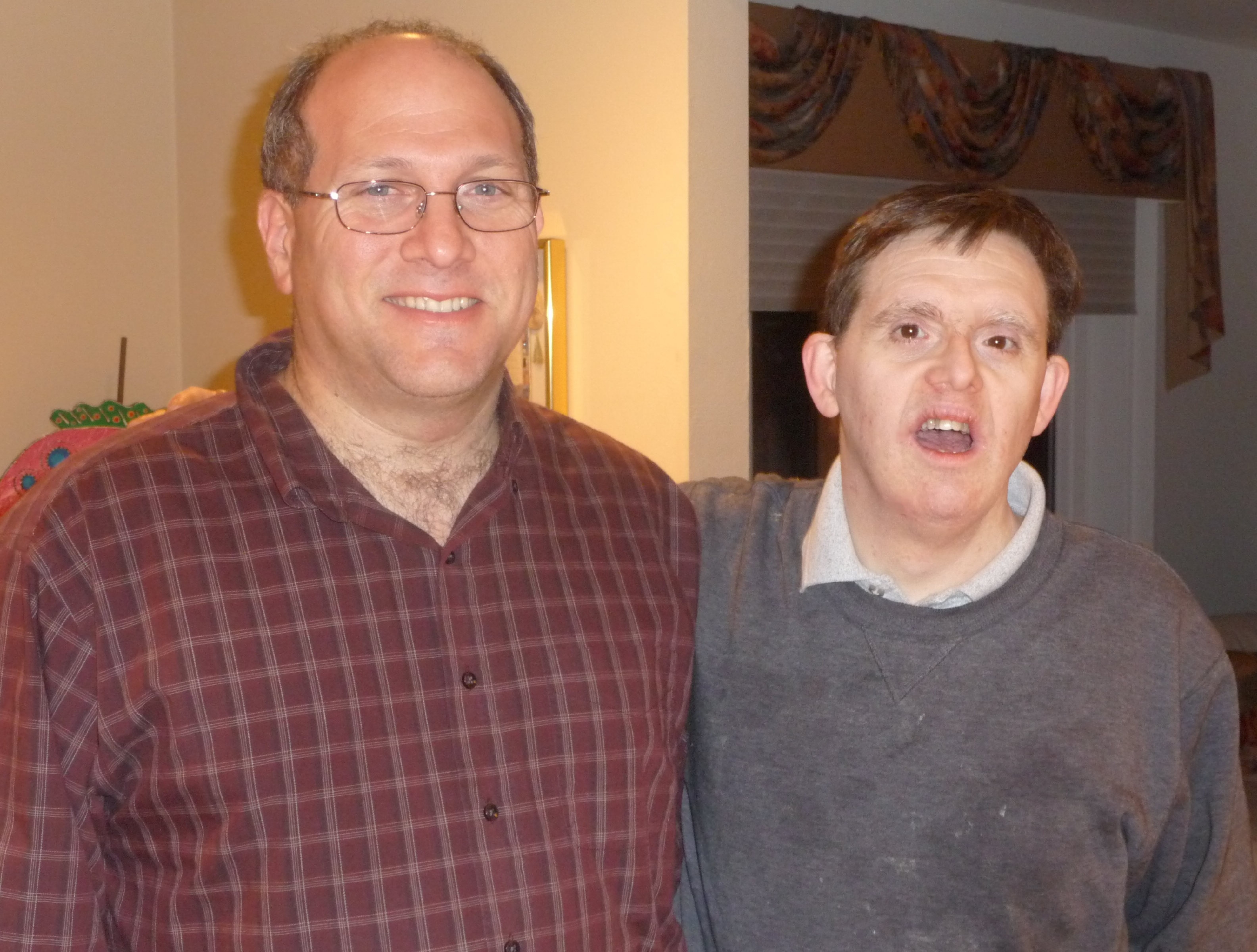
I haven’t been a big brother since my little brother’s death in the summer of 1982. But I am like a big brother to my brother-in-law, Joel, though he is only ten months younger than me.
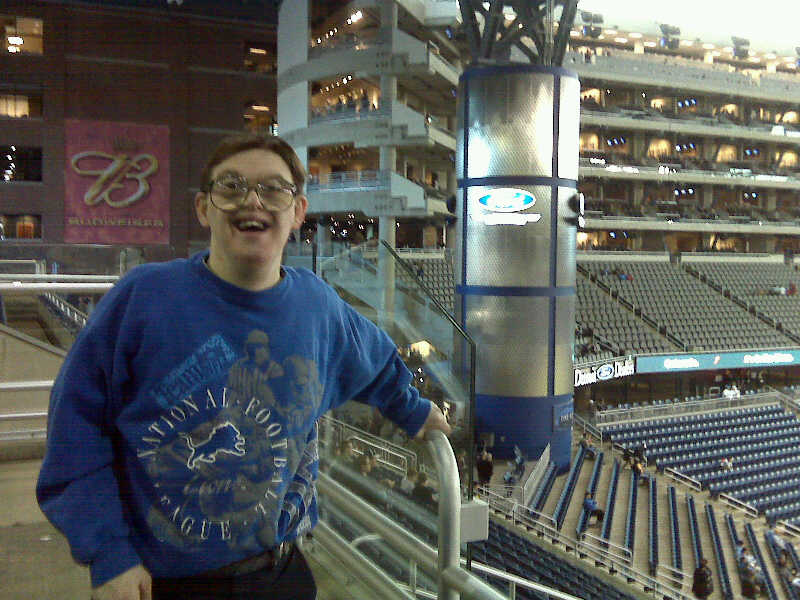
Joel anxiously waited for me to take him as I promised to the new James Bond movie, Quantum of Solace, on his 51st birthday and to a Detroit Lions football game four days later. I hoped for myself to simply escape the fear that is paralyzing my hometown and be in the moment completely, lost in the thrilling fantasies of a new Bond movie and a football game.
Although Joel is 51 years old, he gets excited when he knows that he is going to a new movie or sports game. His favorite things in life are James Bond movies, soap operas, Detroit sports teams, Passover Seders, schedules, bowling, cartoons, and spending time with me, not necessarily in that order.
Last year on his 50th birthday, he slept over my house and I took the day off work to spend it with him. We watched two DVD movies, his three favorite soap operas, went bowling, and hung out together. This year, I bought tickets so I could take him to see the Lions play the Tampa Bay Buccaneers. Even though the Lions lost their first ten games in a row, Joel still believed the Lions had a mathematical chance to be the Wild Card team and eventually make the Super Bowl.
I didn’t have the heart to tell him they won’t but he wouldn’t have accepted it anyways. He is the eternal optimist, having faith that Detroit will win, sooner or later. He doesn’t worry what is happening to the Detroit automakers. He is not concerned that our town and state are going through an economic meltdown unlike any in his 51 years of life. Detroit is weighed down by a heaviness of fear while its last mayor sits in jail. The unemployment rate in the city and state is the highest in the country. The thousands who are employed in the automotive industry or dependent on it are worried if they will have jobs next year.
Fifty-one years ago, when Detroit was “The Motor City,” Joel was born with 47 chromosomes instead of the usual 46. The National Association for Down Syndrome claims the average life expectancy of a person with Down syndrome is 55 years. So for me, each birthday with Joel is an important day to celebrate his life and forget mine.
I was hoping to escape from my reality and celebrate with Joel and his movie and sports fantasies. He has seen every Bond movie and was enthralled by the intense action of the newest though his favorite part was the familiar image and music at the end. On the day of the football game, Joel was excited to see the Detroit Tiger statue as we walked on the side of Comerica Park. There, we stopped to see the sprawling green baseball field through the gates and viewed an exhibit in front of us, featuring two legends from Detroit’s glory years, Hank Greenberg and Al Kaline.
At the front entrance of Ford Field, Joel was excited to get a football magnet and was even more joyous when the Lions took a stunning 17-0 first quarter lead. I cheered along with him and started to believe that our team might pull off a shocking upset. Unfortunately, the lead evaporated quickly as Tampa Bay scored the next 35 points. With a few minutes left in the 4th quarter and with Detroit down 38-20, Joel calculated that all we needed was two touchdowns with two two-point conversions and one field goal to win. He turned to me, pleading, “It’s not too hard. We can still do it.”
I wanted to believe in a miracle finish. I also want to believe that Detroit automakers will get a bridge loan that will allow them to return to respectability and profitability and pay the federal government back with interest.
I want to believe that we in the Detroit area can always win but I know that very few real-life stories end with happy fairy-tale endings. I learned that painful lesson on a hot July night in 1982 after my father took his youngest son to a Detroit Tigers baseball game. On the way home, less than a mile from their house, my father’s car was side-swiped by another, sending both my father and my little 13-year-old brother to the emergency room.
When my brother died after midnight, I lost faith in fairy tales. I believed then that I would never be a big brother again.
I was wrong. Even though I am only related because of my wife, I am truly Joel’s big brother. Without me, he wouldn’t go to any Detroit Tigers, Red Wings, Pistons, or Lions games. He looks forward to spending time with me and I look forward to getting swept away by his enthusiastic optimism.
I realized when I sat in the upper deck of Ford Field that I had nearly forgotten what it feels like to forget the worries of adulthood by getting lost in a forgettable sports game.
I had almost forgotten but have begun to slowly learn from a 51-year-old man with Down syndrome what it is to feel like a kid again.
“Region braces for car crash,” is the headline for this week’s Crain’s Detroit Business headline (Nov. 17, 2008.) The onslaught of newspaper headlines follows the news from Washington, D.C. as the leaders of the once-big-three plead their cases to the current Congress.
To bailout or not to bailout? That is the question being discussed in every newspaper and 24-hour-news-channel in America. Once the bailout bonanza escalated in October with the $850 package thrown together in Washington and passed quickly after the warnings about our next “Great Depression,” the stage was set for the Detroit bailout. In fact, the terror that our government “leaders” created helped bring America’s economy to its knees. Best Buy, GM, and hundreds of other companies said their business almost stopped in the midst of the panic.
It was already bad in Michigan for the last few years as gas and metal prices rose exorbitantly, putting pressure on the SUV and truck sales that Detroit automakers depended on. It was so bad that they were pressed to switch their manufacturing mainly to small fuel-efficient cars, desperately trying to compete with Toyota and Honda.
Then, the gas and commodity price bubble burst as hedge funds liquidated millions of shares, based on fear of the economy imploding. Then, the credit crisis worsened as investment bank stocks fell to new lows. And the bailout balloon was the final straw that killed confidence. People who had already stopped buying houses stopped buying cars as well, and those who wanted had hard times getting loans.
Crain’s Ryan Beene and Amy Lane write, “Economic woes facing the Detroit 3 automakers have Southeast Michigan bracing itself for losses on many fronts—jobs, personal income, revenue for industry, from taxes and, perhaps, a sense of identity.”
In a survey of Crain’s business customers is a quote from Jim Best, owner of Detroit-based Post Electric Inc. who was once a member of the Chief Executive Boards, a group of small business owners, that I’ve been a member of since 2000. Jim no longer does any work in Michigan and “watched his workforce dwindle from 150 to himself here.” He has a small operation in North Carolina, and remains in Detroit “only because his daughter is still in school.”
Jim Best says bluntly, “I have no hope whatsoever for the state of Michigan. I see no light at the end of the tunnel.” (Crain’s Detroit Business, “Nowhere to go but up?” November 17, 2008)
Despair hangs around this town like a noose, not yet squeezing the blood vessels of the neck. And sadly, all we have to hope for is a $25 billion government bailout that would allow the three companies to withstand their cash burn and save them a few months from going into Chapter 11 bankruptcy. Still, that’s better than nothing.
Ford Motor’s CEO, Alan Mulally, says that if an auto company were to file for Chapter 11 bankruptcy protection, the situation might quickly move to Chapter 7, or liquidation. “Going into that kind of a restructuring, where the consumer has great choices, sales would fall off so fast that you could never recover on the cost side and get out of it,” he said.
The three heads of the Detroit 3 are in Washington, D.C., pleading their cases that they need a bridge loan for salvation. The senators don’t seem impressed. In fact, most seem to loathe the Detroit automotive companies. The southern senators don’t want to hurt the Japanese manufacturers in their states, some want to break up the unions, and the rest want to change the auto manufacturers into green companies that sprout small cars that get 50 miles per gallon.
AIG never had to go through this two day public humiliation to get the $143 billion that they have already received. They still sponsor junkets for insurance salesmen at posh hotels and though it breeds angry blogs, the government has not stopped the flood of money. The belief is that AIG is too big to fail and too connected to the rest of the economy.
If you don’t think GM, Ford, and Chrysler have their tentacles all over our national economy, you are dead wrong.
George Will and Mitt Romney are just two of many pleading to the government to let our car companies go. Romney is urgently dire: “IF General Motors, Ford and Chrysler get the bailout that their chief executives asked for yesterday, you can kiss the American automotive industry goodbye. It won’t go overnight, but its demise will be virtually guaranteed.”
Without that bailout, Detroit will need to drastically restructure itself. With it, the automakers will stay the course—the suicidal course of declining market shares, insurmountable labor and retiree burdens, technology atrophy, product inferiority and never-ending job losses. Detroit needs a turnaround, not a check.” (NY Times, November 19, 2008)
Mitt Romney, son of George Romney, once President of American Motors and former Governor of Michigan, never said anything like this to Michigan when he was running for president and won the Michigan Republican Primary. He convinced the voters that he was the “One” who could get the Big 3 back on their feet. Maybe, he meant then that he would bankrupt and then resurrect them back to their glory years of the 1950s and 1960s.
George Will claims the “answer” is to “do nothing that will delay bankrupt companies from filing for bankruptcy protection, so that improvident labor contracts can be unraveled, allowing the companies to try to devise plausible business models.”
Is that really an answer? Then, the car companies can do what United and Delta did, dump their huge employee retirement obligations on the U.S. Pension Benefit Guaranty Corp. which already has an $11 billion deficit.
The air in Michigan is filled with fear and the hot air in Washington is filled with loathing. If the senators would speak honestly, they would say this, “Let Detroit and its car companies go to hell!”
Meanwhile, the American economy is disintegrating fast. Among the retailers that are closing most of their stores are Circuit City, Ann Taylor, Talbots, Cache, Eddie Bauer, J. Jill, Footlocker, Disney, Bombay, Zales, Whitehall, Piercing Pagoda, Linens and Things, Movie Gallery, Pacific Sunware, Pep Boys, Sprint/Nextel, Wilson Leather, Sharper Image, and KB Toys.
It’s going to be one hell of a Christmas season.
We in the Detroit area will try to forget the fear and despair and wait. For what? A New Year, clinging to hope in a new president, a new Senate and Congress, and an automotive industry that will hopefully survive, with bailout or without bailout. We desperately pray that 2009 won’t get any worse than 2008.
“Region braces for car crash,” is the headline for this week’s Crain’s Detroit Business headline (Nov. 17, 2008.) The onslaught of newspaper headlines follows the news from Washington, D.C. as the leaders of the once-big-three plead their cases to the current Congress.
To bailout or not to bailout? That is the question being discussed in every newspaper and 24-hour-news-channel in America. Once the bailout bonanza escalated in October with the $850 package thrown together in Washington and passed quickly after the warnings about our next “Great Depression,” the stage was set for the Detroit bailout. In fact, the terror that our government “leaders” created helped bring America’s economy to its knees. Best Buy, GM, and hundreds of other companies said their business almost stopped in the midst of the panic.
It was already bad in Michigan for the last few years as gas and metal prices rose exorbitantly, putting pressure on the SUV and truck sales that Detroit automakers depended on. It was so bad that they were pressed to switch their manufacturing mainly to small fuel-efficient cars, desperately trying to compete with Toyota and Honda.
Then, the gas and commodity price bubble burst as hedge funds liquidated millions of shares, based on fear of the economy imploding. Then, the credit crisis worsened as investment bank stocks fell to new lows. And the bailout balloon was the final straw that killed confidence. People who had already stopped buying houses stopped buying cars as well, and those who wanted had hard times getting loans.
Crain’s Ryan Beene and Amy Lane write, “Economic woes facing the Detroit 3 automakers have Southeast Michigan bracing itself for losses on many fronts—jobs, personal income, revenue for industry, from taxes and, perhaps, a sense of identity.”
In a survey of Crain’s business customers is a quote from Jim Best, owner of Detroit-based Post Electric Inc. who was once a member of the Chief Executive Boards, a group of small business owners, that I’ve been a member of since 2000. Jim no longer does any work in Michigan and “watched his workforce dwindle from 150 to himself here.” He has a small operation in North Carolina, and remains in Detroit “only because his daughter is still in school.”
Jim Best says bluntly, “I have no hope whatsoever for the state of Michigan. I see no light at the end of the tunnel.” (Crain’s Detroit Business, “Nowhere to go but up?” November 17, 2008)
Despair hangs around this town like a noose, not yet squeezing the blood vessels of the neck. And sadly, all we have to hope for is a $25 billion government bailout that would allow the three companies to withstand their cash burn and save them a few months from going into Chapter 11 bankruptcy. Still, that’s better than nothing.
Ford Motor’s CEO, Alan Mulally, says that if an auto company were to file for Chapter 11 bankruptcy protection, the situation might quickly move to Chapter 7, or liquidation. “Going into that kind of a restructuring, where the consumer has great choices, sales would fall off so fast that you could never recover on the cost side and get out of it,” he said.
The three heads of the Detroit 3 are in Washington, D.C., pleading their cases that they need a bridge loan for salvation. The senators don’t seem impressed. In fact, most seem to loathe the Detroit automotive companies. The southern senators don’t want to hurt the Japanese manufacturers in their states, some want to break up the unions, and the rest want to change the auto manufacturers into green companies that sprout small cars that get 50 miles per gallon.
AIG never had to go through this two day public humiliation to get the $143 billion that they have already received. They still sponsor junkets for insurance salesmen at posh hotels and though it breeds angry blogs, the government has not stopped the flood of money. The belief is that AIG is too big to fail and too connected to the rest of the economy.
If you don’t think GM, Ford, and Chrysler have their tentacles all over our national economy, you are dead wrong.
George Will and Mitt Romney are just two of many pleading to the government to let our car companies go. Romney is urgently dire: “IF General Motors, Ford and Chrysler get the bailout that their chief executives asked for yesterday, you can kiss the American automotive industry goodbye. It won’t go overnight, but its demise will be virtually guaranteed.”
Without that bailout, Detroit will need to drastically restructure itself. With it, the automakers will stay the course—the suicidal course of declining market shares, insurmountable labor and retiree burdens, technology atrophy, product inferiority and never-ending job losses. Detroit needs a turnaround, not a check.” (NY Times, November 19, 2008)
Mitt Romney, son of George Romney, once President of American Motors and former Governor of Michigan, never said anything like this to Michigan when he was running for president and won the Michigan Republican Primary. He convinced the voters that he was the “One” who could get the Big 3 back on their feet. Maybe, he meant then that he would bankrupt and then resurrect them back to their glory years of the 1950s and 1960s.
George Will claims the “answer” is to “do nothing that will delay bankrupt companies from filing for bankruptcy protection, so that improvident labor contracts can be unraveled, allowing the companies to try to devise plausible business models.”
Is that really an answer? Then, the car companies can do what United and Delta did, dump their huge employee retirement obligations on the U.S. Pension Benefit Guaranty Corp. which already has an $11 billion deficit.
The air in Michigan is filled with fear and the hot air in Washington is filled with loathing. If the senators would speak honestly, they would say this, “Let Detroit and its car companies go to hell!”
Meanwhile, the American economy is disintegrating fast. Among the retailers that are closing most of their stores are Circuit City, Ann Taylor, Talbots, Cache, Eddie Bauer, J. Jill, Footlocker, Disney, Bombay, Zales, Whitehall, Piercing Pagoda, Linens and Things, Movie Gallery, Pacific Sunware, Pep Boys, Sprint/Nextel, Wilson Leather, Sharper Image, and KB Toys.
It’s going to be one hell of a Christmas season.
We in the Detroit area will try to forget the fear and despair and wait. For what? A New Year, clinging to hope in a new president, a new Senate and Congress, and an automotive industry that will hopefully survive, with bailout or without bailout.
We desperately pray that 2009 won’t get any worse than 2008.
The financial chaos in the world is enough to bring even the happiest person a twinge of depression. I myself can get a little verklempt at times but I don’t usually fall into the abyss of despair. But you have to have your head in the clouds and avoid all newspapers and magazines to keep a positive attitude.
If you’re feeling a little blue, you might want to avoid any television. But if you like to relax in front of the tube, watch out for a commercial for a prescription drug for depression. For sake of avoiding all lawsuits, call it Wymvalta.
Even if my day is going great, when the commercial comes on and that background music begins, I turn a deeper, darker shade of blue. The commercial is enough to bring on full scale depression.
As I hear the music and watch the sad faces, I prepare to call my doctor for a prescription that he can call to the 24 hour CVS drugstore.
But before I do, I have to listen closely to the fast-paced auctioneer-type announcer recite the following:
All medicines may cause side effects, but many people have no, or minor, side effects. Check with your doctor if any of these most COMMON side effects persist or become bothersome when using Wymvalta Delayed-Release Capsules: Blurred vision; constipation; decreased sexual desire or ability; diarrhea; dizziness; drowsiness; dry mouth; headache; increased sweating; loss of appetite; muscle aches; nausea; sore throat; tiredness; trouble sleeping; vomiting.
Seek medical attention right away if any of these SEVERE side effects occur when using Wymvalta Delayed-Release Capsules:
Severe allergic reactions (rash; hives; itching; difficulty breathing; tightness in the chest; swelling of the mouth, face, lips, or tongue); bizarre behavior; confusion; excessive sweating; dark urine; fainting; fast or irregular heartbeat; fever or chills; hallucinations; loss of coordination; new or worsening agitation, anxiety, panic attacks, aggressiveness, impulsiveness, irritability, hostility, restlessness, or inability to sit still; red, swollen, blistered, or peeling skin; seizures; severe or persistent nausea, vomiting, or diarrhea; severe or persistent trouble sleeping; suicidal thoughts or attempts; tremor; trouble urinating; unusual or severe mental or mood changes; worsening of depression; yellowing of the skin or eyes.
Then, after this fast-speed laundry list of potential side effects, the faces turn happy and the music becomes light and cheery.
Now, I’m no longer depressed. I’m constipated, dizzy, aching, tired, confused, anxious, restless, and I’m becoming suicidal. So I decide to turn off the TV and go to the toilet. But I have trouble peeing and when it comes out, it’s dark, like liquid diarrhea.
Now, I’m really depressed and go to bed, but I can’t sleep.
Maybe it’s time for Bluenesta, the little blue pill.
I think I’ll just stick with counting imaginary sheep and hope in the next morning, I will have forgotten everything.
The financial chaos in the world is enough to bring even the happiest person a twinge of depression. I myself can get a little verklempt at times but I don’t usually fall into the abyss of despair. But you have to have your head in the clouds and avoid all newspapers and magazines to keep a positive attitude.
If you’re feeling a little blue, you might want to avoid any television. But if you like to relax in front of the tube, watch out for a commercial for a prescription drug for depression. For sake of avoiding all lawsuits, call it Wymvalta.
Even if my day is going great, when the commercial comes on and that background music begins, I turn a deeper, darker shade of blue. The commercial is enough to bring on full scale depression.
As I hear the music and watch the sad faces, I prepare to call my doctor for a prescription that he can call to the 24 hour CVS drugstore.
But before I do, I have to listen closely to the fast-paced auctioneer-type announcer recite the following:
All medicines may cause side effects, but many people have no, or minor, side effects. Check with your doctor if any of these most COMMON side effects persist or become bothersome when using Wymvalta Delayed-Release Capsules: Blurred vision; constipation; decreased sexual desire or ability; diarrhea; dizziness; drowsiness; dry mouth; headache; increased sweating; loss of appetite; muscle aches; nausea; sore throat; tiredness; trouble sleeping; vomiting.
Seek medical attention right away if any of these SEVERE side effects occur when using Wymvalta Delayed-Release Capsules:
Severe allergic reactions (rash; hives; itching; difficulty breathing; tightness in the chest; swelling of the mouth, face, lips, or tongue); bizarre behavior; confusion; excessive sweating; dark urine; fainting; fast or irregular heartbeat; fever or chills; hallucinations; loss of coordination; new or worsening agitation, anxiety, panic attacks, aggressiveness, impulsiveness, irritability, hostility, restlessness, or inability to sit still; red, swollen, blistered, or peeling skin; seizures; severe or persistent nausea, vomiting, or diarrhea; severe or persistent trouble sleeping; suicidal thoughts or attempts; tremor; trouble urinating; unusual or severe mental or mood changes; worsening of depression; yellowing of the skin or eyes.
Then, after this fast-speed laundry list of potential side effects, the faces turn happy and the music becomes light and cheery.
Now, I’m no longer depressed. I’m constipated, dizzy, aching, tired, confused, anxious, restless, and I’m becoming suicidal. So I decide to turn off the TV and go to the toilet. But I have trouble peeing and when it comes out, it’s dark, like liquid diarrhea.
Now, I’m really depressed and go to bed, but I can’t sleep.
Maybe it’s time for Bluenesta, the little blue pill.
I think I’ll just stick with counting imaginary sheep and hope in the next morning, I will have forgotten everything.
Detroit is begging the U.S. government to allow them to pull from the $700 bailout while the last mayor of Detroit sits in jail. The losses of GM, Ford, and Chrysler have deepened as the cash burned from the three companies last quarter exceeded 14 billion dollars. And today, Deutsche Bank of Germany is recommending that everyone sell GM bonds and stock, down 22-30% today to as low as $3.02 per share, the lowest price in 60 years. Deutsche is predicting the stock will end at Zero.
The path to bankruptcy seems closer than ever. Even the $50 billion the “Big 3” asks in loans from the government will only give them a few extra months of survival.
No one is buying cars, not just American cars but cars, period. Even Toyota, the worldwide leader in the auto industry, expects its profits this year to be 73% less than last year because of the sudden worldwide drop in sales. At least, Toyota still has profits, something Detroit’s “Big 3” haven’t seen in awhile.
The confidence of the American consumer is at a 27 year low and the availability of credit is limited. Foreclosures are still rising as the value of American houses falls as has the stock market which is down 35% from its peak a year ago. In this financial cataclysm, purchases of “big ticket” items like cars and houses are virtually non-existent.
Showrooms are ghost towns. As you listen to the frightening news about the future of American automobile companies, who is confident enough to go out and get a loan to buy a car from a company that may not be there in the future? That is the really scary question. Loan or no loan from the government: is the path to non-existence inevitable?
Companies that have flourished in the 20th century, for over a hundred years, are in a life and death battle for survival. Circuit City, an American icon in electronic product sales, is the latest company to declare bankruptcy, following Linens & Things and Mervyn’s. And though the country can survive without those retailers, how will it survive the collapse of GM and Ford?
The car companies’ hopes and ours is a government that is in bleeding in astronomical debt levels. But that doesn’t stop the U.S. Treasury and Federal Reserve from offering bailout after bailout to keep companies like AIG, Fannie Mae, and Goldman Sachs alive.
We are all dependent and hopeful for the “new guy”, the inexperienced African American from Chicago to lead us to the Promised Land.
The fury over George W. Bush, accelerated by his weak and uninspired efforts while the financial and stock markets shrunk, and the uncertainty over a 72-year-old war hero senator with an inexperienced governor sidekick who often seemed simply stupid, made it easy to elect a liberal, well-spoken Democrat who seems to have a consistent, unruffled temperament.
The country hopes Barack Obama, like an imaginary superhero, can save the American auto industry, rescue Wall Street, and “give money to Main Street,” all before he’s even sworn into office.
Economist Robert J. Samuelson writes in the Newsweek cover story, “A Darker Future for us” (November 10, 2008) that “We Americans are progress junkies. We think that today should be better than yesterday and that tomorrow should be better than today. Compared with most other peoples, we place more faith in ‘opportunity’ and ‘getting ahead.’ We may now be on the cusp of a new era that frustrates these widespread expectations. It is not just the present financial crisis and its astonishing side effects, from bank rescues to frenzied stock-market swings. The crisis coincides with a series of other challenges—an aging society, runaway health spending, global warming—that imperil economic growth. America’s next president takes office facing the most daunting economic conditions in decades: certainly since Ronald Reagan and double-digit inflation, and perhaps since Franklin Roosevelt and 25 percent unemployment.”
Investor Doug Kass writes, “As we approach the next decade, our social, economic and political future has materially changed, owing to the deep and muddy financial ditch in which we are now squarely stuck. Moreover, the scope and duration of the financial meltdown has placed our economy well past the tipping point, and it will have an enduring and negative effect. Consider that U.S. home prices have dropped by over $5 trillion in the last one and a half years and that, during the month of October alone, nearly $10 trillion has been lost in the global equity markets. Quite frankly, that ditch is so deep right now that we are in big trouble if our policymakers get it wrong over the next 12 months. My concern is that we might even be in trouble for a long period of time if they get it right.” (“Welcome to Dystopia,” 11/03/08, thestreet.com.)
The outlook is bleak in Detroit and it’s not much better in the other main streets in America. Kass and Samuelson look realistically at social, political, and economic scenarios and their conclusions are that we will face what Samuelson calls “affluent deprivation,” fighting over “pieces of a fairly fixed economic pie rather than sharing ever-larger pieces of an expanding pie.”
It is the end of Detroit as we know it, and probably the end of increasing affluence many Americans felt in the last few decades.
Even with the prevalent fears, we need to be somewhat optimistic. Like much of America, we have to have hope in our new president and the government of the United States. It is easy to be cynical and pessimistic but it’s also important to realize the passionate excitement of so many in America who have celebrated this historic election.
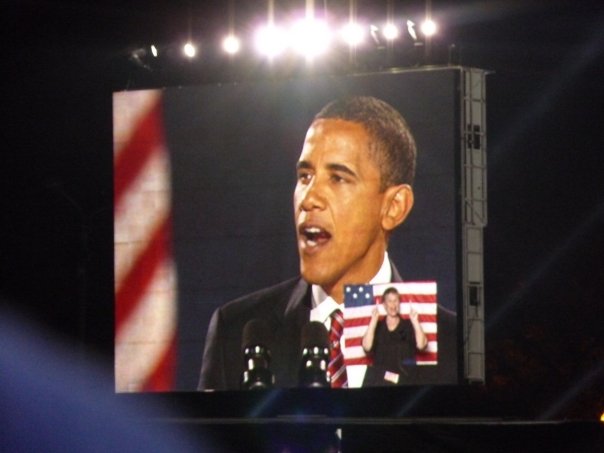
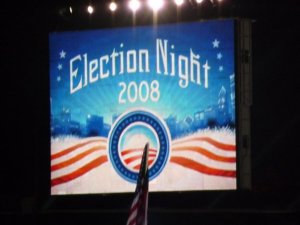
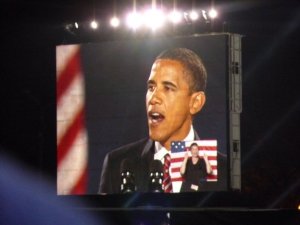
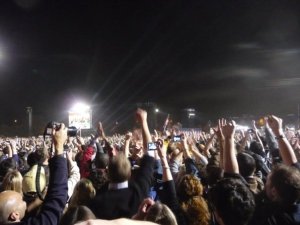
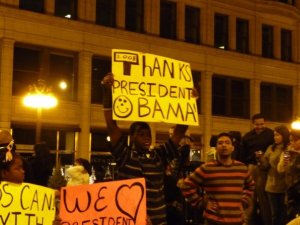
Instead of brooding on the future of GM, Ford, and American affluence, let’s look at some of the joyous photos from Grant Park on Election Night 2008. My son, Kyle, a recent graduate of Wharton Business School and an ardent supporter of Obama, went to Grant Park to take part in the celebration.
My wife, Judy, and daughter, Marlee, were in Washington D.C. on Election Day with our daughter’s eighth grade class. In their two days in this memorable time, they went from Gettysburg to the White House, to the Washington Monument, the Lincoln Memorial, viewed the actual Declaration of Independence, visited the Smithsonian, and were moved at Arlington National Cemetery and at the U.S. Holocaust Memorial Museum. The eighth graders, especially our daughter’s black friends, were especially excited that an African American was elected president for the first time. To them and so many others, this is the New Day in America.
We must be like these eighth graders and pray that the new leader of America will help stop the spread of fear and bring optimism back to a nation that is sorely lacking it. We must hope that the death of the Detroit we knew is not the end of the America we cherish. 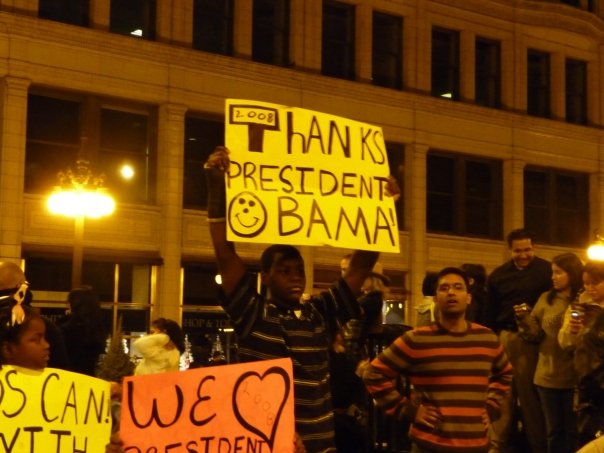


Detroit is begging the U.S. government to allow them to pull from the $700 bailout while the last mayor of Detroit sits in jail. The losses of GM, Ford, and Chrysler have deepened as the cash burned from the three companies last quarter exceeded 14 billion dollars. And today, Deutsche Bank of Germany is recommending that everyone sell GM bonds and stock, down 22-30% today to as low as $3.02 per share, the lowest price in 60 years. Deutsche is predicting the stock will end at Zero.
The path to bankruptcy seems closer than ever. Even the $50 billion the “Big 3” asks in loans from the government will only give them a few extra months of survival.
No one is buying cars, not just American cars but cars, period. Even Toyota, the worldwide leader in the auto industry, expects its profits this year to be 73% less than last year because of the sudden worldwide drop in sales. At least, Toyota still has profits, something Detroit’s “Big 3” haven’t seen in awhile.
The confidence of the American consumer is at a 27 year low and the availability of credit is limited. Foreclosures are still rising as the value of American houses falls as has the stock market which is down 35% from its peak a year ago. In this financial cataclysm, purchases of “big ticket” items like cars and houses are virtually non-existent.
Showrooms are ghost towns. As you listen to the frightening news about the future of American automobile companies, who is confident enough to go out and get a loan to buy a car from a company that may not be there in the future? That is the really scary question. Loan or no loan from the government: is the path to non-existence inevitable?
Companies that have flourished in the 20th century, for over a hundred years, are in a life and death battle for survival. Circuit City, an American icon in electronic product sales, is the latest company to declare bankruptcy, following Linens & Things and Mervyn’s. And though the country can survive without those retailers, how will it survive the collapse of GM and Ford?
The car companies’ hopes and ours is a government that is in bleeding in astronomical debt levels. But that doesn’t stop the U.S. Treasury and Federal Reserve from offering bailout after bailout to keep companies like AIG, Fannie Mae, and Goldman Sachs alive.
We are all dependent and hopeful for the “new guy”, the inexperienced African American from Chicago to lead us to the Promised Land.
The fury over George W. Bush, accelerated by his weak and uninspired efforts while the financial and stock markets shrunk, and the uncertainty over a 72-year-old war hero senator with an inexperienced governor sidekick who often seemed simply stupid, made it easy to elect a liberal, well-spoken Democrat who seems to have a consistent, unruffled temperament.
The country hopes Barack Obama, like an imaginary superhero, can save the American auto industry, rescue Wall Street, and “give money to Main Street,” all before he’s even sworn into office.
Economist Robert J. Samuelson writes in the Newsweek cover story, “A Darker Future for us” (November 10, 2008) that “We Americans are progress junkies. We think that today should be better than yesterday and that tomorrow should be better than today. Compared with most other peoples, we place more faith in ‘opportunity’ and ‘getting ahead.’ We may now be on the cusp of a new era that frustrates these widespread expectations. It is not just the present financial crisis and its astonishing side effects, from bank rescues to frenzied stock-market swings. The crisis coincides with a series of other challenges—an aging society, runaway health spending, global warming—that imperil economic growth. America’s next president takes office facing the most daunting economic conditions in decades: certainly since Ronald Reagan and double-digit inflation, and perhaps since Franklin Roosevelt and 25 percent unemployment.”
Investor Doug Kass writes, “As we approach the next decade, our social, economic and political future has materially changed, owing to the deep and muddy financial ditch in which we are now squarely stuck. Moreover, the scope and duration of the financial meltdown has placed our economy well past the tipping point, and it will have an enduring and negative effect. Consider that U.S. home prices have dropped by over $5 trillion in the last one and a half years and that, during the month of October alone, nearly $10 trillion has been lost in the global equity markets. Quite frankly, that ditch is so deep right now that we are in big trouble if our policymakers get it wrong over the next 12 months. My concern is that we might even be in trouble for a long period of time if they get it right.” (“Welcome to Dystopia,” 11/03/08, thestreet.com.)
The outlook is bleak in Detroit and it’s not much better in the other main streets in America. Kass and Samuelson look realistically at social, political, and economic scenarios and their conclusions are that we will face what Samuelson calls “affluent deprivation,” fighting over “pieces of a fairly fixed economic pie rather than sharing ever-larger pieces of an expanding pie.”
It is the end of Detroit as we know it, and probably the end of increasing affluence many Americans felt in the last few decades.
Even with the prevalent fears, we need to be somewhat optimistic. Like much of America, we have to have hope in our new president and the government of the United States. It is easy to be cynical and pessimistic but it’s also important to realize the passionate excitement of so many in America who have celebrated this historic election.
Instead of brooding on the future of GM, Ford, and American affluence, let’s look at some of the joyous photos from Grant Park on Election Night 2008. My son, Kyle, a recent graduate of Wharton Business School and an ardent supporter of Obama, went to Grant Park to take part in the celebration.
My wife, Judy, and daughter, Marlee, were in Washington D.C. on Election Day with our daughter’s eighth grade class. In their two days in this memorable time, they went from Gettysburg to the White House, to the Washington Monument, the Lincoln Memorial, viewed the actual Declaration of Independence, visited the Smithsonian, and were moved at Arlington National Cemetery and at the U.S. Holocaust Memorial Museum. The eighth graders, especially our daughter’s black friends, were especially excited that an African American was elected president for the first time. To them and so many others, this is the New Day in America.
We must be like these eighth graders and pray that the new leader of America will help stop the spread of fear and bring optimism back to a nation that is sorely lacking it. We must hope that the death of the Detroit we knew is not the end of the America we cherish.
Halloween fell on a Friday night, capping a month of Friday night frights. It was a month featuring a falling stock market amidst worldwide economic turmoil when banks wouldn’t lend and the government decided to borrow billions to get them lending again. It was a month that saw GM and Chrysler shrink even closer to bankruptcy, desperately hoping to get a government loan so that GM would buy Chrysler and shrink its workforce even more. It was a month of preparation for an historic election dividing the country.
Halloween in Detroit was unseasonably warm and a pleasant diversion to the real frights in the world. It was a parade of little creatures in masks walking in the light of pre-daylight-savings and ending the night in darkness.
No fear in the world can prepare a parent for the fate of a little boy facing the dreaded disease of cancer. A few hours before Halloween began, Noah’s mother got the phone call she dreaded.
Noah’s cancer had spread. The doctors had found “many new lesions throughout the right arm and leg and one in his skull.”
Diana wrote in her Carepages blog that “the chemo and drug did absolutely nothing—didn’t even slow it down. We have removed him from this trial.” The MIGB radiation therapy that looked promising had a backlog of waiting kids, meaning Noah was to wait for treatment for many weeks.
Until then, the strategy is an aggressive chemo treatment of Topotecan and Cytoxin, followed by Neupogen shots to help the white blood cells. The MIBG radiation therapy scheduled hopefully by the end of the year shoots radioactive isotopes into Noah’s body. For at least five days, he will have to be in complete isolation followed by more intense chemo.
A little boy facing such harsh treatment and such long odds seems inhuman and cruel. There is no superhero who can slay such devastation. But a terrifying phone call could not stop Noah’s mother from dressing him up in his Spiderman outfit and going trick and treating with him on Friday. And nothing could stop a mother from taking Noah to the zoo on a warm November Monday.
We can only hope that the subconscious wish for a boy to be superhuman can help his immunity, making him impervious to the blasts of radioactive isotopes and chemotherapy.
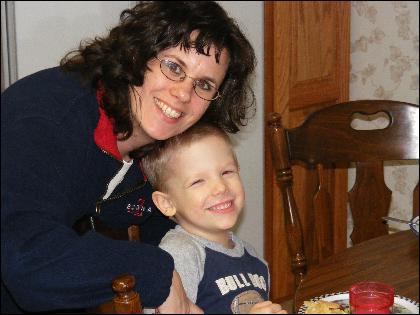
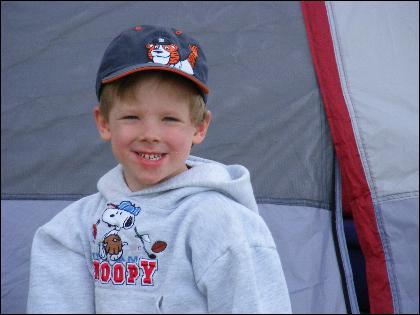
Diana and Noah in happier timesNoah with a Snoopy shirt and Tiger hat
 Aggman's Blog
