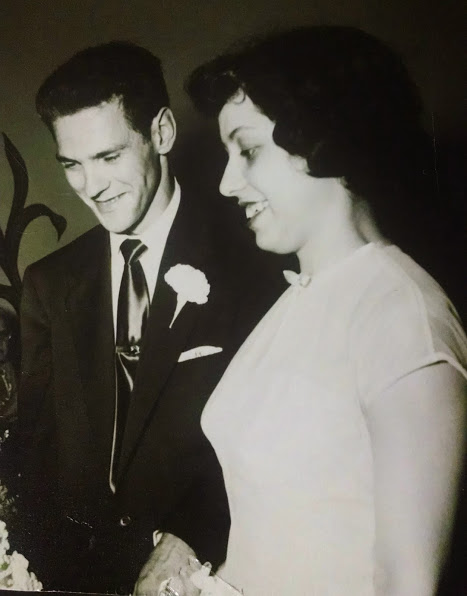
I say the words, glorified and sanctified In Hebrew, almost a year since My mom was erased from her life. Sitting in the sanctity of My memories, blessed and praised, I await the day ever slowly when I won’t stand up for Kaddish, The mourner’s prayer, mom just A fading apparition since the last day […]


Written on April 3, 2007 and dedicated to my father-in-law, Max Frank
Some days are made for celebration. When I told my son, Kyle, that I was going to get a mini-package of Tiger tickets which included Opening Day, he wondered whether we should pay the extra $75 fee and extend his visit for one more day. He was coming home from college for only three days and was planning to leave April 1st, the day before Passover. I agreed with him that it wasn’t worth it and he should go back to school to attend his one class on Monday, April 2nd. But when I talked to my wife, she disagreed and after we discussed it, I realized she was right as usual. For Kyle to spend an afternoon with me at our first Opening Day and then to be here with his family for the first seder was, as the commercial says, priceless.
April 2nd started with Siyum HaB’khor, the service commemorating the sparing of the Hebrew first-born sons on Passover. I had imagined Kyle’s Zadeh Max noticing my son putting on tefillin in the back of Adat Shalom’s chapel, jubilant his grandson had not flown back to Philadelphia as scheduled. But Zadeh Max can’t see well these days and it was only me joining him. Kyle slept in, needing his last day of rest before school and not wanting to ruin the surprise. Besides, I didn’t have tefillin, after I realized the night before that the brand new set I received for my 50th birthday was missing the “shel rosh,” the black box with Torah passages on parchments with kosher leather straps to be worn on the head. Instead, it had two “shel yads,” two black boxes with their long leather strands to be wrapped seven times around the arm. I wondered what Rabbi Nevins would have said if I wore these on both arms instead of on my head. Even though the rabbi is a really nice man, a true mensh, I doubt if he would have been too pleased.
Rabbi Nevins was in good spirits this morning as he discussed the Mishna’s Tractate, Chagigah, and its obscure rules, and mentioned the counting of the Omer. I was lost in thought, imagining the baseball game in a few hours. But I realized also that this would be the rabbi’s last breakfast before Passover with us, his congregation, as he was leaving in the summer for New York City and his new position at the Jewish Theological Seminary. When I sat near him and ate my last chametz breakfast before the seder, I was more thankful than disappointed that we were able to share this dedicated teacher for thirteen years. When the 28-year-old rabbi gave his first sermon at Adat, Kyle was only 8 years old.
Before leaving for the baseball game, I gave the last of our chametz to my father-in-law to burn on his driveway. (If you’re not Jewish, it’s not worth explaining chametz or tefillin or the Haggadah. Consult a rabbi, a good book on Judaism, or Wikopedia.)
Kyle and I decided to leave at 11:00a.m., even though we knew the Lodge was blocked. I detoured down ‘696 to ’75 before we reached downtown where we proceeded to wander for thirty minutes, trying one full lot after another, and finally parked in a glass-filled vacant lot, giving the large man near us his requested $20. The question was, would my car still be there afterward and would we make it in time for the American League Championship flag ceremony?
As we quickly walked through the throngs of people in the cold wind, I didn’t think about Comerica’s executives exiting Detroit for Dallas or that our state’s economy was miserable. We were preoccupied with spring, the sunshine, the clock, and the excitement of the Tigers starting a new season after their year of winning the American League pennant.
Maybe this year would bring the glory of a World Series Championship. In spring, in the season’s renewal of hope, anything seemed possible.
We cheered with the rest of the city during the first game, celebrating this new year of baseball. When I saw kosher hot dogs at a food stand, I licked my lips, already missing bread even before my first taste of matzo. I ordered the kosher dog with onions but threw out the bun. I couldn’t remember the exact reason we couldn’t eat bread in the hours before the first Passover Seder. The rabbi said this morning that after 10:00a.m., leavened bread was prohibited. It was just one of many Pesach rules we were simply supposed to follow.
I didn’t really need food anyway. It was a mitzvah being with my only son, celebrating his first Opening Day and mine. We had both seen our first World Series game last October in the cold rain and now, we were together again for this baseball rite of spring. It was another meaningful moment in my life, one of many since I’d turned fifty. Even though the Tigers lost in 10 innings, 5-3, it was still a gorgeous sunny day, in weather and in spirit.
As we were basking in the sunshine, in the excitement of the game, my wife, Judy, and my youngest daughter, Marlee, were busy, helping my mother-in-law cook the seder meal. Passover is a huge responsibility, if you follow all of the rules. It involves weeks of intense house-cleaning and getting everything ready for Pesach. And the seder meal itself can take days to produce. But when the seder finally comes, all the work before it seems worthwhile.
Then, when Kyle’s aunt, uncle, and grandparents finally saw their first grandson after he entered their home for the seder, it was as if Elijah himself had entered. He knocked on the door ten minutes after me and was let in. My mother-in-law had told Judy that she had cried a few times during the week, realizing that her oldest grandson would not make the seder. He had been there every year since birth except once, in his freshmen year at college. When she turned, stunned to see his face behind her, she truly wept with joy.
My two daughters, wife, and I sat down to the table to join Judy’s brother, sister, and parents. Just like the last 22 years, we proceeded to read and sing the Haggadah, beginning with the very first page, all the way to the Had Gadya, the bloody poem about a little goat. I felt nostalgic from all the seders we had shared at Judy’s old home and felt incredible gratitude that we were still here, together, thankfully one year older.
We were celebrating the mitzvah of being Jews in America, able to enjoy the bounteous dinner and the knowledge that without Moses and God, we wouldn’t be here. For one night, we could forget about layoffs and terrorism in Iraq and Israel and rejoice in our ancestors’ freedom and our own. We could celebrate another year of haroset, the combination of walnuts, apples, cinnamon, and wine, the simple treat that accompanies the bitter herbs and matzos. We could recite the four questions, Dayeinu, and rejoice in each other.
As we raised our glasses of wine and grape juice, I realized that even in these turbulent, troubled times, we could still be happy. We were a part of America with its baseball, hot dogs, and apple pie. But instead, we had an apple cake made with matzo meal rather than wheat flour.
It didn’t matter. Spring was about to begin. Baseball was reborn in Detroit. We were celebrating tradition, family, eating, prayer, memories, gratitude, and freedom. We were just happy.
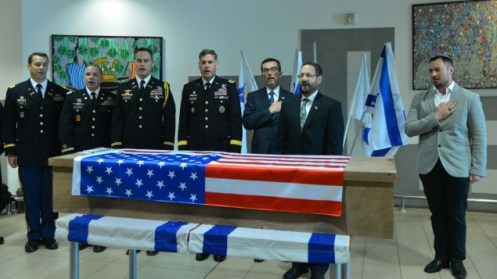
How many of us feel angry and helpless as we witness what is happening in Israel. Day after day, we learn of horrific hate-filled events that show its vulnerability and shake us as American Jews.
Iran’s Islamic Revolutionary Guards Corps (IRGC) test-fired two ballistic missiles on June 9th, designed to be able to reach 870 miles, specifically Israel. “The reason we designed our missiles with a range of 2,000 km is to be able to hit our enemy the Zionist regime from a safe distance,” Brigadier General Amir Ali Hajizadeh said. Even more disturbing was that these were the words (in Hebrew) stamped on the missiles: “Israel should be wiped from the pages of history.”
In Israel the night before, there was a stabbing in Petah Tikva in which a young Israeli man was stabbed repeatedly yet managed to remove the knife from his neck and stab and kill his attacker, as well as a shooting in the head of two police officers in Jerusalem. Soon after, 22-year-old Palestinian Bashar Massalha killed an American tourist, US army veteran Taylor Force, and injured 10 other people, five critically, in a stabbing spree at the Jaffa Port and along the Tel Aviv beach promenade. U.S. Vice President Joe Biden’s wife and children were not far away, dining on the beach. The official news station of the Palestinian Authority described the terrorist who went on a stabbing spree in Jaffa Wednesday night as a “martyr” and called his victims “settlers” (according to PA Media Watch), and both Hamas and Fatah praised the terrorist attacks as well.
After hearing silence from President Obama over many months of violence in Israel, it was refreshing to hear Biden quickly speak out, “Let me say in no uncertain terms: The United States of America condemns these acts….It is just not tolerable in the 21st century. They’re targeting innocent civilians, mothers, pregnant women, teenagers, grandfathers, American citizens. There can be no justification for this hateful violence and the United States stands firmly behind Israel when it defends itself as we are defending ourselves at this moment as well.”
It’s easy to recoil in fear when hearing of such random brutality. My wife and I spent hours in Jaffa last August and she is going back there this May, so I will join many other tourists and Israeli citizens in anxiety, but fear doesn’t eclipse the sadness of the loss of life. The latest is US Army veteran, Taylor Force, a graduate from West Point Military who served as a field artillery officer from 2009-2014. A veteran of Iraq and Afghanistan, he was in Israel on a school program.
In an excellent essay written by Taylor’s long-time friend, (“My friend Taylor Force is dead,” David Simpkins, The Times of Israel, March 9, 2016), David wrote, “I couldn’t think of someone who was more of a model of ‘America’s finest’ than him. He was articulate, brilliant, and just so GOOD. I can’t think of a moment where he wasn’t exuding an aura of pure positive energy. He was as honest and heartfelt as they come, but now he’s dead.”
David wrote that his friend died in a “war that he didn’t know he was in the middle of.” Taylor, a believer in the two-state Solution, felt comfortable in the “illusion” that Israeli Jews and Arabs can live together, even though the Palestinian Center for Policy and Survey Research (PSR) conducted a poll in December showing that “two thirds of all Palestinians admitted they supported the knife attacks against Israelis.”
Many of the Palestinians, including Fatah leader Abbas, not only don’t condemn the constant terror attacks but praise murderers as martyrs. And as Simpkins wrote, “Hamas announced that they’re celebrating their martyrs last night. As I write this, there are parties from Gaza to Ramallah continuing all day, and probably tonight. It’s not every day they get a former US Army officer who served in Iraq and Afghanistan. For them, this is a great boon.”
Terror is deliberately random and has no boundaries. Jews, Israelis, and Americans are targeted but anyone can be a victim. Tuesday night, one of the people attacked in Jaffa was an Arab, Mohammed Wari, who condemned the attacks: “Terror is an illness that needs to be stopped. Terror has a clear goal: to kill and destroy the world and the coexistence in which we live.”
Anti-Semitic hatred of Israel is the gasoline that drives terror but Wari is right that terror kills and destroys the world. We Jews like to think positively that saving a soul saves the world but the Talmud also says, “Whoever destroys a soul, it is considered as if he destroyed an entire world.”
Today, in Israel, the beat of hatred goes on and on and the world seems to get a little bit darker each day. In my daily prayers, I stop and realize the importance of these words (translated) from the Amidah: “May all the enemies of Your people be speedily extirpated; and may You swiftly uproot, break, crush and subdue the reign of wickedness speedily in our days. Blessed are You L-rd, who crushes enemies and subdues the wicked.”
Amen.
As detailed in “Ramifications of Ignoring American Antisemitism” an average American Jew is over TWICE as likely to be attacked as either a Muslim or black American. Yet anti-Semitism is never flagged by Obama. That is actually too kind. Anti-Semitic attacks are often whitewashed by the Obama administration, such as his denial that Jews were targeted in Paris in January 2015.
Source: The Invisible Anti-Semitism in Obama’s 2016 State of the Union
From Benjamin Netanyahu:
The Nazis believed in a master race. The militant Islamists believe in a master faith. They just disagree about who among them will be the master… of the master
The road is finally open, its pavement
Smooth and black, the orange barrels
Scattered far from my eyes.
The September air is cold in the Forest Park
Baptist Church parking lot as I walk up
The path to the bridge. Across the street,
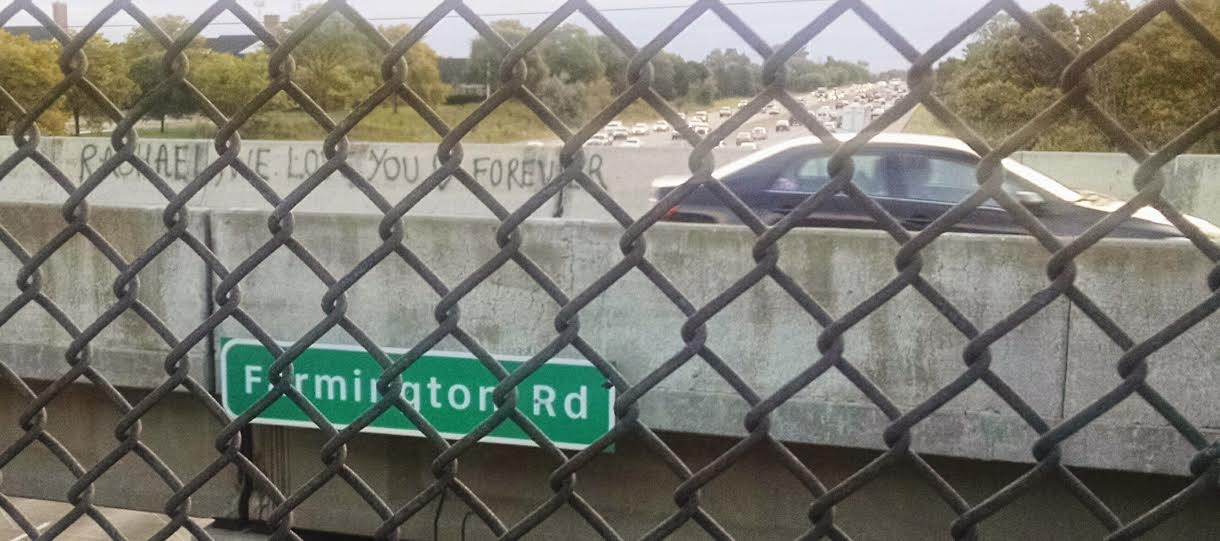
Through the stainless fence, the sign is clear
on the concrete overpass north of OCC.
I can barely stand and stare, the
Vehicles on 696 like an army of drums
Beating constantly, the motion of the
Pavement rocking the bridge,
Never slowing down,
My eyes barely able to
Open, the cold sadness glaring
Across the road.
It is 8:30, 13 days and five hours
After she leapt, alone in the dark.
I cannot bare to imagine her last moments,
The awful emptiness of despair.
Why is the concrete wall so short?
Why wasn’t there a high fence
Across the street that could not be climbed,
That would stop a young girl
From scaling such height and valor
To face darkness and death? I stand
Still, waiting a minute for the
Breath of her spirit to shhh
In my ear, I’m here, I’m here,
I know now how many mourn
That I’m gone….I can see the sign
Where I fell and felt my last breath…
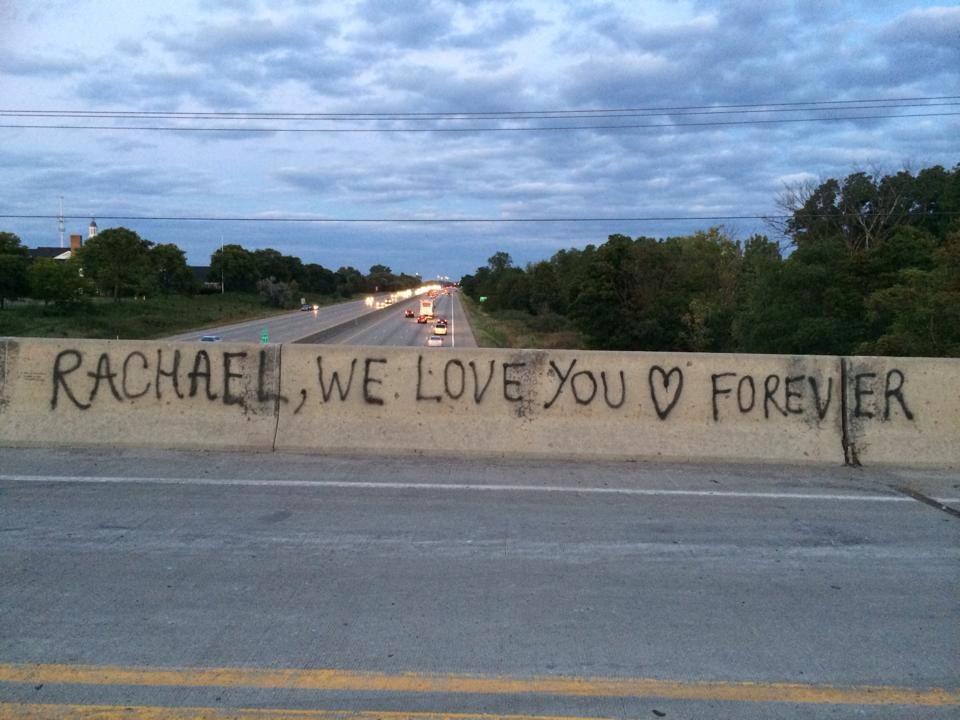
Rachael, We Love You Forever.
I wait for her aura but the morning is
So mournful, the cars on Farmington
Whispering something else,
No breath in my ear,
Just a faint prayer of
Rachael floating wherever
Her sisters’ dreams propel
Her shadow, down empty roads
Without cars, no pavement,
No sadness or cruelty,
Just floating, floating.
The Girl Who Wants to Die
September 10, 2014
“I am the girl who cannot love herself but I will love you with all that I have. I am the girl who cannot fix herself but I will make sure you’re never broken. I am the girl who wants to die but I will spend my life keeping you safe. I am the girl who harms herself but I would never do a thing to hurt you.” From Rachael Reynolds, Jan 29, 2014
My wife, Judy, says I’m obsessed with death and that’s all I share with the world. She looked at some Facebook posts from a few days ago, which had photos of my brother and dad that I posted weeks ago, but had some recent responses to them.
Yes, maybe I am obsessed with death and especially with suicide, especially after my daughter, Marlee, told Judy and I about the suicide death of a Facebook friend of hers today, which stopped I-696 for hours, after Rachael Reynolds jumped to her death from a freeway overpass near our home and was then run over by a car.
The Farmington Observer wrote: “A young Farmington Hills woman died early Tuesday in an apparent suicide on the I-696 overpass at Farmington Road, closing the freeway until 6:30 a.m., according to police. Police and emergency services personnel were called to the scene at about 3:15 a.m. Tuesday. The woman is believed to have jumped from the overpass and then was struck by a vehicle on eastbound I-696.
Maybe it’s because I know exactly where that bridge is, so close to our home, so close to Oakland Community College, where Rachael went to school.
Maybe because it’s my mother’s birthday and it’s the day before 9/11.
Maybe it’s because my Aunt Shirley killed herself over 35 years ago.
Maybe it’s because I have periodic episodes of depression.
Maybe it’s because Rachael’s birthday was one day before Kyle’s and that she’s 19 like Marlee.
Maybe it’s because my cousin’s daughter is also named Rachel (without the a) and has had her shares of troubles and pain.
Maybe it’s because Marlee starred in Butterfly Kisses three years ago, a movie about a teen suicide.
Maybe it’s because it has rained so much of the day and we’re getting pounded and flooded, the same way it rained on the day of my dad’s death, 30 days ago.
Maybe it’s because the first month anniversary of my father’s death is tomorrow.
Maybe it’s because this follows the suicide of Robin Williams and the accidental death of Joan Rivers.
Maybe it’s because I’ve been obsessed for weeks with the crazy psychopathic group, ISIL, who are killing Christians and everyone else they hate, and the President is finally announcing a strategy tonight on TV to go after these murderous bastards.
Maybe it’s because anyone can share their deepest thoughts, photos, and fears, on Facebook, Vine, Instagram, and Twitter, as Rachael had.
Maybe it’s because I feel so much for Rachael’s haunted parents who will be wondering why and what could they have done to prevent their daughter from taking her own life.
Maybe it’s because I have looked at Rachael’s Facebook and Twitter pages (@rachreynolds_) and am haunted by the desperation of a young girl, the same age as my daughter and her friends.
Rachael changed her photo a few days ago on Facebook and Twitter and it’s of a very cute, smiling girl. She started her Twitter feeds in early 2011 when she was 15. Her first Twitter photo was of a simple YouTube video of a dance song to “Pumped Up Kicks.” On January 23, 2012, she bragged how her team’s record 400M relay time at Farmington High School had still never been beaten. On April 8, 2012, she showed a photo of her dad playing Sudoko outside and wrote, “I love my dad.” On November 6, 2012, she wrote how thrilled she was, getting her new IPhone 5 “finally” in the mail.
Rachel had 8357 tweets and 752 followers and 1677 Facebook friends.
She went to school at Oakland Community College and was a sales rep at Nestle Toll House Café.
Her Twitter history is an eye-opening history of heartbreak, cynicism, sadness, disappointment, struggles, punctured by occasional laughter and joy.
On New Year’s Day, this year, she shared this:
Me right now pic.twitter.com/5UAZgxCyb4
On January 29th, she wrote these telling words:
Rachael Reynolds @rachreynolds_ · Jan 29
no better way to describe myself. pic.twitter.com/E6rQqv8z7H
The last two weeks of her life included this:
why do I even bother (from August 27th, a day before Rachael’s 19th birthday)
Rachael Reynolds @rachreynolds_ · Sep 1
This was the shortest summer ever.
I’m 420% done right now.
Rachael Reynolds @rachreynolds_ · Sep 3
I’m extremely unappreciated by nearly every person in my life.
Rachael Reynolds @rachreynolds_ · Sep 3
The fact that I’m already ridiculously stressed out about school is a huge indicator that something is wrong with the US school system.
Rachael Reynolds @rachreynolds_ · Sep 5
I’m going straight to hell for this.
This was her last Tweet from September 9th:
Rachael Reynolds @rachreynolds_ · Sep 9
The worst and the last day
Five words: Everything sad and horrible in one simple tweet, “the worst and the last day.”
Now, all we can do is look for clues and wonder why someone once again felt so much despair, so much heartache, and did what very few could ever imagine: Jump off a highway overpass bridge at 3am in the morning.
The Farmington Observer wrote that this was the fourth suicide for the city of Farmington Hills.
A year ago, City Councilman Ken Massey, with the help of other officials, created SAFE-Suicide Prevention for All.
The irony of this is that two days earlier, on September 8th, Massey read a “proclamation in recognition of September as Suicide Prevention Awareness Month. The proclamation details the country’s 33,000 annual suicides with many more suicide attempts. In Oakland County alone, suicides have increased 21 percent since 2008.”
One night later, Rachael jumped off a bridge to her death.
Goodbye Rachael.
I never knew you but
I really feel like I do know you, somewhat,
Now that I have read your words and seen your photos.
What made you give up?
Now, we will never read another word from you again.
Your voice is gone and your family and friends and all of us “outsiders” are left to wonder why.
Suicide leaves so many gaping holes in so many broken souls, all left wondering what could they have done.
Haunted by the death of a young girl that I never really knew, I reread the words of Edward Hirsch, who wrote about the death of his son in his long poem, Gabriel.
His last line reads,
“Wild spirit beloved son
Where have you fled”
How can I not grieve and wonder…
Rachael, where have you fled?
How can I not now learn something from this?
We must pick up the phone now, before it’s too late and tell our children, or tell anyone we love, one loved soul at a time, one at a time, I love you. I love you.


A Jewish superhero may be coming back soon.
A few weeks before Hanukkah, a press release stated that the sequel to the Hanukkah movie, The Hebrew Hammer, was in the funding stage. The original Hebrew Hammer is about an Orthodox Jew named Mordechai Jefferson Carver (played by Adam Goldberg) who goes on a quest to save Hanukkah from Santa Claus’s evil son, Damian (played by Andy Dick.) The movie, featuring one of the few Jewish “superheroes” in movies, had its premiere in 2003 at the Sundance Film Festival but didn’t do well at the domestic box office. Yet, it started finding an audience on Comedy Central over the next few Hanukkahs, gaining acceptance and taking on “cult status” in the decade since.
Writer/director Jonathan Kesselman received feedback from fans over the last decade, asking him if he was ever going to make another Hammer movie. “For the last ten years, on every job I ever got, everything I’ve ever done, fans are constantly telling me how much they love the movie,” he says. A few weeks ago, a kid came up to him and wanted to meet him because he said he was “inspired” by Kesselman. So finally, this past fall, he bought out the movie rights and decided to finance and make the sequel himself.
Nearly ten years after the original film, Kesselman wrote a script called “The Hebrew Hammer vs. Hitler,” The sequel takes place a decade later when Mordechai is no longer the Jewish superman that the kids on the block looked up to when he walked the streets of Brooklyn, wearing a long leather coat and a feather-topped fedora over his payis. Now he has a job selling trees to Israel for the Jewish Justice League in order to support his expecting wife. Mordechai is still neurotic and upset by everything, especially kids admiring the “Semitic Jewish Man” – another neighborhood hero whose name, Hammer kvetches, is not an alliteration or an acronym for anything!
When a plan goes kaput to send the Semitic Jewish Man to kill Hitler in a time-traveling Sukkah, it gives Hammer and the “Shaft”-like Mohammed Ali Paula Abdul Rahim, (also from the original movie,) a chance to travel through Jewish history and meet a who’s-who of historical characters, including Abraham and Isaac, Moses and Jesus, Anne Frank and Hitler.
To help fund what Kesselman calls “Bill and Ted’s Excellent Adventure meets History of the World, which is my favorite Mel Brooks movie of all time,” he launched a crowd-sourcing campaign on the new http://www.Jewcer.com, asking for $200,000 of the projected $1.5 million budget for “The Hebrew Hammer vs. Hitler.” Various levels of funding, anywhere from $5 to $10,000, are suggested, including the Chai package, the Triple Chai, the Talmud, the Big Macher, Watch the Mohel Work, Dance the Hora, and the Mitzvah. Various levels feature incentives for those who donate, including signed scripts and DVDs, meeting the actors and director, spending a day on the set, and being involved in the making of the movie.
What is Jewcer? It is a crowd-funding platform, similar to Kickstarter, “that promotes collaboration and trust both within and around our community to develop and implement projects linked to the Jewish people and/or Israel.” Jewcer is open to hosting projects created by individuals as well as established organizations and synagogues and is designed to help finance innovative ideas through small pledges collected from many funders (jewcers.) Projects can come from any field — cultural, technological, secular or spiritual, a small business, a personal project or an advocacy campaign — as long as a positive link to the Jewish or Israel community is created. The network of jewcers and friends can track the impact of their small donations and follow the progress of the project they helped spark. Jewcer’s projects request either an all-or-nothing model for a specific monetary goal or a donation model. “The Hebrew Hammer vs. Hitler” is looking for a minimum of $50,000 of its requested $200,000 by the end of January, 2013.
Jewcer was created by Amir Give’on, “a professional geek,” whose drive “stems from his passion for Israel advocacy and connecting Israelis with Jewish Americans” and Naomi Leight, Jewcer’s “resident diplomat,” who presents the site to media outlets, educators, professionals, and entrepreneurs in the Jewish and Israeli community. Jewcer began in March, 2012 and has raised more than $100,000 in contributions so far, tiny compared to Kickstarter. Yet, the site is beginning to be recognized in the Jewish community, partly because of the many worldwide fans of The Hebrew Hammer.
Writer/director Kesselman said it was tough getting funding for the first movie which helped steer him toward Jewcer this time around. “Everybody kept saying it was funny,” he recalled, “but too Jewish.” Kesselman wanted to make a Hammer sequel for a few years but had so much frustration with Hollywood that he spent much of the last decade, writing screenplays for numerous studios, directing commercials, and handling the creative advertising for the yogurt company, Red Mango.
Now, Kesselman believes his biggest contribution to the world is through laughter. “With all the insanity going on the world, I believe it’s important for things like ‘The Hebrew Hammer vs. Hitler’ to get made. It offers a loving look at American Jewish culture that connects with all audiences and ages. Laughter brings people together and makes the world feel a little less heavy.”
 Kesselman doesn’t shy away from controversy, all in the name of laughing at our preconceptions, making fun of stereotypes. His next “Jewxploitation” film is aimed for laughter while fulfilling revenge fantasy against Hitler, kind of a hyped-up comical Inglourious Basterds. His three-and-a-half minute fund-raising video on Jewcer shows his fearless, irreverent humor. “We will take Christian money, we will take Muslim money. Bernie Madoff, you wanna make good with the Jewish people? This is a start, give us money!” And the video concludes, ‘What, We Should Beg?’”
The crowd-funding platform Kesselman chose is not just for financing fictional films. Jewcer has successfully funded two documentaries, “Hummus Wars” and “The Strength to Tell,” as well as games for families in bomb shelters, an Israel comedy tour, the Jewish Family Channel, Embracing Wholiness for Jewish youth, the Israel Ambassador program for teens, and a web series called, “Dude, Where’s my Chutzpah? These are just a handful of the programs that have successfully raised their funding goals on Jewcer.
Today, many programs are trying to get funding on Jewcer, including “Hebrew Name Registry,” a Passover Bingo game, “Operation Pillar of Support” which helps “those most affected by Hamas terror,” and many more.
As the Jewcer website claims, “It’s Not Donation, It’s Participation!” Jewish crowd-funding is important for the Jewish and Israel community because it gives all sorts of Jewish innovators a chance to raise money without going through arduous legal or tax-exempt documentation. Jewcer claims that “each campaign you pledge money to, you are not just giving but you are receiving.”
Jewcer seeks to decrease the six-degrees of separation to one degree by linking Jews around the world and in Israel through innovative ideas. This is certainly timely and worth embracing. As Kesselman reitererates, can donating to Jewcer projects such as “The Hebrew Hammer vs. Hitler” make “the world feel a little less heavy?” Why not? It certainly cannot hurt.

 Aggman's Blog